
Is Modern Israel Really Israel? Romans 11 Explained in a Three-Part Bible Study
Some say the people living in Israel today are not Israel at all: that they descend from Khazars, that the real Israelites are someone else, or that the Church took Israel’s place long ago. This three-part study answers those claims from the Bible itself, with Romans 11 explained alongside Isaiah 11, Jeremiah 31 and Ezekiel 36. Each day takes one question. Day 1 checks the record. Day 2 lets Scripture define who Israel is. Day 3 gives three tests anyone can run on a claim they hear.
Start with Day 1 → · All Three in One Place →
The Three Days
Each teaching is taught in three segments, with the Scripture quoted in full and a short summary at the end of each one. The days build on each other, so they read best in order.
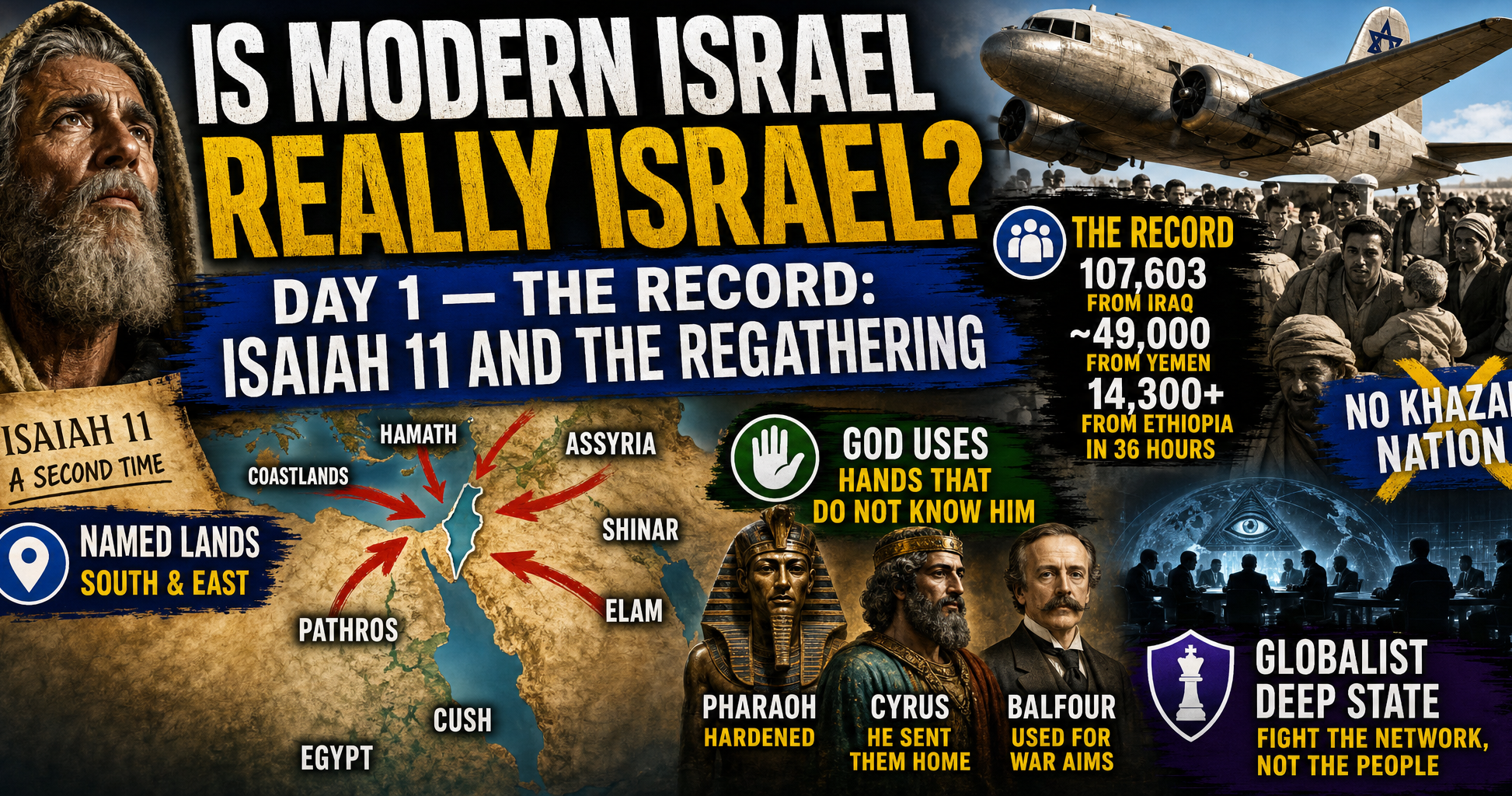
Day 1
The Record: Isaiah 11 and the Regathering
Isaiah 11 names the lands God would gather His people from a second time: Assyria, Egypt, Cush, Elam, Shinar and the coastlands. Day 1 goes land by land and checks who actually came home, from the airlifts out of Iraq and Yemen to the rescues from Ethiopia. It looks at what the genetic studies show about Ashkenazi Jews, and at why God can use a Cyrus, a Pharaoh or a Balfour to move His people.
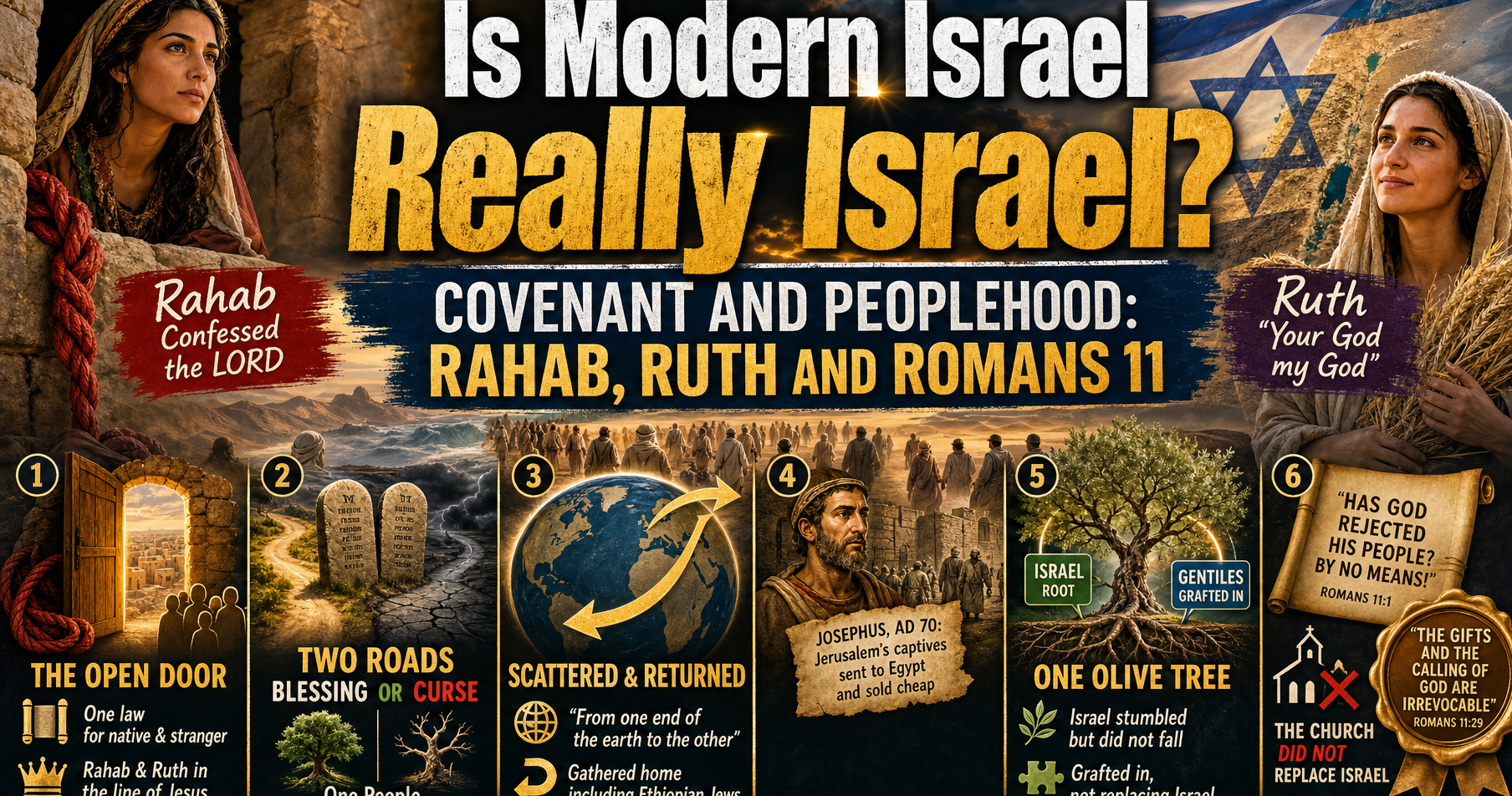
Day 2
Covenant and Peoplehood: Rahab, Ruth and Romans 11
Is Israel defined by bloodline or by covenant? Day 2 lets the Bible answer, through a Canaanite woman who hid the spies and a Moabite widow who became the great-grandmother of King David. It reads Deuteronomy 28 together with Deuteronomy 30, and Romans 9 together with Romans 11, and walks through Paul’s olive tree, where Gentile believers are grafted into Israel’s tree rather than planted in its place.
→ Read Day 2: Covenant and Peoplehood
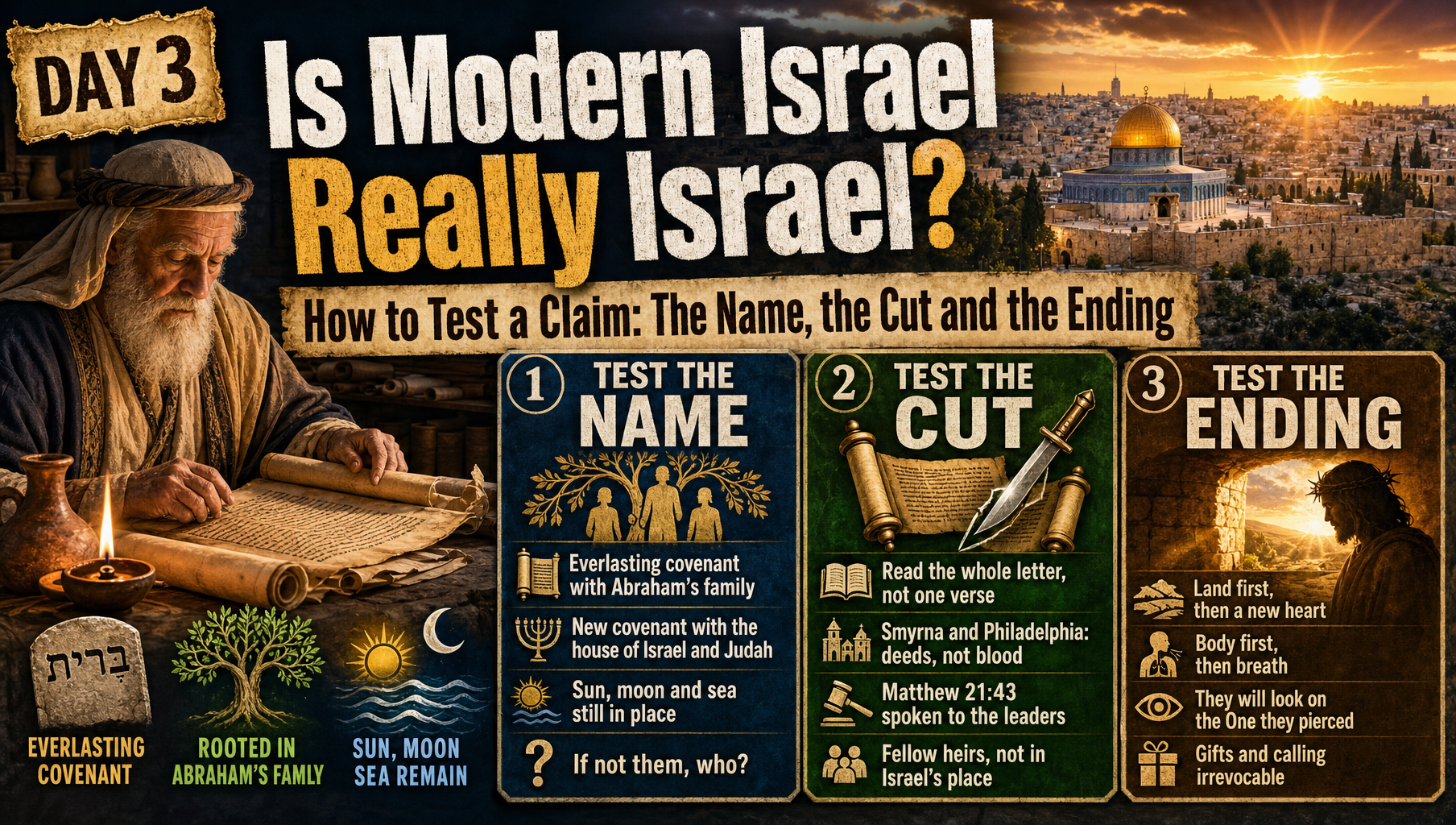
Day 3
How to Test a Claim: The Name, the Cut and the Ending
The Bereans checked even the apostle Paul against the Scriptures, and the Bible calls them noble for it. Day 3 turns the whole series into three questions. Does the claim name the people God named? Does it quote one verse out of its context? Does it say God is finished? It runs those tests on Jeremiah 31, Revelation 2:9, Matthew 21:43, Ezekiel 36 and Zechariah 12:10.
→ Read Day 3: How to Test a Claim
Romans 11 Explained: Has God Rejected Israel?
Romans 11 is the chapter where Paul answers the question this series asks. He has just spent two chapters grieving that most of his own people rejected Jesus as the Messiah. Then he asks the obvious question and answers it in two words.
I ask, then, has God rejected his people? By no means!
Paul offers himself as the first proof. He is an Israelite, a descendant of Abraham, from the tribe of Benjamin. If God had rejected Israel, Paul could not be standing there as an apostle. He then points back to Elijah, who thought he was the last faithful man in Israel, and to God’s answer that seven thousand had not bowed to Baal. In Paul’s day, as in Elijah’s, there is a remnant chosen by grace.
Next Paul asks whether Israel stumbled in order to fall for good, and again he answers no. Their stumbling opened the door of salvation to the Gentiles, and that is meant to make Israel jealous and draw them back. If their stumbling brought riches to the world, Paul says, how much more will their full inclusion mean?
The olive tree in Romans 11
Paul then gives the picture that settles the question of replacement. Israel is a cultivated olive tree rooted in the promises to the patriarchs. Some natural branches were broken off because of unbelief. Gentile believers, branches from a wild olive, were grafted in among the ones that remained and now share in the root. Paul’s warning to those Gentile branches is direct.
do not be arrogant toward the branches. If you are, remember it is not you who support the root, but the root that supports you.
The tree is not cut down and a new one planted. Gentiles are grafted into Israel’s tree, and Paul adds that God is able to graft the natural branches back in, which he says is the more natural thing of the two.
“All Israel will be saved” and the irrevocable calling
Paul closes the argument by calling it a mystery. A partial hardening has come on Israel until the fullness of the Gentiles has come in, “and in this way all Israel will be saved” (Romans 11:26), as Isaiah wrote that the Deliverer would come from Zion. He adds that, as regards the gospel, Israel is opposed for the Gentiles’ sake, but as regards election they are beloved for the sake of their forefathers.
For the gifts and the calling of God are irrevocable.
Christians read “all Israel” in more than one way. Many understand it as the Jewish people as a nation, turning to the Messiah at the end of the age. That is how this series reads it, and it fits the national promises in Jeremiah 31 and Ezekiel 36. Others take it to mean the full number of Jewish believers saved across history. Others, following a reading found in Calvin, take it to mean the whole people of God, Jew and Gentile together. What all three readings share is the verse that follows: God has not withdrawn the calling He gave to Israel.
Who Is Israel in the Bible?
In Scripture, Israel begins as one man’s new name. God renamed Jacob, and his twelve sons became the twelve tribes. From the start, though, membership was never a matter of blood alone. A mixed multitude left Egypt with Israel. Rahab, a Canaanite, was received into Israel after she hid the spies at Jericho. Ruth, a Moabite, told Naomi, “Your people shall be my people, and your God my God” (Ruth 1:16), and she became an ancestor of David and of Jesus.
So the Bible defines Israel by covenant: the family God made promises to, with the door always open to outsiders who joined themselves to Israel’s God. That is why the question “are they Israelites by blood?” is not the question Scripture asks first. The question it asks is whether these are the people God named in His covenant.
Are Ashkenazi Jews Descended From the Khazars?
The Khazars were a Turkic people whose kingdom spread north of the Caucasus. Some of their leaders are reported to have adopted Judaism, in a conversion story set in the 700s and 800s. The idea that most European Jews descend from them was popularized by Arthur Koestler’s 1976 book The Thirteenth Tribe.
Most geneticists who have studied the question find substantial Middle Eastern ancestry in Ashkenazi Jews, alongside European admixture, and they do not find the signal the Khazar theory predicts. A small number of researchers, most prominently Eran Elhaik, have argued for a Khazar link. Critics of that work point out that it used present-day Armenians and Georgians as stand-ins for the Khazars, because no Khazar population exists to test. Day 1 walks through this evidence. And the Jews who came home from Iraq, Yemen and Ethiopia were never Ashkenazi at all, so the theory could not describe them even if it were true.
Did the Church Replace Israel?
Replacement theology, also called supersessionism, teaches that the Church has taken Israel’s place in God’s plan and that the promises to Israel are now fulfilled in the Church. It has a long history, and many sincere Christians and respected teachers hold some form of it. They often point to Galatians 3:29, Romans 2:29 and Matthew 21:43.
This series reads those verses in their context and comes out differently. Galatians 3:29 tells Gentile believers that they belong to Abraham, and Ephesians 3:6 calls them fellow heirs, sharing the promise with Israel rather than receiving it instead of Israel. In Romans 2:29, Paul guards against misuse right away, in Romans 3:1–2, saying the Jew has much advantage in every way. In Matthew 21:43, the chief priests and Pharisees understood that Jesus was speaking about them. And Romans 11:28–29 still calls Israel beloved, even in unbelief. The study’s conclusion is that the Church did not replace Israel. Gentiles were grafted in.
The New Covenant in Jeremiah 31:31
Jeremiah 31:31 is the only verse in the Old Testament that uses the words “new covenant,” and it names the parties.
Behold, the days are coming, declares the LORD, when I will make a new covenant with the house of Israel and the house of Judah,
Jesus sealed this covenant in His blood at the Last Supper (Luke 22:20), and Hebrews 8:8 quotes Jeremiah and names both houses again. Gentiles share in it through faith in Christ. A few verses later, God ties Israel’s survival as a nation to the fixed order of the sun, the moon and the sea, and says He will not cast off the offspring of Israel for all that they have done.
Is the Regathering of Israel Bible Prophecy?
He will raise a signal for the nations and will assemble the banished of Israel, and gather the dispersed of Judah from the four corners of the earth.
Isaiah calls this a second gathering, after the first return from Babylon, and he lists the lands by name. In the last century, Jewish communities came home from those regions: from Iraq in Operation Ezra and Nehemiah, from Yemen in Operation On Wings of Eagles, and from Ethiopia in Operations Moses and Solomon.
Ezekiel 36 gives the order of the promise. God gathers His people from the nations and brings them into their own land, then gives them a new heart and puts His Spirit within them. Ezekiel 37 shows the same order in the valley of dry bones: a body first, then breath. The series reads the present gathering as the first part of that promise, not the end of it. The promised turning of heart is still ahead, the day Zechariah 12:10 describes, when they look on the One they pierced.
Does Supporting Israel Mean Supporting Every Government Decision?
No. God’s faithfulness to Israel is His faithfulness to His own word. It is not an endorsement of every decision a government makes, and the series says so plainly. A believer can hold to every promise God made to Israel and still test what any government, ministry or media voice says, the same way the Bereans tested Paul.
Three Questions to Test Any Claim About Israel
Day 3 gives three questions to ask of anything you hear:
1. Does it name the people the Bible names? God made His covenant with Abraham’s offspring and His new covenant with the house of Israel and the house of Judah. A claim that hands those promises to someone else has to explain how it got around those names.
2. Does it quote one verse out of its context? When one verse is doing all the work, keep reading until the passage finishes its thought. Deuteronomy 28 needs Deuteronomy 30. Romans 9 needs Romans 11. Revelation 2:9 needs the letter to Smyrna it was written in.
3. Does it say God is finished? Romans 11:29 says His gifts and calling are irrevocable. A claim that closes the door God says is still open fails the test.
Questions People Ask About This Series
What does Romans 11 teach about Israel?
Romans 11 teaches that God has not rejected the people He foreknew. Israel’s stumbling is partial and temporary, it opened salvation to the Gentiles, and it ends with a promise that all Israel will be saved. Paul grounds it all in one line: God’s gifts and calling cannot be revoked.
Is the modern state of Israel the same Israel as in the Bible?
The series argues that it is the same people, the family God named in His covenant with Abraham and in the new covenant of Jeremiah 31, now gathered back in part. That is different from saying every policy of the modern state is holy. The people are the covenant people. The government is a government.
Who are the Israelites today?
The Jewish people are the descendants of Judah, Benjamin and Levi, along with members of the other tribes who joined them over the centuries. Groups that claim to be the true Israelites in their place, such as British Israelism or some Hebrew Israelite movements, have to set aside the people the Bible and history both identify.
What is the synagogue of Satan in Revelation 2:9?
The phrase comes from Jesus’ letter to the church in Smyrna, a persecuted first-century congregation. Most commentators take it to mean local opponents who were slandering that church, so Jesus is judging what they did, not their ancestry. It is not a coded description of a medieval kingdom that would not exist for centuries.
Why study Israel at all if salvation is through Christ?
Because the promises Christians stand on are the promises God made to Israel. If God could cancel His covenant with Abraham’s family, the believer would have reason to wonder about the covenant made in Christ’s blood. Romans 11 shows the same faithful God keeping both.
Where can I watch or discuss this teaching?
All three days are on FaithNFreedom Social in Faith Blogs & Discussions, where readers can comment and ask questions under each post. The series is taught by Rick Rene, and FaithNFreedomTV streams Christian teaching free, around the clock.
Read the Series on FaithNFreedom
Three days, one question: is modern Israel really Israel? Start with the record, let the Bible define Israel, then learn to test what you hear.
Start with Day 1 →
All Three in One Place →
Faith Blogs & Discussions →
Watch Free Now →
Scripture quotations are from the ESV® Bible (The Holy Bible, English Standard Version®), © 2001 by Crossway, a publishing ministry of Good News Publishers. Used by permission. All rights reserved.