
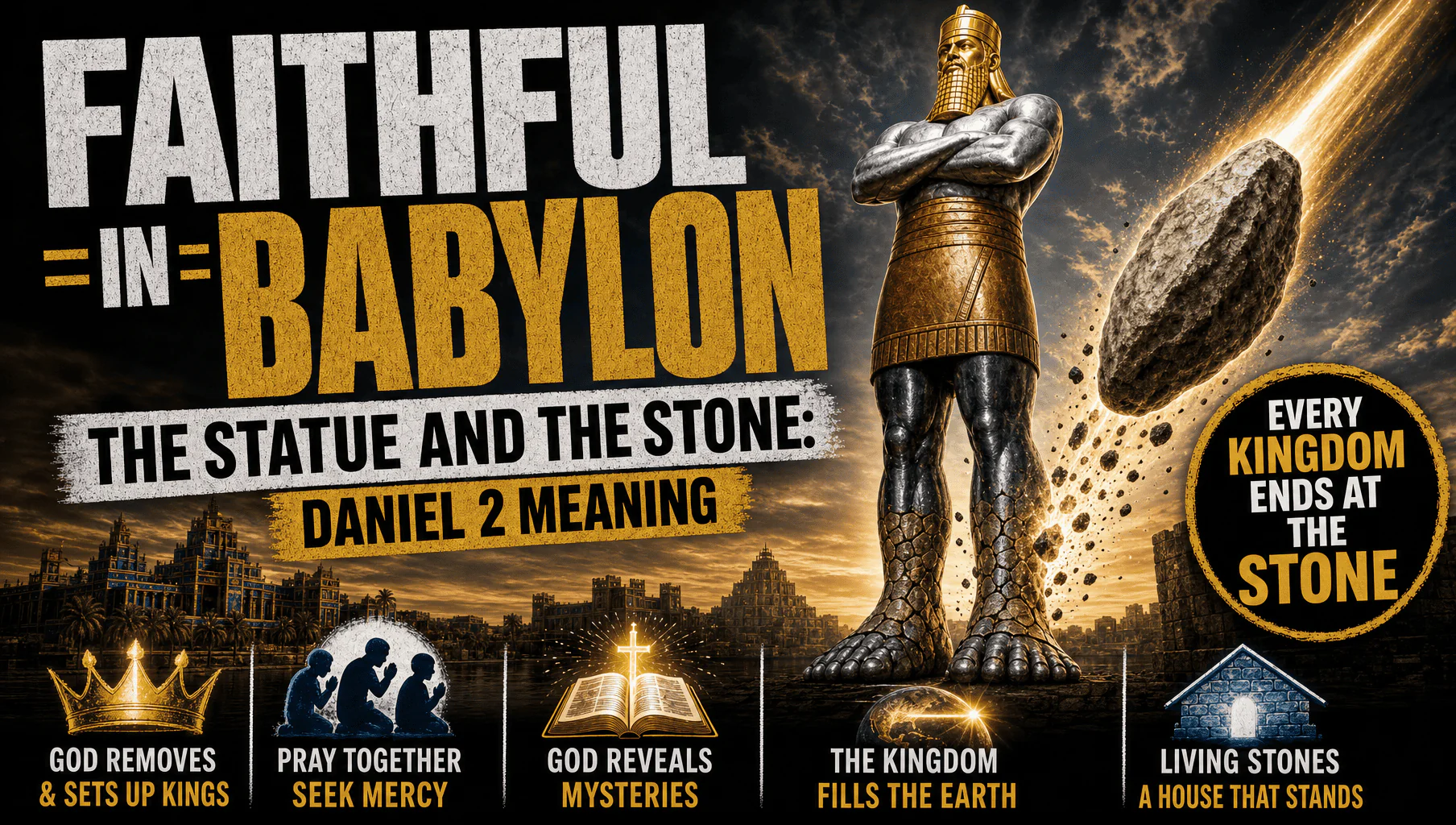
What is the Daniel 2 meaning? In Daniel 2, King Nebuchadnezzar dreams of a great statue of gold, silver, bronze, iron and clay, and a stone cut out by no human hand strikes it and breaks it in pieces. Daniel explains that the statue stands for the kingdoms of men, beginning with Babylon, and that the God of heaven will set up a kingdom that shall never be destroyed.
By Rick Rene
Faithful in Babylon: Lessons from Daniel is a seven-day Bible study through the book of Daniel, taught on FaithNFreedom Social. One thread runs through every day: God rules over every kingdom of men, so His people can live faithfully inside a system that wants to rename and remake them. This page gathers the series in one place, starting with the chapter that shows every kingdom of men from beginning to end: Daniel 2.
Daniel 2 Meaning: The Statue and the Stone
Nebuchadnezzar demanded that his wise men tell him both his dream and its meaning. They answered that no man on earth could do it (Daniel 2:10–11). God revealed the dream to Daniel, and Daniel told the king what he had seen: a great image, mighty and frightening (Daniel 2:31).
The head of this image was of fine gold, its chest and arms of silver, its middle and thighs of bronze, its legs of iron, its feet partly of iron and partly of clay. As you looked, a stone was cut out by no human hand, and it struck the image on its feet of iron and clay, and broke them in pieces.
— Daniel 2:32–34 (ESV) · Daniel Interprets the Dream, Daniel 2:31–35
The metals are crushed together and blown away like chaff, and the stone becomes a great mountain that fills the whole earth (Daniel 2:35). Then Daniel gives the interpretation, and he begins with the man in front of him:
You, O king, the king of kings, to whom the God of heaven has given the kingdom, the power, and the might, and the glory, … you are the head of gold.
— Daniel 2:37–38 (ESV) · Daniel Interprets the Dream, Daniel 2:31–45
That is where the Daniel 2 meaning starts. The greatest king on earth held his kingdom because the God of heaven gave it to him. Every kingdom on the statue, gold to clay, rises and falls under the same hand.
The Four Kingdoms of Daniel 2
After Babylon come a lesser kingdom of silver, a kingdom of bronze that rules over all the earth, and a fourth kingdom strong as iron that breaks and shatters all things (Daniel 2:39–40). The fourth ends in feet that do not hold together:
And as you saw the feet and toes, partly of potter’s clay and partly of iron, it shall be a divided kingdom, but some of the firmness of iron shall be in it, just as you saw iron mixed with the soft clay. And as the toes of the feet were partly iron and partly clay, so the kingdom shall be partly strong and partly brittle.
— Daniel 2:41–42 (ESV) · Daniel Interprets the Dream, Daniel 2:31–45
| Part of the statue | Most common reading |
|---|---|
| Head of gold | Babylon, named by Daniel (Daniel 2:38) |
| Chest and arms of silver | Medo-Persia (see Daniel 8:20) |
| Middle and thighs of bronze | Greece (see Daniel 8:21) |
| Legs of iron | Rome |
| Feet of iron and clay | The fourth kingdom in a divided form |
| The stone cut out by no human hand | The kingdom of God |
Daniel names Babylon himself, and a later vision names Media and Persia, then Greece (Daniel 8:20–21). Most Bible teachers across church history read the fourth kingdom as Rome. Many academic scholars instead count Media and Persia as two kingdoms and end the four with Greece.
The feet are read three main ways: as fulfilled at Christ’s first coming, in the days of Rome; as the nations that came out of Rome; or as a final form of the fourth kingdom still to come. Faithful in Babylon teaches the last of these: the feet are the final, divided form of the fourth kingdom, and the stone strikes when Christ returns to the earth, with God’s promises to Israel kept (Romans 11:29).
Whichever reading a believer holds, Daniel is clear about how the statue ends:
And in the days of those kings the God of heaven will set up a kingdom that shall never be destroyed, nor shall the kingdom be left to another people. It shall break in pieces all these kingdoms and bring them to an end, and it shall stand forever …
— Daniel 2:44 (ESV) · Daniel Interprets the Dream, Daniel 2:31–45
The Stone Is Christ
Daniel 2 does not name the stone, but the rest of Scripture does. Psalm 118:22 speaks of the stone the builders rejected, and Jesus applied it to Himself (Matthew 21:42). Peter wrote to believers:
As you come to him, a living stone rejected by men but in the sight of God chosen and precious,
— 1 Peter 2:4 (ESV) · A Living Stone and a Holy People, 1 Peter 2:4–12
Peter goes on to call believers living stones, built up as a spiritual house (1 Peter 2:5). So the Day 2 teaching ends with a promise: every kingdom of man ends at the Stone, and those who belong to Christ are already part of what He is building. Revelation gives the same ending in heaven’s words:
Then the seventh angel blew his trumpet, and there were loud voices in heaven, saying, “The kingdom of the world has become the kingdom of our Lord and of his Christ, and he shall reign forever and ever.”
— Revelation 11:15 (ESV) · The Seventh Trumpet, Revelation 11:15
Read Day 2: The Statue and the Stone
Day 1 — Renamed but Not Remade: Daniel 1:8
Babylon carried Daniel away from Jerusalem, renamed him Belteshazzar, trained him in the literature and language of the Chaldeans, and set the king’s food before him. Day 1 teaches what Daniel 1:8 means: a young man decided in his heart that he belonged to God before anyone tested him.
But Daniel resolved that he would not defile himself with the king’s food, or with the wine that he drank. Therefore he asked the chief of the eunuchs to allow him not to defile himself.
— Daniel 1:8 (ESV) · Daniel’s Faithfulness, Daniel 1:8–16
The chapter says three times that God gave: He gave Judah into Babylon’s hand (1:2), He gave Daniel favor (1:9), and He gave the four young men wisdom:
As for these four youths, God gave them learning and skill in all literature and wisdom, and Daniel had understanding in all visions and dreams.
— Daniel 1:17 (ESV) · Daniel’s Faithfulness, Daniel 1:8–21
Daniel served Babylon with excellence and never belonged to it, and he was still there in the first year of King Cyrus, after Babylon fell (Daniel 1:21).
Read Day 1: Renamed but Not Remade
The Rest of the Series
Each day is added to this page after it is taught.
- Day 3 — But If Not (Daniel 3)
- Day 4 — Praying When Prayer Is Outlawed (Daniel 6)
- Day 5 — Praying for a Nation (Daniel 9)
- Day 6 — The Most High Rules (Daniel 4–5)
- Day 7 — One Like a Son of Man (Daniel 7)
Closing Prayer
Father, thank You that You rule over every kingdom of men. You remove kings and set up kings, and nothing on the statue of this world is outside Your hand. Give us the heart Daniel had, to belong to You in Babylon and to pray when the world’s wise men have nothing. Thank You for Jesus, the Stone cut out by no human hand, whose kingdom shall never be destroyed. Keep us faithful until He comes. In Jesus’ name, amen.
Bible Teaching and Discussion
Bible teaching and discussion continue in Faith Blogs & Discussions on FaithNFreedom Social, and you can watch FaithNFreedomTV free, 24/7.
Scripture quotations are from the ESV® Bible (The Holy Bible, English Standard Version®), © 2001 by Crossway, a publishing ministry of Good News Publishers. Used by permission. All rights reserved.
Questions About Daniel 2 and the Series
What is the meaning of Daniel 2?
Daniel 2 records King Nebuchadnezzar’s dream of a great statue with a head of gold, chest and arms of silver, middle of bronze, legs of iron and feet of iron and clay, struck and broken by a stone cut out by no human hand. Daniel explained that the statue stood for kingdoms of men, beginning with Babylon, and that the God of heaven will set up a kingdom that shall never be destroyed (Daniel 2:44).
What are the four kingdoms in Daniel 2?
Daniel names Babylon as the head of gold (Daniel 2:38), and Daniel 8:20–21 names Media and Persia, then Greece. Most Bible teachers across church history read the four kingdoms as Babylon, Medo-Persia, Greece and Rome, the fourth strong as iron. Many academic scholars instead count Media and Persia separately and end the four with Greece. Faithful in Babylon follows the first reading, which most of church history has held.
What do the feet of iron and clay mean in Daniel 2?
Daniel 2:41–43 describes the feet and toes as a divided kingdom, partly strong and partly brittle, whose parts will not hold together. They are read three main ways: as fulfilled at Christ’s first coming in Roman times, as the nations that came out of Rome, or as a final form of the fourth kingdom still to come. Faithful in Babylon teaches the last view, with the stone striking when Christ returns to the earth.
Who is the stone in Daniel 2?
Daniel says the stone stands for the kingdom the God of heaven will set up, which shall stand forever (Daniel 2:44–45). The rest of Scripture names the stone: Psalm 118:22 speaks of the stone the builders rejected, Jesus applied that verse to Himself in Matthew 21:42, and 1 Peter 2:4–6 calls Him the living stone. Christians therefore read the stone cut out by no human hand as Jesus Christ and His kingdom.
Why could Babylon’s wise men not tell the king his dream?
Nebuchadnezzar demanded that his magicians, enchanters, sorcerers and Chaldeans tell him the dream itself as well as its meaning. They answered that no man on earth could meet that demand and that only the gods, whose dwelling is not with flesh, could show it (Daniel 2:10–11). Daniel and his three friends prayed to the God of heaven instead, and the mystery was revealed to Daniel in a vision of the night (Daniel 2:17–19).
What does Daniel 1:8 mean?
Daniel 1:8 says Daniel resolved that he would not defile himself with the king’s food or the wine he drank, and he asked the chief of the eunuchs for permission not to. Babylon had renamed him and was training him for the king’s service, but it could not change whom he belonged to. Faithful in Babylon teaches the verse as a decision of the heart made before the test came, not as a diet.
What is Faithful in Babylon: Lessons from Daniel?
Faithful in Babylon: Lessons from Daniel is a seven-day Bible study through the book of Daniel, taught on FaithNFreedom Social. It covers Daniel 1, 2, 3, 6, 9, 4–5 and 7, and its thread is that God rules over every kingdom of men, so His people can live faithfully inside a system that wants to rename and remake them. Each day is a full teaching with the Bible open, and this page gathers the series in one place.