Rapture Series — Day 2 of 7 | FaithNFreedom.social
The Rapture vs. the Second Coming: A Critical Biblical Distinction
The single most common mistake in all of end-times teaching is treating the Rapture and the Second Coming as the same event.
They are not.
The Bible describes two distinct phases of the Lord’s return — one where He comes for His saints in the air, and one where He comes with His saints to the earth. The locations, purposes, participants, visibility, and outcomes are entirely different. Once you see it, you cannot unsee it.
Two Movements — Completely Opposite Directions
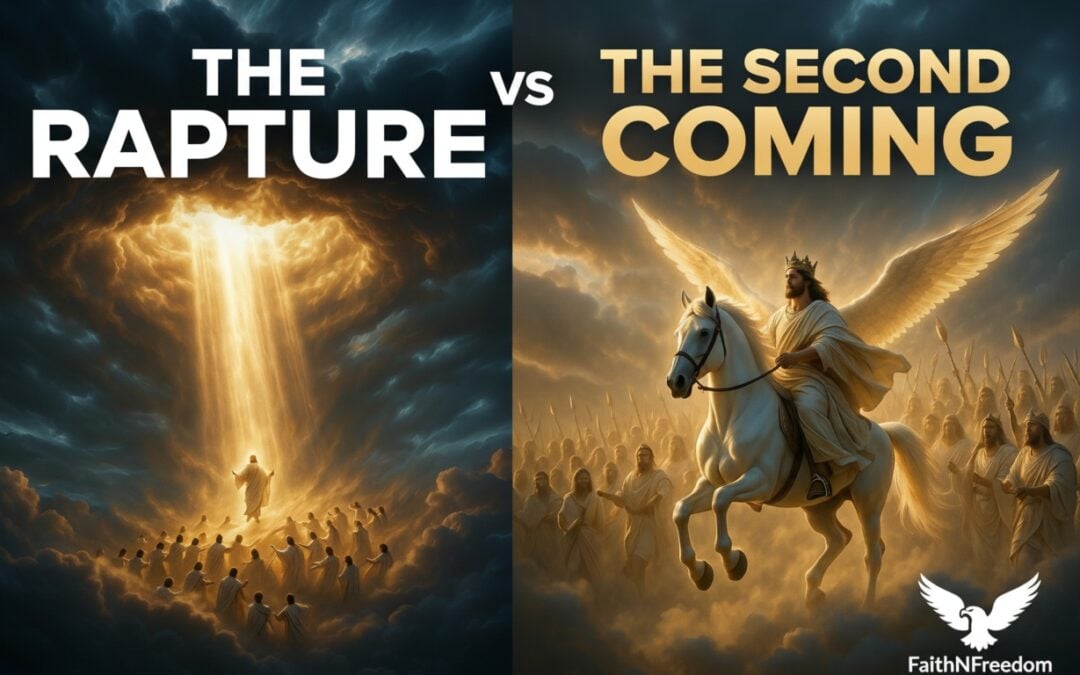
In John 14:2-3, Jesus promises on the night before the cross that He is going to prepare a place and will come again to take His people to where He is. That movement is upward — believers removed to where Christ is. In Revelation 19:11-16, the movement is downward — Christ descending to earth with the armies of heaven following Him in white linen to judge the nations. The saints are already with Him in Revelation 19. They were not on earth during the tribulation. They were removed before it began.
The Pattern God Always Uses
This is not a new pattern. God removed Lot from Sodom before fire fell — Genesis 19:22 records He could not act in judgment until Lot was physically out. Jesus references this directly in Luke 17:28-30. Noah was preserved before the flood came — Matthew 24:37-39 uses that same comparison. The Greek word rhyomai — active, forceful rescue — appears in 2 Peter 2:9 and in 1 Thessalonians 1:10 where Jesus delivers us from the wrath to come. The Rapture follows this divine pattern at a global scale.
What Day 2 Covers Passage by Passage
The full Day 2 study walks through every key passage — 1 Thessalonians 4, Revelation 19, Zechariah 14, John 14, Matthew 24, Luke 17, Acts 1, 2 Peter 2, and Jude 1 — with complete ESV scripture quotes and Greek word studies on apantēsis (meet), atomos (twinkling of an eye), and rhyomai (active forceful rescue). Every objection is addressed from the Word alone. No denominational filter. No avoided questions.
Most Christians were never taught this distinction — and the mainstream church has largely gone silent on it. This is Day 2 of a 7-day series. Day 1 established harpazo as the Greek foundation of the Rapture. Day 3 tackles pre-trib, mid-trib, and post-trib directly from Scripture. Read Day 2 of the Rapture series on FaithNFreedom.social. If you want to start from the beginning or follow the complete study, browse our complete Rapture series on FaithNFreedom.social.
Read the Full Day 2 Teaching Free
The Rapture vs. the Second Coming — two events the Bible never conflates. Full ESV study free on FaithNFreedom.social.
Read Day 2 Now →
Watch live Monday through Thursday at 5pm CST and Sunday at 11am CST: https://rumble.com/c/Blessed2Teach
Watch FaithNFreedom TV free 24/7 on any device: https://faithnfreedom.live
Frequently Asked Questions
What is the core biblical difference between the Rapture and the Second Coming?
The Rapture describes Christ descending to the clouds where living and dead believers are caught up to meet Him in the air before God’s wrath falls — an upward removal described in 1 Thessalonians 4:16-17. The Second Coming describes Christ returning visibly to earth with His glorified saints to judge the nations and establish His Kingdom in Revelation 19:11-16. Different direction, different purpose, different participants, different outcome.
Why does it matter theologically whether these are two separate events?
If the Rapture and Second Coming are the same event, then believers go through the full tribulation and God’s wrath — which contradicts 1 Thessalonians 5:9 declaring the church is not destined for wrath and 1 Thessalonians 4:18 calling this comfort. Understanding them as distinct events makes the entire prophetic timeline coherent and preserves the promises God made to the church about deliverance before judgment falls.
What Greek words does Day 2 cover in the Rapture vs. Second Coming study?
Day 2 walks through apantesis meaning a formal meeting where a delegation goes out to escort a dignitary back — used in 1 Thessalonians 4:17 for believers meeting Christ in the air. Atomos from 1 Corinthians 15:52 means an indivisible instant, giving us the English word atom. Rhyomai from 2 Peter 2:9 and 1 Thessalonians 1:10 means active forceful rescue — the word used when God removes His people before wrath falls.
How does Zechariah 14:4 distinguish the Second Coming from the Rapture?
Zechariah 14:4 states that on the day of the Second Coming the feet of the Lord will stand on the Mount of Olives and it will split in two from east to west. This is a visible, physical, earth-touching return — the opposite of the Rapture where Christ descends only to the clouds and believers are caught up to meet Him in the air. Acts 1:9-11 confirms the angels told the disciples Jesus would return the same way He left — from the Mount of Olives.
Who are the armies of heaven riding with Christ in Revelation 19:14?
The armies of heaven in Revelation 19:14 are clothed in fine white linen — the same garment given to the bride of Christ in Revelation 19:8 — identifying them as glorified believers returning with Christ. For them to return with Him at the Second Coming they must have been removed from earth before the tribulation began. Their presence with Christ in Revelation 19 requires a prior catching away, which is exactly what the Rapture describes in 1 Thessalonians 4.
What is FaithNFreedom.social and why is the Rapture series published there?
FaithNFreedom.social is a free uncensored Christian Patriot community founded by Rick Rene where believers gather for biblical teaching, prophetic discussion, and fellowship outside the reach of mainstream media censorship. The 7-day Rapture series is published there in the Growing Your Faith space alongside a 24/7 streaming platform, live program guides, and creator discussions covering biblical truth, American liberty, and health freedom.
What does 1 Thessalonians 4:16-17 actually say about the Rapture?
1 Thessalonians 4:16-17 states that the Lord Himself will descend from heaven with a cry of command, the archangel’s voice, and the sound of God’s trumpet — the dead in Christ will rise first, then those who are alive will be caught up together with them in the clouds to meet the Lord in the air. This is the foundational Rapture passage the entire Day 2 study is built around.
Is the Rapture a secret event while the Second Coming is public?
Yes, in the framework this series teaches. The Rapture is described as a sudden catching away visible primarily to believers involved, while the Second Coming in Revelation 1:7 states every eye will see Him — a globally visible, unmistakable event with no ambiguity about what is happening.
More questions
Are there signs that precede the Rapture the way there are signs before the Second Coming?
The Rapture is taught as imminent and sign-free — it could occur at any moment with no preceding cosmic signs. The Second Coming, by contrast, is preceded by the specific tribulation events, cosmic signs in Matthew 24:29, and the full sequence of judgments described in Revelation, making it a signaled rather than sudden event.
What does John 14:2-3 promise about Christ’s return for believers?
John 14:2-3 records Jesus telling His disciples He is going to prepare a place for them and will come again to receive them to Himself, so that where He is they may be also. This promise, given the night before the cross, forms the relational and personal foundation for the Rapture as an event where Christ personally comes for His own.
How does Acts 1:9-11 relate to the pattern of Christ’s return?
Acts 1:9-11 records Jesus ascending into a cloud while His disciples watched, with two angels declaring He would return in the same way He left. This passage establishes the pattern of a visible, physical return and is directly tied to the Second Coming’s fulfillment at the Mount of Olives in Zechariah 14:4.
Why is comfort emphasized as part of the Rapture teaching?
1 Thessalonians 4:18 instructs believers to encourage one another with the words of the Rapture teaching, framing it not as a doctrine for speculation or fear but as a source of comfort and hope for believers grieving the loss of loved ones in the faith.
Do different Christian denominations agree on the Rapture and Second Coming distinction?
No — views vary widely across denominations, including pre-tribulation, mid-tribulation, post-tribulation, and amillennial positions that reject a literal future rapture altogether. This series presents the pre-tribulation position as its conviction while acknowledging the broader range of views within the church.
Why has the mainstream church gone largely silent on this distinction?
The series attributes this silence to a broader retreat from detailed end-times teaching in many pulpits, leaving most Christians without clear instruction on how the Rapture and Second Coming differ — a gap this 7-day study is specifically built to address through direct, passage-by-passage Scripture study.
What role does Jude 1 play in this teaching?
Jude 1 is referenced among the key passages Day 2 examines alongside 2 Peter 2, both epistles addressing God’s pattern of judgment and rescue, reinforcing the Lot and Noah parallels used throughout the study to explain how God removes the righteous before judgment falls.
What is the significance of the Rapture being described as a mystery in 1 Corinthians 15:51?
Calling the Rapture a mystery in 1 Corinthians 15:51 indicates it was a truth not previously revealed in the Old Testament but disclosed through New Testament apostolic teaching — distinguishing it from Second Coming prophecies that were extensively foretold by Old Testament prophets like Zechariah and Daniel.
How does this teaching address common objections to a pre-tribulation Rapture?
The study states that every objection is addressed from the Word alone, without denominational filtering or avoided questions, walking through Matthew 24, Luke 17, and related passages that skeptics of the pre-tribulation view often cite, and explaining why those passages describe Second Coming judgment rather than the Rapture.
What does Day 3 of the series cover after establishing this distinction?
Day 3 of the series directly addresses the timing debate among pre-tribulation, mid-tribulation, and post-tribulation positions, building on the Rapture-versus-Second-Coming distinction established in Day 2 to examine when within the tribulation timeline the Rapture is believed to occur.