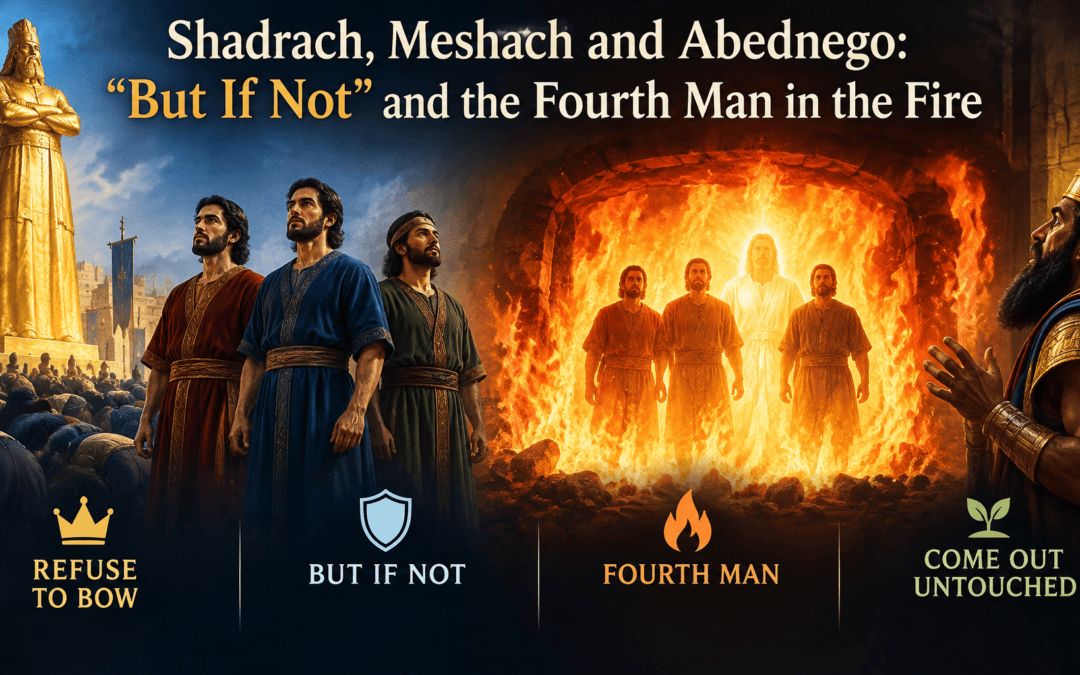
What is the story of Shadrach, Meshach and Abednego? Shadrach, Meshach and Abednego were three young Jewish captives in Babylon who refused to bow to King Nebuchadnezzar’s golden image, even under threat of the fiery furnace (Daniel 3). They told the king their God was able to deliver them, “but if not,” they still would not bow. God met them in the fire: a fourth man walked with them, and they came out unharmed, without even the smell of smoke.
▶ Read the Full Day 3 Teaching: But If Not
Who Were Shadrach, Meshach and Abednego?
Shadrach, Meshach and Abednego were three young men of Judah taken to Babylon with Daniel after Jerusalem fell. Their Hebrew names were Hananiah, Mishael and Azariah. Babylon trained them for the king’s service and gave them new names that pointed to its own gods, the story that begins in Daniel 1:
And the chief of the eunuchs gave them names: Daniel he called Belteshazzar, Hananiah he called Shadrach, Mishael he called Meshach, and Azariah he called Abednego.
When Daniel later interpreted the king’s dream of the great statue, the king honored him, and Daniel asked for his three friends to be promoted:
Daniel made a request of the king, and he appointed Shadrach, Meshach, and Abednego over the affairs of the province of Babylon. But Daniel remained at the king’s court.
That is where Daniel 3 finds them: trusted officials of the empire, and still servants of the God of Israel.
Daniel himself does not appear in Daniel 3. The three friends stand on their own.
The Golden Image on the Plain of Dura
Daniel 3 begins with the same king who had dreamed of a statue with a head of gold. God had shown Nebuchadnezzar that his kingdom was only the head of that statue and that every kingdom of man would come to an end. Now the king built an image that was gold from top to bottom:
King Nebuchadnezzar made an image of gold, whose height was sixty cubits and its breadth six cubits. He set it up on the plain of Dura, in the province of Babylon.
Sixty cubits is about ninety feet. The king summoned every official in the empire to the dedication, and a herald announced the order: when the music played, everyone was to fall down and worship the golden image. Anyone who refused would be thrown into a burning fiery furnace (Daniel 3:4–6). When the horn, pipe, lyre and the rest of the music sounded, the whole crowd went down (Daniel 3:7).
Three men stayed on their feet. God had settled the question for them long before the music played:
You shall have no other gods before me. You shall not make for yourself a carved image, or any likeness of anything that is in heaven above, or that is in the earth beneath, or that is in the water under the earth. You shall not bow down to them or serve them …
Why Did Shadrach, Meshach and Abednego Refuse to Bow?
Some of the king’s officials saw their chance and reported the three men. The only charge against them was faithfulness to God:
There are certain Jews whom you have appointed over the affairs of the province of Babylon: Shadrach, Meshach, and Abednego. These men, O king, pay no attention to you; they do not serve your gods or worship the golden image that you have set up.
They were not accused of stealing, lying or rebellion. They served the king well. What they would not do was worship his gods, which were no gods at all. Jesus gave the same answer when the devil offered Him all the kingdoms of the world for one act of worship: “You shall worship the Lord your God and him only shall you serve” (Matthew 4:10). The apostles stood on the same ground before the rulers of their day:
But Peter and the apostles answered, “We must obey God rather than men.
Nebuchadnezzar was furious, but he gave them a second chance to bow, and he ended his offer with a challenge: who is the god who will deliver you out of my hands? (Daniel 3:15).
“But If Not”: The Meaning of Daniel 3:17–18
The answer Shadrach, Meshach and Abednego gave the king is one of the boldest statements of faith in the Bible:
Shadrach, Meshach, and Abednego answered and said to the king, “O Nebuchadnezzar, we have no need to answer you in this matter. If this be so, our God whom we serve is able to deliver us from the burning fiery furnace, and he will deliver us out of your hand, O king. But if not, be it known to you, O king, that we will not serve your gods or worship the golden image that you have set up.”
Their answer has three parts:
- God is able. They had no doubt about God’s power to save them from the furnace.
- God will deliver. One way or another, the king’s hand would not have the last word.
- But if not, we will not bow. Their obedience did not depend on getting the rescue they wanted.
“We have no need to answer you” was not rudeness. It meant the decision had been made before the music ever played. Faith that says “but if not” trusts God’s power and God’s will at the same time. It does not treat faith as a guarantee of the outcome, and it does not conclude that God is unable when the rescue does not come. Jesus told His disciples where that kind of courage comes from:
And do not fear those who kill the body but cannot kill the soul. Rather fear him who can destroy both soul and body in hell.
The Fourth Man in the Fire
The king’s anger made the fire hotter. He ordered the furnace heated seven times more than usual and had the three men bound and thrown in:
Because the king’s order was urgent and the furnace overheated, the flame of the fire killed those men who took up Shadrach, Meshach, and Abednego. And these three men, Shadrach, Meshach, and Abednego, fell bound into the burning fiery furnace.
Then the king saw something no one expected:
Then King Nebuchadnezzar was astonished and rose up in haste. He declared to his counselors, “Did we not cast three men bound into the fire?” They answered and said to the king, “True, O king.” He answered and said, “But I see four men unbound, walking in the midst of the fire, and they are not hurt; and the appearance of the fourth is like a son of the gods.”
Three men went in bound. Four men were walking, unbound. The only thing the fire took from Shadrach, Meshach and Abednego was what had them tied up.
Who Was the Fourth Man in the Fire? Two Views
Daniel does not name the fourth man, and Bible-believing Christians read the passage in two main ways.
An angel sent by God. This view starts with the king’s own words a few verses later, when he answered his own question about which god could deliver them:
Nebuchadnezzar answered and said, “Blessed be the God of Shadrach, Meshach, and Abednego, who has sent his angel and delivered his servants, who trusted in him, and set aside the king’s command, and yielded up their bodies rather than serve and worship any god except their own God.
This view notes that Daniel 6:22 describes the lions’ den the same way, with God sending His angel to shut the lions’ mouths. It also notes that “a son of the gods” is a pagan king’s phrase, not a confession of Christ. The King James Version’s “like the Son of God” shaped much of the traditional reading, while the ESV’s “a son of the gods” follows the Aramaic more closely.
A Christophany, an appearance of Christ before His birth. This view points out that “the angel of the LORD” in the Old Testament often speaks as God Himself and is treated as God, as with Hagar (Genesis 16:7–13), at Mount Moriah (Genesis 22:11–16) and with Manoah (Judges 13:18–22). So the king’s word “angel” does not rule out a divine figure. It also points to the burning bush, where the angel of the LORD appeared in a fire that did not consume the bush (Exodus 3:2). Above all, it notes what the fourth man did: he did not pull the three men out of the furnace. He walked with them in the middle of it, which is what God promised to do:
When you pass through the waters, I will be with you; and through the rivers, they shall not overwhelm you; when you walk through fire you shall not be burned, and the flame shall not consume you.
Both views agree on the point Daniel makes plain: God did not leave Shadrach, Meshach and Abednego alone in the fire. The full Day 3 teaching on FaithNFreedom Social walks through both views and explains why it reads the fourth man as most likely a Christophany.
Not Even the Smell of Smoke
The king came to the door of the furnace and called the three men out as servants of the Most High God. Every official who had bowed to the image gathered to look:
And the satraps, the prefects, the governors, and the king’s counselors gathered together and saw that the fire had not had any power over the bodies of those men. The hair of their heads was not singed, their cloaks were not harmed, and no smell of fire had come upon them.
Nebuchadnezzar then decreed that there is no other god who is able to rescue in this way (Daniel 3:29), and he promoted the three men in the province of Babylon (Daniel 3:30). The faith of three young men changed what a pagan king said about God. Peter wrote that faith tested by fire is worth more than the gold Nebuchadnezzar used for his image:
so that the tested genuineness of your faith—more precious than gold that perishes though it is tested by fire—may be found to result in praise and glory and honor at the revelation of Jesus Christ.
What Shadrach, Meshach and Abednego Teach Christians Today
The golden image is long gone, but the pressure to bow is not. A job may ask a believer to say what is not true. A culture may demand that everyone celebrate the same cause. A diagnosis, a child who has walked away from the Lord, or a country that has changed can each feel like a furnace. Daniel 3 shows the way through:
- Settle it before the music plays. The three men did not decide in the moment; the decision was already made.
- Serve well, and still belong to God. They were faithful officials of Babylon who would not worship Babylon’s gods.
- Pray boldly. God is able, and it is right to ask Him for the rescue.
- Trust Him if the answer is different. “But if not” keeps faith from depending on the outcome.
- Remember who is in the fire with you. God may keep His people out of the fire, or He may meet them in it.
Settling it ahead of time is the choice Joshua put to Israel long before Babylon, when he told the people to choose whom they would serve:
But as for me and my house, we will serve the LORD.
And the believer who settles that question does not walk into the fire alone. David knew it:
Even though I walk through the valley of the shadow of death, I will fear no evil, for you are with me; your rod and your staff, they comfort me.
The image of gold on the plain of Dura is gone. The faith of the three men who would not bow to it is still being read all over the world.
Continue the Series
This study comes from Day 3 of Faithful in Babylon: Lessons from Daniel, a seven-day Bible teaching on FaithNFreedom Social. Read the full teaching and join the discussion, then continue the series through Daniel 6, 9, 4–5 and 7. See the whole Faithful in Babylon series, or start with Day 1 on Daniel 1:8.
▶ Read the Full Day 3 Teaching: But If Not
Closing Prayer
Father, You are the Most High God, and there is no other god who is able to rescue like You. Thank You for standing with Shadrach, Meshach and Abednego in the fire. Give us their settled hearts. When the world plays its music and tells us to bow, help us stay on our feet. We believe You are able to deliver us, and we ask You boldly for what we need. And if the answer is not what we asked, we still will not bow. Meet us in the fire, loose what binds us, and let our faith bring honor to You. In Jesus’ name, amen.
Bible Teaching and Discussion
Bible teaching and discussion continue in Faith Blogs & Discussions on FaithNFreedom Social, and you can watch FaithNFreedomTV free, 24/7.
Scripture quotations are from the ESV® Bible (The Holy Bible, English Standard Version®), © 2001 by Crossway, a publishing ministry of Good News Publishers. Used by permission. All rights reserved.
Questions About Shadrach, Meshach and Abednego
Who were Shadrach, Meshach and Abednego?
Shadrach, Meshach and Abednego were three young men of Judah taken captive to Babylon with Daniel. Their Hebrew names were Hananiah, Mishael and Azariah, and Babylon renamed them after its own gods (Daniel 1:7). After Daniel interpreted the king’s dream, they were appointed over the affairs of the province of Babylon (Daniel 2:49). In Daniel 3 they refused to bow to the king’s golden image.
What does “but if not” mean in Daniel 3:18?
“But if not” means Shadrach, Meshach and Abednego would stay faithful whether or not God rescued them. They told Nebuchadnezzar their God was able to deliver them from the furnace and would deliver them from his hand. If He did not, they still would not serve the king’s gods or worship the golden image (Daniel 3:17–18). Their obedience did not depend on the outcome.
Why did Shadrach, Meshach and Abednego refuse to bow?
Shadrach, Meshach and Abednego refused to bow because God commanded His people to have no other gods and not to bow to any carved image. Exodus 20:3–5 settled the question for them before the music played. Like Jesus in Matthew 4:10, they would worship the Lord their God and serve Him only. They served the king faithfully but would not worship his gods.
Who was the fourth man in the fire?
The fourth man in the fire is the figure Nebuchadnezzar saw walking with Shadrach, Meshach and Abednego, whose appearance was “like a son of the gods” (Daniel 3:25). The king later said God “has sent his angel” (Daniel 3:28). Some Bible teachers see an angel, and others see a Christophany, an appearance of Christ before His birth. Daniel makes plain that God did not leave them alone.
What is a Christophany?
A Christophany is an appearance of Christ before He was born in Bethlehem. Many Bible teachers see Christophanies in Old Testament passages where “the angel of the LORD” speaks as God, such as Genesis 16, Genesis 22 and Judges 13. Those who read the fourth man in the fire this way point to Isaiah 43:2, where God promises to be with His people when they walk through fire.
What happened to Shadrach, Meshach and Abednego after the fiery furnace?
After the fiery furnace, Nebuchadnezzar blessed their God and promoted Shadrach, Meshach and Abednego in the province of Babylon (Daniel 3:30). The fire had no power over their bodies: their hair was not singed, their cloaks were not harmed, and no smell of fire was on them (Daniel 3:27). The king decreed that no other god is able to rescue in this way (Daniel 3:29).
What can Christians learn from Shadrach, Meshach and Abednego?
Christians learn from Shadrach, Meshach and Abednego to settle their loyalty to God before pressure comes, and to stay faithful whether or not God gives the rescue they ask for. They served Babylon well but would not worship its gods. Jesus said to fear God rather than those who can only kill the body (Matthew 10:28), and 1 Peter 1:7 says faith tested by fire is more precious than gold.