
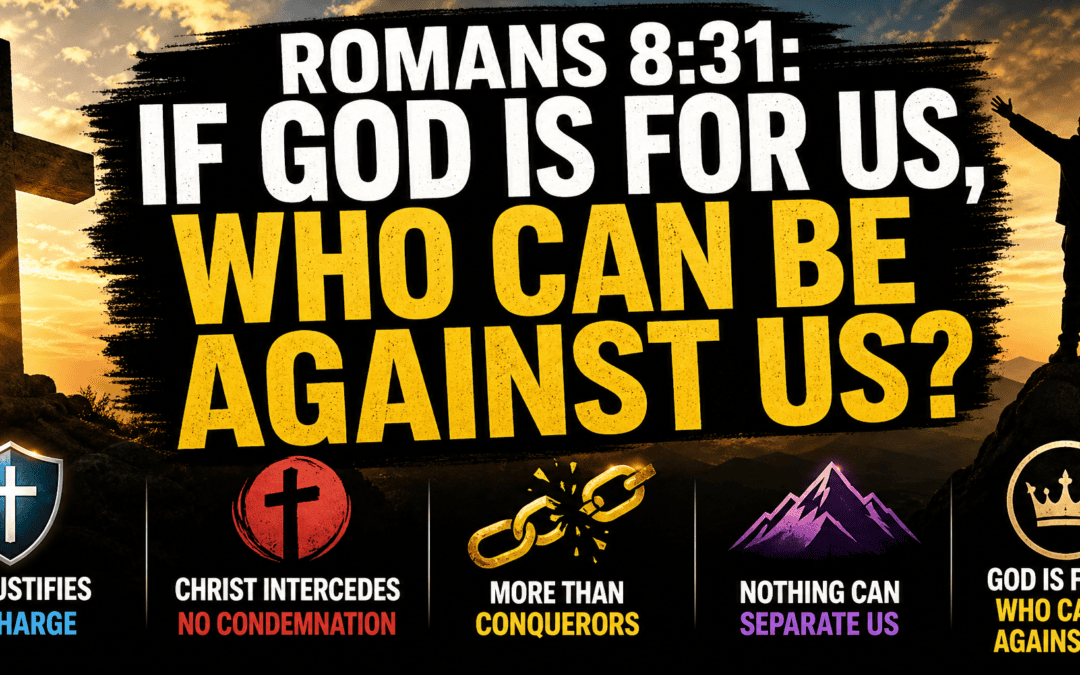
What does Romans 8:31 mean? Romans 8:31 means that because God has committed Himself to His people, no opponent can finally stand against them. Paul asks, “If God is for us, who can be against us?” and the rest of the chapter gives the answer: no one who can prevail. Opposition still comes, and Paul names it plainly a few verses later, but none of it can overturn what God has done or separate believers from His love in Christ Jesus.
Romans 8:31 in the ESV
What then shall we say to these things? If God is for us, who can be against us?
The verse is a question, and it is meant to be answered. Paul has spent the whole chapter laying out what God has done for those who are in Christ Jesus: there is no condemnation for them (Romans 8:1), the Spirit of God dwells in them, they are adopted as children of God, and future glory is promised to them. Verse 31 asks what all of that adds up to.
What Are “These Things”?
“These things” points back to everything Paul has laid out in the chapter, and especially to the verses just before it. The best known is verse 28:
And we know that for those who love God all things work together for good, for those who are called according to his purpose.
Paul then traces God’s work from beginning to end in verses 29 and 30: those God foreknew He also predestined to be conformed to the image of His Son, and those He predestined He also called, justified and glorified (Romans 8:29–30). Every step in that chain is something God does. That is why the question in verse 31 is not wishful thinking. It rests on God’s own actions.
The Proof Paul Gives: God Did Not Spare His Own Son
He who did not spare his own Son but gave him up for us all, how will he not also with him graciously give us all things?
Verse 32 is Paul’s evidence that God is for His people. He argues from the greater to the lesser: if God has already given the most costly gift, His own Son, He will not withhold what is needed after that. Anyone who wonders whether God is for them is pointed to the cross, where God settled the question.
Three Questions, and God’s Answer to Each
Paul follows with three questions. Each is answered by what God has already done.
Who shall bring any charge against God’s elect? It is God who justifies.
The first is a courtroom question. The only verdict that matters belongs to the Judge Himself, and He is the one who justifies. No accusation can stand once God has declared a person righteous.
Who is to condemn? Christ Jesus is the one who died—more than that, who was raised—who is at the right hand of God, who indeed is interceding for us.
The second asks who could condemn. Christ died, was raised, sits at the right hand of God and intercedes for His people. The only one with the standing to condemn is the one praying for them.
Who shall separate us from the love of Christ? Shall tribulation, or distress, or persecution, or famine, or nakedness, or danger, or sword?
The third asks what could separate believers from Christ’s love. Paul’s list was not hypothetical: he and the early church knew tribulation, persecution, hunger, danger and the threat of the sword firsthand. In the next verse he quotes Psalm 44:22 to say that God’s people are regarded as sheep to be slaughtered (Romans 8:36).
More Than Conquerors
No, in all these things we are more than conquerors through him who loved us.
Paul’s answer is not that these things never happen. It is that they cannot win. Believers are more than conquerors “in all these things,” in the middle of them, and the victory belongs to Christ, “him who loved us,” not to their own strength.
Nothing Can Separate Us from the Love of God
For I am sure that neither death nor life, nor angels nor rulers, nor things present nor things to come, nor powers,
nor height nor depth, nor anything else in all creation, will be able to separate us from the love of God in Christ Jesus our Lord.
Paul closes the chapter with the widest list he can make: death and life, angels and rulers, things present and things to come, powers, height and depth, and anything else in all creation. None of it can separate believers from the love of God in Christ Jesus our Lord. That is the full answer to the question of verse 31.
What Romans 8:31 Does Not Promise
Romans 8:31 is sometimes read as a promise that a believer will never face opposition. The chapter itself rules that out. The same passage names tribulation, persecution and the sword, and Paul wrote it as a man who was beaten and imprisoned for the gospel (2 Corinthians 11:23–25). The promise is not the absence of enemies. It is that no enemy can overturn God’s verdict or separate His people from His love in Christ Jesus.
Standing on Romans 8:31 This Week
The world will say that opposition means God has stepped back. The enemy will press the same lie in a quieter voice: that a setback is proof God is no longer for us. Romans 8 answers both. The accuser has no standing, the Judge has already ruled, and Christ is interceding. When the pressure comes this week, we can answer it with Paul’s own words: if God is for us, who can be against us?
Read Romans 8 aloud from beginning to end, and notice how much of it is about what God has done. To stand against the schemes of the devil, see The Full Armor of God: All 7 Parts from Ephesians 6.
Bible Teaching and Discussion
Bible teaching and discussion continue in Faith Blogs & Discussions on FaithNFreedom Social, and you can watch FaithNFreedomTV free, 24/7.
Scripture quotations are from the ESV® Bible (The Holy Bible, English Standard Version®), © 2001 by Crossway, a publishing ministry of Good News Publishers. Used by permission. All rights reserved.
Questions About Romans 8:31
What is the meaning of Romans 8:31?
Romans 8:31 means that because God gave His own Son for His people, no one who opposes them can finally prevail. Paul asks, “If God is for us, who can be against us?” to sum up everything in Romans 8. The rest of the chapter answers it: no charge can stand, no one can condemn, and nothing in creation can separate believers from God’s love in Christ Jesus.
Who wrote “If God is for us, who can be against us”?
The apostle Paul wrote “If God is for us, who can be against us” in his letter to the Romans, chapter 8, verse 31. The ESV reads: “What then shall we say to these things? If God is for us, who can be against us?” Paul wrote it as a man who had been beaten and imprisoned for the gospel (2 Corinthians 11:23–25), not from a life without enemies.
Does Romans 8:31 mean Christians will not face opposition?
No, Romans 8:31 does not promise a life without opposition. The same chapter names tribulation, distress, persecution, famine, nakedness, danger and sword, and Paul quotes Psalm 44:22 about being regarded as sheep to be slaughtered. The promise is that opposition cannot win: in all these things believers are more than conquerors through Christ (Romans 8:37), and nothing can separate them from His love.
How does Romans 8:32 support Romans 8:31?
Romans 8:32 gives the proof that God is for His people: He did not spare His own Son but gave Him up for us all. Paul argues from the greater to the lesser. If God has already given the most costly gift, He will not withhold what His people need after that. Anyone who wonders whether God is for them is pointed to the cross, where God settled the question.
What verses come after Romans 8:31?
Romans 8:32–39 come after Romans 8:31 and finish Paul’s argument. Verse 32 gives the proof: God did not spare His own Son. Then Paul asks three questions: who can bring a charge, who can condemn and what can separate believers from Christ’s love. He ends the chapter by saying that nothing in all creation will be able to separate us from the love of God in Christ Jesus our Lord.
What does “more than conquerors” mean in Romans 8:37?
“More than conquerors” in Romans 8:37 means believers do not merely survive hardship but win through it, because the victory belongs to Christ, “him who loved us.” Paul says this is true “in all these things,” in the middle of tribulation and persecution, not only after they are gone. The strength is not the believer’s own; it comes from the One who loved them first.