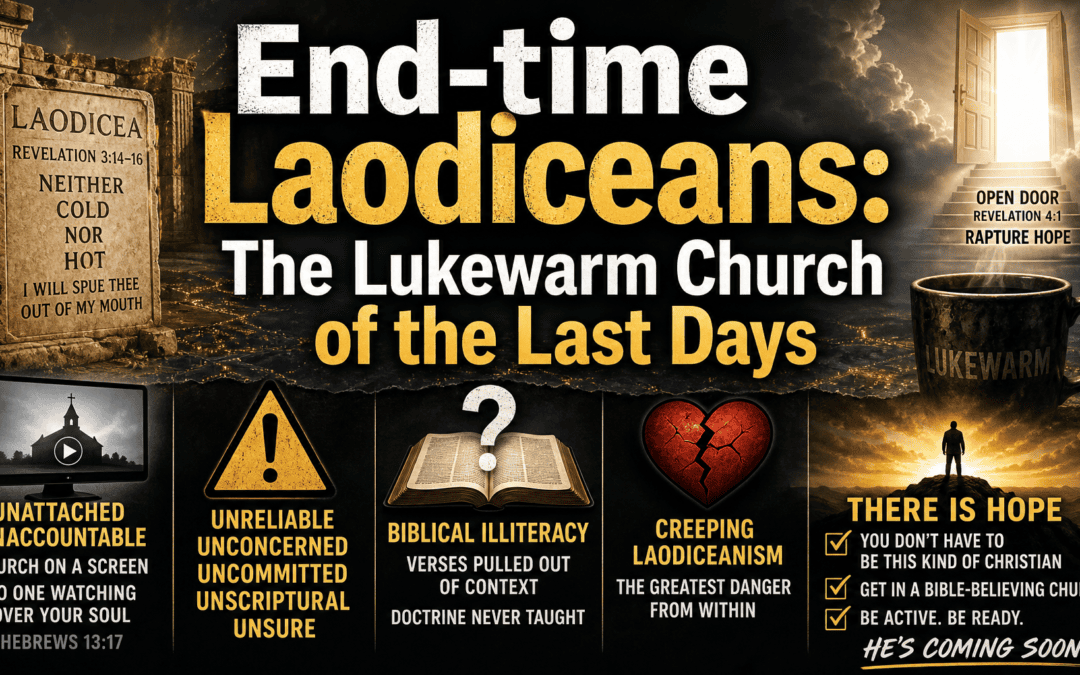
What is lukewarm Christianity? Lukewarm Christianity is a faith that is neither hot nor cold: comfortable, self-satisfied and unwilling to cost anything. The phrase comes from Jesus’ letter to the Laodicean church in Revelation 3:14–22, where He says, “because thou art lukewarm, and neither cold nor hot, I will spue thee out of my mouth.” Yet the same letter ends with an invitation: Christ stands at the door and knocks.
▶ Watch “End-time Laodiceans” Free on FaithNFreedomTV
Revelation 3:14–16: Neither Cold Nor Hot
The last of the seven letters in Revelation 2–3 goes to the church in Laodicea. It is the only one of the seven for which Jesus has no word of praise:
And unto the angel of the church of the Laodiceans write; These things saith the Amen, the faithful and true witness, the beginning of the creation of God;
I know thy works, that thou art neither cold nor hot: I would thou wert cold or hot. So then because thou art lukewarm, and neither cold nor hot, I will spue thee out of my mouth.
Jesus introduces Himself as the faithful and true witness, and a witness who is faithful and true cannot flatter. He sees a church that is comfortable, busy and religious, and of no use to Him at all.
The Laodicean Church in History
Laodicea was a wealthy city in the Lycus Valley in what is now western Turkey. Paul knew the believers there and asked that his letter to nearby Colossae be read to them too:
And when this epistle is read among you, cause that it be read also in the church of the Laodiceans; and that ye likewise read the epistle from Laodicea.
For I would that ye knew what great conflict I have for you, and for them at Laodicea, and for as many as have not seen my face in the flesh;
Historians point to three things the city was known for, and every one shows up in Jesus’ letter:
- Banking and wealth. Laodicea was rich enough to rebuild itself after an earthquake around AD 60 without help from Rome.
- Textiles. The city was famous for garments of glossy black wool.
- Medicine. A medical school nearby was known for a powder used to treat the eyes.
The city also had a water problem. Nearby Hierapolis had hot springs and Colossae had cold, clear water, but Laodicea’s water came in by aqueduct and arrived tepid and full of minerals. Many teachers read Jesus’ words against that background: hot water heals, cold water refreshes, and lukewarm water does neither.
“I Am Rich, and Increased with Goods”
Because thou sayest, I am rich, and increased with goods, and have need of nothing; and knowest not that thou art wretched, and miserable, and poor, and blind, and naked:
This is the heart of the diagnosis. Laodicea’s problem was not open sin or persecution; it was self-sufficiency. The church measured itself by what it had and decided it was fine. Jesus measured it by what it lacked and called it poor, blind and naked. Scripture warned about this long before:
give me neither poverty nor riches; feed me with food convenient for me: lest I be full, and deny thee, and say, Who is the LORD?
Lukewarm Christianity rarely announces itself. It sounds like “I am rich, and increased with goods, and have need of nothing.” It looks like a full calendar with no room for prayer, and a faith that costs nothing.
Christ’s Counsel: Gold, White Raiment and Eyesalve
Jesus does not leave the church with a diagnosis. He offers the cure, and each item answers one of the city’s boasts:
I counsel thee to buy of me gold tried in the fire, that thou mayest be rich; and white raiment, that thou mayest be clothed, and that the shame of thy nakedness do not appear; and anoint thine eyes with eyesalve, that thou mayest see.
- Gold tried in the fire for a city of bankers: a faith tested and made real, worth more than any account.
- White raiment for a city of black wool: the righteousness only Christ can give.
- Eyesalve for a city with a famous eye medicine: spiritual sight to see ourselves as He sees us.
Notice the words “buy of me.” The cure comes from Christ alone. Isaiah used the same picture of buying what cannot be bought:
Ho, every one that thirsteth, come ye to the waters, and he that hath no money; come ye, buy, and eat; yea, come, buy wine and milk without money and without price.
Rebuke Is an Act of Love
As many as I love, I rebuke and chasten: be zealous therefore, and repent.
The hardest letter of the seven carries one of the tenderest lines. Jesus rebukes Laodicea because He loves it. The cure for lukewarmness is not a better program; it is zeal and repentance. Hebrews says the same about the Father:
For whom the Lord loveth he chasteneth, and scourgeth every son whom he receiveth.
If your heart has gone lukewarm, the conviction you feel reading this is not rejection. It is the Lord knocking.
“Behold, I Stand at the Door and Knock”
Behold, I stand at the door, and knock: if any man hear my voice, and open the door, I will come in to him, and will sup with him, and he with me.
This verse is often used in evangelism, and it does invite anyone to Christ. But in context Jesus is standing outside a church. He has been shut out of the very fellowship that bears His name, and He is still knocking. The promise is personal, “if any man,” so one believer can open the door even when the whole congregation will not. And the letter ends with a throne:
To him that overcometh will I grant to sit with me in my throne, even as I also overcame, and am set down with my Father in his throne. He that hath an ear, let him hear what the Spirit saith unto the churches.
Lukewarm Christianity in the Last Days
Paul described the spirit of the last days in words that read like a commentary on Laodicea:
This know also, that in the last days perilous times shall come. For men shall be lovers of their own selves, covetous, boasters, proud, blasphemers, disobedient to parents, unthankful, unholy,
Having a form of godliness, but denying the power thereof: from such turn away.
Jesus asked a question that should stop every believer: when He returns, will He find faith? Many Bible teachers read the seven churches as both real first-century congregations and a picture of the church age, with Laodicea last. Whether or not you hold that view, the warning applies to every generation that grows comfortable.
Nevertheless when the Son of man cometh, shall he find faith on the earth?
Prophecy In The Spotlight on the Laodicean Church
On FaithNFreedomTV, Evangelist Dan Goodwin and Dr. Charles Hiltibidal of Prophecy In The Spotlight gave two programs to Revelation 3:14–22. Dr. Hiltibidal teaches that the seven letters went to real churches and also traced the eras of church history:
These are seven churches, chapter two and chapter three, and they are letters written to seven individual churches. They were real churches… But I don’t think that their letters are just for them. I think they are prophetic, to give us an overall view of the church age.
— Prophecy In The Spotlight, “End-time Laodiceans”
The hosts then work through a list of what they call the marks of the Laodicean Christian: unattached, unaccountable, unreliable, unconcerned, unfaithful, unwilling, uncommitted, unscriptural, unsure, unaware, unproductive, unanchored and ungrounded. In part two they trace the list back to its root, a string of “self” words: self-centered, self-absorbed, self-satisfied, self-directed, self-righteous and self-indulgent. Dr. Hiltibidal shared a line whose original author he could not trace, but which sums up the series:
The greatest danger facing the modern church is not active opposition to us, but a creeping Laodiceanism among its followers.
— Prophecy In The Spotlight, “End-time Laodiceans”
That is the warning of Revelation 3:17 in one sentence. Scripture names the same danger:
For if a man think himself to be something, when he is nothing, he deceiveth himself.
Obey them that have the rule over you, and submit yourselves: for they watch for your souls, as they that must give account, that they may do it with joy, and not with grief: for that is unprofitable for you.
Part two opens on Revelation 3:20, and the series closes on hope:
Jesus is outside knocking on the door… It appears that Jesus isn’t welcome inside these churches. And we may laugh at that, but it’s a pretty serious matter.
— Prophecy In The Spotlight, “Laodicean Christianity” (part two)
You don’t have to be this kind of a Christian. Your church doesn’t have to be this kind of a church.
— Prophecy In The Spotlight, “End-time Laodiceans”
Watch on FaithNFreedom
▶ Watch “End-time Laodiceans” Free on FaithNFreedomTV
Watch “End-time Laodiceans” on FaithNFreedomTV, part one of the series, where Dan Goodwin and Dr. Charles Hiltibidal read Revelation 3:14–17 and walk through the marks of the Laodicean Christian. Part two, “Laodicean Christianity,” airs on FaithNFreedomTV’s Growing Your Faith channel. Watch FaithNFreedomTV free, 24/7, and meet the rest of the network’s independent Christian creators.
How to Stop Being a Lukewarm Christian
Jesus’ counsel to Laodicea is the path out, and it is open to anyone today:
- Admit the need. Laodicea’s problem was “have need of nothing.” Start by telling the Lord you need Him.
- Repent and be zealous. Name what has cooled your heart and turn from it (Revelation 3:19).
- Open the door. Make room every day for prayer and the Word; that is where you eat with Him (Revelation 3:20).
- Get attached. Commit to a Bible-teaching local church where someone watches over your soul.
- Serve. A fire that is fed and shared does not go out.
Not slothful in business; fervent in spirit; serving the Lord;
And let us consider one another to provoke unto love and to good works: not forsaking the assembling of ourselves together, as the manner of some is; but exhorting one another: and so much the more, as ye see the day approaching.
Closing Prayer
Lord Jesus, You are the faithful and true witness, and You see us as we really are. Forgive us for every place we have said we “have need of nothing.” We need You. Sell us gold tried in the fire, clothe us in Your righteousness, and anoint our eyes so we can see. Thank You for loving us enough to rebuke us. We hear You knocking, and we open the door. Come in, set our hearts on fire again, and make us zealous for You until You come. In Jesus’ name, amen.
Bible Teaching and Discussion
Bible teaching and discussion continue in Faith Blogs & Discussions on FaithNFreedom Social, and you can watch FaithNFreedomTV free, 24/7.
Scripture quotations are from the King James Version (KJV).
Questions About Lukewarm Christianity
What does lukewarm mean in the Bible?
In the Bible, lukewarm describes a faith that is neither hot nor cold, comfortable but of no use to Christ. The word comes from Revelation 3:15–16, where Jesus tells the church in Laodicea, “because thou art lukewarm, and neither cold nor hot, I will spue thee out of my mouth.” The church thought it was rich and had need of nothing, but Jesus called it wretched, poor, blind and naked.
What was the Laodicean church?
The Laodicean church was the congregation in Laodicea, the seventh church addressed in Revelation 2–3. Laodicea was a wealthy city in the Lycus Valley of what is now western Turkey, known for banking, black wool and an eye medicine. Paul mentions the believers there in Colossians 4:16. It is the only one of the seven churches for which Jesus has no word of praise.
Why did Jesus say he would spit out the lukewarm?
Jesus said He would spit out the lukewarm because a faith that is neither hot nor cold is useless to Him. Laodicea’s water arrived tepid by aqueduct, while nearby Hierapolis had healing hot springs and Colossae had refreshing cold water. Lukewarm water does neither. Jesus’ strong words in Revelation 3:16 show how seriously He takes self-satisfied faith, yet verse 19 says He rebukes because He loves.
What does “I stand at the door, and knock” mean?
“I stand at the door, and knock” means Christ is calling a self-satisfied church, and every person in it, to let Him back in. In Revelation 3:20 Jesus stands outside the Laodicean church and promises, “if any man hear my voice, and open the door, I will come in to him, and will sup with him.” It invites unbelievers to salvation and lukewarm believers back into close fellowship with Him.
What is Christ’s counsel to the Laodicean church?
Christ counsels the Laodicean church to buy of Him gold tried in the fire, white raiment and eyesalve (Revelation 3:18). Each answers a boast of the city: gold for bankers, white raiment for a city of black wool, eyesalve for a city with a famous eye medicine. The cure comes only from Christ: tested faith, His righteousness and spiritual sight to see ourselves truly.
Are we living in the Laodicean church age?
Many Bible teachers believe we are living in the Laodicean church age. They read the seven churches of Revelation 2–3 as real first-century congregations that also picture the eras of church history, with Laodicea last before Revelation 4:1. Others read the letters as warnings for every generation. Either way, the self-satisfied spirit of Revelation 3:17 fits Paul’s description of the last days in 2 Timothy 3:1–5.
How do I stop being a lukewarm Christian?
You stop being lukewarm by doing what Jesus told Laodicea: admit your need, be zealous and repent, and open the door to Him (Revelation 3:17–20). In practice that means daily prayer and Bible reading, commitment to a Bible-teaching local church, and serving others. Romans 12:11 says, “fervent in spirit; serving the Lord.” A shared fire stays lit.