
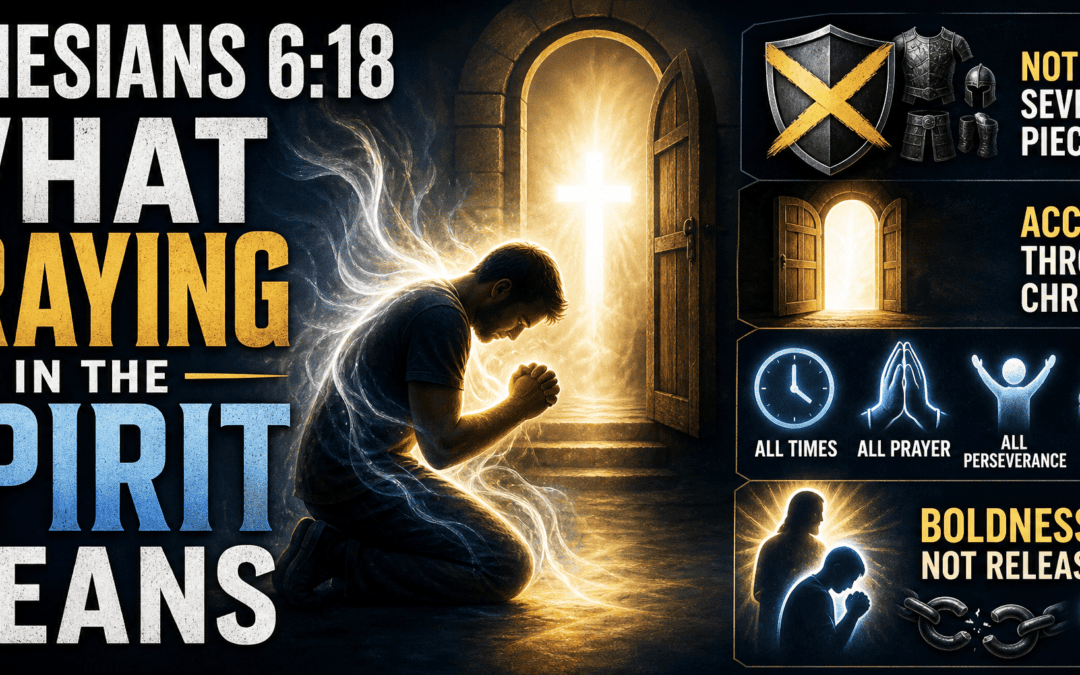
What does Ephesians 6:18 mean? Ephesians 6:18 tells believers to pray “at all times in the Spirit” as they stand in the armor of God. Paul does not add prayer as a seventh piece of equipment. It is the way the six pieces are worn: an ongoing conversation with the Father, opened through Christ and carried by the Holy Spirit, even on the days a believer has no words of their own.
Ephesians 6:18 in the ESV
Paul has just named the helmet of salvation and the sword of the Spirit, which is the word of God. In the ESV, verse 17 ends with a comma rather than a full stop. The sentence runs straight on into prayer:
praying at all times in the Spirit, with all prayer and supplication. To that end, keep alert with all perseverance, making supplication for all the saints,
The sword and the prayer belong together. The same sentence that hands a believer the word of God tells them to keep talking to God while they hold it.
Not a Seventh Piece of Armor
Every piece of armor in Ephesians 6 comes with a verb a believer does once: fasten the belt, put on the breastplate, put on the shoes, take up the shield, take the helmet and the sword. Prayer is different in kind. There is no Roman equipment to match it, no plate or blade. It is the thing going on the whole time the armor is being worn.
That is why Ephesians 6:18 matters for the whole passage. If prayer were one more item, a believer could leave it behind and still be six-sevenths armored. Paul does not allow that reading. He pictures the armor being worn in prayer, not prayer stored alongside it.
What “In the Spirit” Means: Access
Earlier in the same letter, Paul explains why prayer is possible at all:
For through him we both have access in one Spirit to the Father.
Every Person of the Trinity is in that one sentence: through Him, in one Spirit, to the Father. Praying in the Spirit is less a skill to master than a door already opened. Christ secured the access, and the Spirit who brings believers to the Father is the Spirit in whom they pray.
The Four “Alls” of Ephesians 6:18
Read the verse again and count one word. All times, all prayer, all perseverance, all the saints: four times in one sentence. Together they answer when, what kind, how long, and for whom.
All times. No one can pray at all times on their own strength. Words run out, and Paul knew it. He wrote this to the Romans:
Likewise the Spirit helps us in our weakness. For we do not know what to pray for as we ought, but the Spirit himself intercedes for us with groanings too deep for words.
The promise is not that believers become skilled at prayer. It is that the Spirit within them takes up what they cannot put into words.
All prayer. Every kind of prayer counts: asking, thanking, pleading, confessing. Jesus told of a tax collector who would not even lift his eyes and prayed only, “God, be merciful to me, a sinner!” (Luke 18:13). He went home justified. Some of the most honest prayers in the Bible are short.
All perseverance. Luke tells the point of one parable before he tells the story:
And he told them a parable to the effect that they ought always to pray and not lose heart.
The widow in that parable had no money and no leverage, and her only strategy was to keep coming back. Jesus contrasts the unjust judge with God, who will give justice to his elect who cry to him day and night (Luke 18:7).
All the saints. Roman soldiers locked their shields together in formation. In the same way, no believer is meant to pray only for themselves. Paul describes Epaphras as always struggling in prayer for the Colossians, that they might stand mature and fully assured in all the will of God (Colossians 4:12). Believers keep standing in part because others carry them in prayer.
The Spirit Prays in You, and the Son Prays for You
Romans 8:26 shows the Spirit interceding within believers. The New Testament also shows Jesus interceding for them:
Consequently, he is able to save to the uttermost those who draw near to God through him, since he always lives to make intercession for them.
Romans 8:34 says the same of Christ, who is at the right hand of God, interceding for us (see Romans 8:31: If God Is for Us, Who Can Be Against Us?). Put the two together and the picture is complete: the Spirit prays in the believer, the Son prays for the believer, and the prayer goes to the Father even when it is offered badly.
What Paul Asked For: Boldness, Not Release
Having told the church to pray for all the saints, Paul asks for prayer for himself:
and also for me, that words may be given to me in opening my mouth boldly to proclaim the mystery of the gospel,
He was in chains, and he could have asked for anything. He asked for words, and in the next verse he calls himself an ambassador in chains (Ephesians 6:20). The church had prayed the same way before. When Peter and John were threatened in Acts 4, the believers named the threat to God and asked for boldness to keep speaking His word, and they were all filled with the Holy Spirit (Acts 4:29–31).
Jude and Praying in the Holy Spirit
Another New Testament writer uses nearly the same words:
But you, beloved, building yourselves up in your most holy faith and praying in the Holy Spirit,
Jude continues: keep yourselves in the love of God (Jude 21). In Jude, praying in the Spirit is more than making requests. It is how believers keep themselves in the love of God.
Praying in the Spirit This Week
The world will say that prayer is a block on the calendar, and the enemy will say that a believer who prays badly should not pray at all. Ephesians 6:18 answers both. Prayer runs underneath the day, and the Spirit carries what we cannot say.
- Pray while doing everything else. It was never meant to be a separate task.
- When there are no words, keep going. Romans 8:26 says the Spirit carries that part.
- Short prayers count. The tax collector prayed one line, and Jesus said he went home justified.
- Pray for someone else to stand. Pick one person, the way Epaphras did.
- Ask for boldness before asking for relief. That is what Paul asked for in chains.
This article draws on Praying in the Spirit, Day 7 of the Armor of God series on FaithNFreedom Social. For every piece of the armor, see the full armor of God in Ephesians 6:10-18.
Scripture quotations are from the ESV® Bible (The Holy Bible, English Standard Version®), © 2001 by Crossway, a publishing ministry of Good News Publishers. Used by permission. All rights reserved.
Questions About Ephesians 6:18
What does it mean to pray in the Spirit?
To pray in the Spirit means praying with the access God has already given: through Christ, in one Spirit, to the Father (Ephesians 2:18). It is not a technique to master but the way the whole armor of God is worn. When words run out, Romans 8:26 says the Spirit Himself intercedes with groanings too deep for words, so no believer prays alone.
Is prayer the seventh piece of the armor of God?
Prayer is not a seventh piece of equipment, but it is how the other six are worn. Paul names six pieces in Ephesians 6:14–17, and verse 18 continues the same sentence with praying at all times in the Spirit. Many teachers count seven parts, yet prayer has no Roman equipment to match it. A believer cannot set it aside and still be fully armored.
What are the four “alls” in Ephesians 6:18?
The four “alls” in Ephesians 6:18 are all times, all prayer, all perseverance and all the saints. Together they answer when to pray, what kind of prayer counts, how long to keep going and whom to pray for. Every kind of prayer counts, from thanksgiving to a one-line plea, and no believer is meant to pray only for themselves, the way Epaphras prayed for the Colossians (Colossians 4:12).
What did Paul ask the Ephesians to pray for him?
Paul asked the Ephesians to pray for boldness, not for release from his chains. In Ephesians 6:19–20 he asks that words be given to him to proclaim the mystery of the gospel boldly, and calls himself an ambassador in chains. The early church prayed the same way in Acts 4:29–31, asking for boldness under threat, and they were all filled with the Holy Spirit.
What does Romans 8:26 say about prayer?
Romans 8:26 says the Holy Spirit helps believers in their weakness when they do not know how to pray. When we do not know what to pray for as we ought, the Spirit Himself intercedes for us with groanings too deep for words. The promise is not that believers become skilled at prayer, but that the Spirit within them carries what they cannot put into words.
Does Jesus pray for believers?
Yes, Jesus prays for believers continually. Hebrews 7:25 says He always lives to make intercession for those who draw near to God through Him, and Romans 8:34 says Christ is at the right hand of God, interceding for us. Together with Romans 8:26 the picture is complete: the Spirit prays in the believer, the Son prays for the believer, and the prayer reaches the Father.
Where else does the Bible mention praying in the Holy Spirit?
Jude 20 is the other New Testament passage that mentions praying in the Holy Spirit. Jude tells believers to build themselves up in their most holy faith and to pray in the Holy Spirit, and verse 21 continues: keep yourselves in the love of God. In Jude, praying in the Spirit is more than making requests; it is how believers stay rooted in God’s love while they wait for Christ’s mercy.