
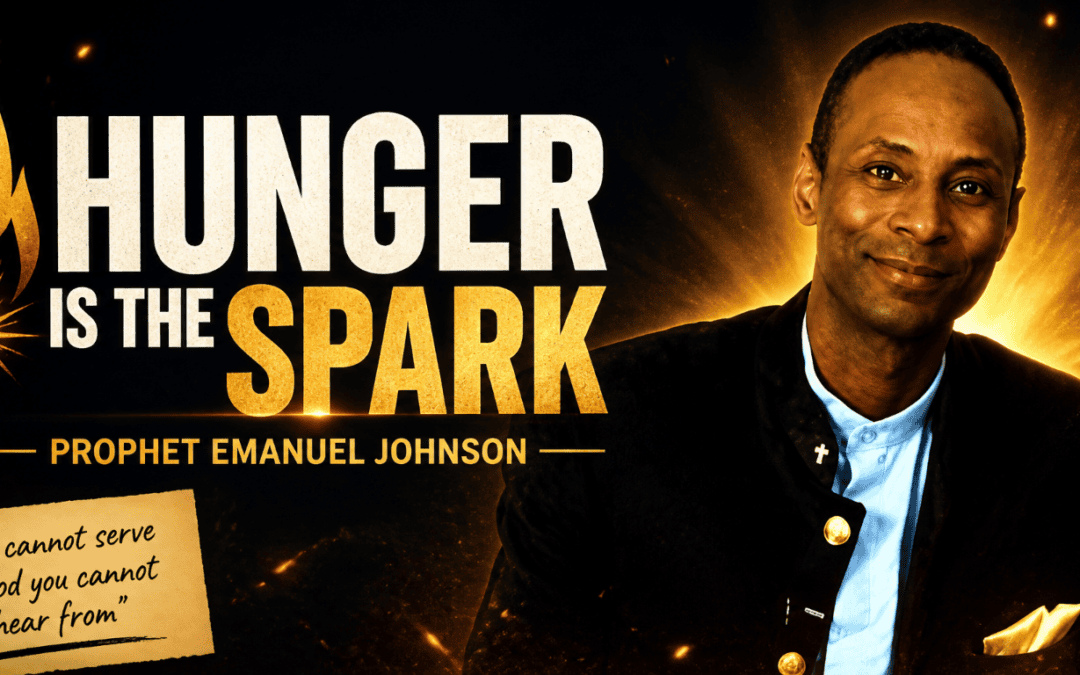
How does God speak to us? Prophet Emanuel Johnson’s answer, given on Day 7 of the FaithNFreedom Hearing from God series, is that the question itself is usually asked backwards. People want the method. Scripture keeps handing them a Person. Across thirty years of prophetic ministry, Johnson has come to one conclusion he states without hedging: God is not silent, and He has never used a single channel to reach everyone.
The line that stopped the room was blunter than that. “You cannot serve a God you cannot hear from.”
This is the full Day 7 teaching — the biblical pattern Johnson lays out, the testimony behind it, and the practice he recommends for anyone who has asked the question and come away empty. Day 7 sits inside the twelve-day Hearing from God series, in which a different prophetic voice teaches each day.
“My sheep hear my voice, and I know them, and they follow me.” — John 10:27 ESV
The Biblical Answer: One God, Many Channels
Johnson builds his case from Scripture before he tells a single story about himself, and the pattern he traces is difficult to argue with once it is laid out in sequence.
Moses was given forty days on a mountain. That was Moses’ assignment, and God never handed it to anyone else. Joshua was told plainly how God would speak to him — through the Urim, an entirely different mechanism — and Joshua was wildly successful. Saul did not hear God directly at all; the word reached him through the prophet Samuel. Johnson’s response to that is worth quoting: “That’s okay. As long as you heed what He’s saying.”
Gideon was so frightened he asked for the fleece test twice, in opposite directions — dry fleece on wet ground, then wet fleece on dry ground. God did not lose patience once. Johnson’s reading is that Gideon had to learn to hear God in order to win the battles ahead of him, and that God took a man full of fear and made him fearless with hope.
Then there is Samuel, who heard God’s literal voice and assumed it was Eli. Three times. He needed an aging priest to explain to him what he was already hearing.
“Speak, for your servant hears.” — 1 Samuel 3:10 ESV
Samuel could not say that sentence until somebody told him whose voice he was listening to. Johnson believes a great many believers are standing exactly there — hearing accurately, with the wrong name attached to what they hear.
God’s Own Defense of the Variety
When Miriam and Aaron complained that Moses was not the only one God spoke to, God answered them directly, and the answer is not what either of them expected.
“If there is a prophet among you, I the LORD make myself known to him in a vision; I speak with him in a dream.” — Numbers 12:6 ESV
Notice what God does not say. He never claims Moses is the only one who hears. He describes two different modes of speaking and defends His freedom to choose between them. Johnson also points out a detail in the burning bush account that most readers pass over: Moses saw the bush before he heard his name. The visual came first. God engaged his eyes, then spoke.
Elisha called for a musician, and as the music played the hand of the LORD came upon him. Johnson says instrumental worship works the same way on him — and adds immediately that it does not work on everyone.
At Pentecost, roughly a hundred and twenty people sat in one room. One rushing sound. One fire. Every person received. And then every person spoke a different language.
“All these are empowered by one and the same Spirit, who apportions to each one individually as he wills.” — 1 Corinthians 12:11 ESV
As He wills. Not as anyone researched, and not as a favourite teacher demonstrated. And when God finally came to Elijah in the cave, He was not in the wind, the earthquake, or the fire.
“…and after the fire the sound of a low whisper.” — 1 Kings 19:12 ESV
The same God who had just dropped fire from heaven for that man chose a whisper the next time He came. He does not repeat Himself simply because something worked before — which is a strange kind of good news. It means nobody’s testimony is the ceiling, and the way He intends to reach any given person has not been used up by somebody else.
Does Scripture actually teach that God speaks to different people in different ways?
Yes, and the range is wider than most believers assume. Moses received forty days on the mountain. Joshua received the Urim. Saul received a prophet. Samuel heard an audible voice and misidentified it three times. Elisha needed a musician. Elijah received a whisper after expecting fire. Numbers 12:6 records God defending His own freedom to choose. The variety is not a modern accommodation — it is the pattern from the beginning.
The Testimony Behind the Teaching
Johnson came to Christ in what he calls a quaint, basic church. Nothing remarkable about the building. Three things arrived in the same instant: unconditional love, unconditional acceptance, unconditional forgiveness. He says his parents loved him — they did — but this was something else entirely. “That blew my mind.”
“There is therefore now no condemnation for those who are in Christ Jesus.” — Romans 8:1 ESV
A man who says openly that he does not like to read books found himself reading the Bible cover to cover. Not by discipline. By appetite.
“As a deer pants for flowing streams, so pants my soul for you, O God.” — Psalm 42:1 ESV
Seven Days, and What He Did With Them
Church was good. It was not enough. Then a number arrived in his heart: seven days. No audible voice — he simply knew. He asked his employer for the time and they granted it.
What he did next is the most practical thing in the entire teaching. He gave God the exact hours he would have given his job. He was on the clock at five in the morning, so he got up at five in the morning and sought the Lord instead. He did not design a programme. He redirected time he was already spending.
“You will seek me and find me, when you seek me with all your heart.” — Jeremiah 29:13 ESV
He is careful with that phrase. When someone tells him they have sought God and heard nothing, his question is always the same: with all your heart, or according to your own standards?
He did not pray in tongues. He did not know tongues existed. He cried out — tears, loud, hours at a stretch. It got loud enough that a neighbour screamed at him through the wall to be quiet. It made him louder.
“And many rebuked him, telling him to be silent. But he cried out all the more, ‘Son of David, have mercy on me!'” — Mark 10:48 ESV
Bartimaeus was told to be quiet by a crowd, not one neighbour through a wall, and he is the man who walked away seeing. Johnson had not read that story yet. He did the same thing anyway.
Thursday Morning
Monday, Tuesday, Wednesday — same routine, nothing spectacular. Thursday morning, before his alarm, God woke him first.
Johnson had no category for what followed. He describes coming out of his body, standing in the living room, looking at his own body asleep. He was not frightened. He says he felt more alive outside his body than in it, with awareness he puts at a hundred out of a hundred rather than twenty-twenty.
“…whether in the body or out of the body I do not know, God knows — and he heard things that cannot be told.” — 2 Corinthians 12:3–4 ESV
Paul had no explanation for his own experience either, and refused to invent one. Johnson tells it with the same restraint — this is what happened, he does not fully understand the mechanics, and he builds no doctrine on it.
He describes being taken up through the roof, seeing the earth and the building he had just left, seeing things yet to come, and hearing a voice he identifies as Jesus: that what he had been crying out for had been granted, and that he was called to be a prophet. Then the sense that it was time to return, and he woke. From that morning, he says, God’s voice was clear.
The sequence matters more than the spectacle. The encounter did not make him a prophet because it was dramatic. The encounter was God answering a week of hunger. The hunger came first.
Filled and Emptied at the Same Time
Johnson volunteered the part most people miss: “I didn’t realize during those days that I was crying out, I was also being emptied out.” He had a great deal of the world in him that needed to come out. That was his requirement, in his season — not a formula.
He was emphatic about it. “God may just tell you one thing, and boom.” Someone else’s week might be ten minutes.
And God had spoken to him long before any of it. At eighteen, before he was born again and before he knew any Scripture, he laid his head down at a friend’s house and heard a voice he knew was God, promising to be with him and never to leave him. He kept it in his heart the way Mary kept hers. Which raises a question worth sitting with honestly: anyone convinced they have never heard God might first ask whether they have simply never counted what they already heard.
Is a dramatic encounter required before a person can hear God clearly?
No — and Johnson is the first to say so. The seven days and the encounter were what God required of him, at that stage, with that much of the world still in him. What transfers is not the schedule or the drama. It is the hunger, and the willingness to give God real time currently being given to something else. He redirected work hours. Someone else might redirect ten minutes of screen time. The size of the offering is not what God is responding to.
Why the Answer Feels Like Silence
Johnson’s sentence for this is the one people repeated afterwards: “God’s voice is one. But the distractions are many.”
His argument is that America — and much of the world — is so saturated with competing input that people have concluded God went quiet. He has not. The line is open. Something else is on it. And the harder half: the distractions are not going away. Nobody outlasts them. They have to be taken authority over.
His own declarations were plain: the phone will not be his master, the internet will not be his master, mainstream media will not be his master.
The challenge attached to them is specific. Turn the television off for one day. Turn the phone off for a few hours — not overnight while asleep, but during the day when it costs something. Then expect the flesh to object. Sleepiness arrives. Errands surface. Johnson’s counsel is that the resistance is confirmation rather than failure: the distraction is proof of what is at stake. Fall asleep, wake up, go at it again.
Start at the Edge of the Mountain
If eight hours sounds impossible, that is because it is not the assignment. Ten minutes. Then twenty. Then twenty-five. “God will meet you where you’re at.” His image is starting at the edge of the mountain before climbing it. And then the sentence that takes the pressure off the whole thing: “If you’re hungry, He has patience.”
Pray, Then Stop Talking
Johnson makes a distinction that quietly corrects most prayer lives. God often does not want him praying for an hour and calling it finished. God wants him to pray — and then be still.
“If you’re just saying I’m praying for an hour a day — what is that to God? It has to be both ways. I’m talking, and He’s talking, and we’re fellowshipping. Now you’ve got something.”
Write It Down Before You Are Sure
Write down what you think God is saying, even when certainty is missing. Date it. Keep it.
“Write the vision; make it plain on tablets, so he may run who reads it.” — Habakkuk 2:2 ESV
Two things happen. Time confirms or corrects, and the record slowly teaches a person the sound of God’s voice from their own experience rather than somebody else’s testimony.
Asking for Confirmation Is Not Doubt
Johnson still asks God for signs after thirty years and open-eye visions. Gideon asked twice in opposite directions and God never once took offence.
“When the Spirit of truth comes, he will guide you into all the truth.” — John 16:13 ESV
Guidance is the Spirit’s assignment, not the believer’s. Which means wanting to be sure is not a failure of faith — it is an invitation to the One whose job it already is.
What is the most common reason a believer cannot hear God?
Johnson’s answer is distraction, and he does not expect it to resolve on its own. Phones, internet and media occupy the same attention that God’s voice would occupy, and they do not surrender that ground voluntarily. His remedy is deliberate: switch things off during waking hours rather than at bedtime, and then add the half most people skip — pray, and then be still. An hour of one-directional talking is not a conversation.
Where This Lands
Johnson gave a word publicly in December 2023, repeated it in January 2024, and spoke it on camera in February 2024: a major pushback against the enemies of God, beginning at the Supreme Court and moving down, with an announcement between February and March. On 4 March 2024 the Supreme Court ruled unanimously that Colorado could not remove Donald Trump from the ballot under the Fourteenth Amendment’s insurrection clause, a decision that also closed parallel efforts in Maine and Illinois. Johnson played the original dated clip, and says his point was never personal credit — it was that the timestamps are public and cannot be moved. He described a further shaking in the world’s currencies, in gold, silver and copper, which he says he is still watching.
That public accountability is why he guards the line as carefully as he does. And it sits alongside the least glamorous thing he said all night: “It’s not the big ministry. It’s the big obedience.” His mother’s assignment was to raise her children in the ways of the Lord. She did it well, and he says she will stand among worldwide evangelists — because obedience is what is being measured.
Thirty years on, he still prays one standing prayer: that God would quicken his spirit and never let him go dull. He is still guarding the thing he received in a dark apartment before dawn as a brand-new believer who did not know what tongues were. Which is the whole teaching compressed into a sentence. Hunger opened the door. Hunger keeps it open — and it is available to anyone willing to be hungry, which is a far shorter list of requirements than most people feared.
Discuss Day 7 with the Community →
Questions About How God Speaks
How does God speak to us most commonly today?
Through Scripture first. Emanuel Johnson’s wife is his own example — she tried his method of early-morning crying out, received nothing from it, and was then told plainly by God that He would reveal Himself to her through His Word. She opens her Bible now and God speaks. Beyond Scripture, Johnson’s testimony and the biblical record include internal knowing without an audible voice, dreams and visions, a word delivered through another believer, and on rare occasions a voice heard clearly. He resists ranking these, because Scripture does not.
Why can’t I hear God even though I am trying?
Johnson asks two questions in return. First, whether the seeking has been wholehearted or measured against a personal standard — the distinction Jeremiah 29:13 draws. Second, and more often overlooked, whether God has already spoken and gone unrecognised. Samuel heard God three times and credited the voice to Eli. Johnson himself received a word at eighteen, years before he was born again, and had no category for it at the time.
Does God still speak today, or did that end with Scripture?
Johnson’s position, argued from Numbers 12:6 and from thirty years of ministry, is that the channels described in Scripture were never closed. God declared visions and dreams to be His method with prophets. Joel’s promise, quoted by Peter at Pentecost, extends dreams and visions to sons and daughters. Nothing in the text announces an end date. What has changed, in his view, is the volume of competing noise on the receiving end.
How much time does hearing God actually require?
Less than the seven-day story suggests. Johnson’s recommendation for anyone starting is ten minutes at a fixed time, building to twenty and then twenty-five. What he insists on is that the time be genuinely redirected from something else and genuinely two-directional. Ten minutes of praying and then listening is closer to what he means by fellowship than an hour of uninterrupted talking.
Is it wrong to ask God for confirmation before acting?
Johnson still does it after three decades. Gideon asked twice in opposite directions and drew no rebuke. John 16:13 assigns guidance to the Spirit of truth, which makes asking for it participation rather than resistance. Johnson frames confirmation as stewardship of what has been heard — particularly when other people will be affected by the obedience.
What should a person do with something they think God said but are not sure about?
Write it down and date it. Johnson recommends the honest wording: Lord, I think You are telling me this. Habakkuk 2:2 is the pattern. The record does two jobs over time — it confirms or corrects the specific word, and it slowly builds a personal reference for what God’s voice sounds like, drawn from experience rather than borrowed from a testimony that belongs to someone else.
Does a person need a prophetic calling to hear God clearly?
No. Johnson’s own summary of what God measures is obedience rather than office or audience size, and he applies it to his mother, whose assignment was raising her children and who he believes will stand among worldwide evangelists. Saul heard indirectly through Samuel and Johnson’s verdict on that arrangement is simply that it counted, so long as Saul heeded it.