
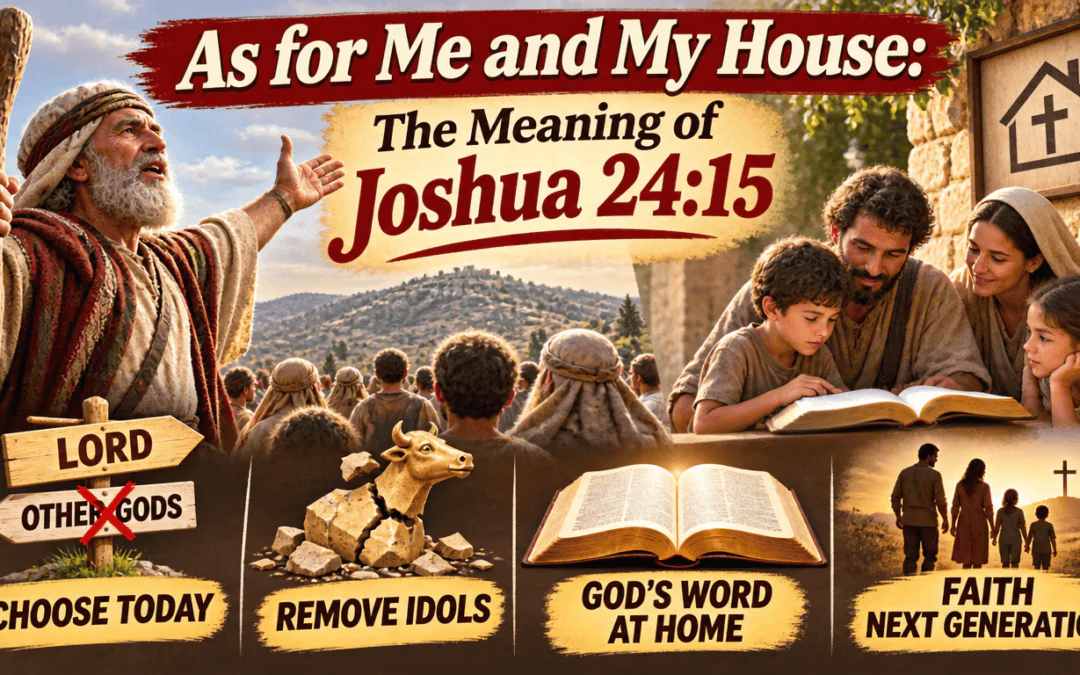
What does “as for me and my house” mean? In Joshua 24:15, Joshua tells Israel to choose that day whom they will serve, the LORD or the gods of their fathers and neighbors, and declares that he and his household will serve the LORD. The words come at the end of his life, after a full account of God’s faithfulness, as a call for every person and every home to decide.
Test yourself: two Joshua 24 trivia questions are at the end of this article.
▶ Read the Word from the Lord: My Judgment from My Court Is One of Mercy
Joshua 24:15 in Context
Joshua 24 comes at the end of Joshua’s life. He had led Israel across the Jordan and through the conquest of the land, and now, old and near death, he gathered all the tribes of Israel at Shechem (Joshua 24:1). Shechem was where God first promised the land to Abraham (Genesis 12:6–7), and it lies beside Mount Ebal, where Israel had renewed the covenant under Joshua years before (Joshua 8:30–35). Joshua spoke the LORD’s words over the people and told their story from the beginning: “Long ago, your fathers lived beyond the Euphrates, Terah, the father of Abraham and of Nahor; and they served other gods” (Joshua 24:2).
He walked them through it all: Abraham called out, Egypt and the Exodus, the wilderness, the battles, and a land they did not labor for. Every line of the story ends with what God did. Then Joshua turned from what God had done to what Israel would do:
Now therefore fear the LORD and serve him in sincerity and in faithfulness. Put away the gods that your fathers served beyond the River and in Egypt, and serve the LORD.
And if it is evil in your eyes to serve the LORD, choose this day whom you will serve, whether the gods your fathers served in the region beyond the River, or the gods of the Amorites in whose land you dwell. But as for me and my house, we will serve the LORD.
Joshua 24:15 is a call to decide, made after a full account of God’s faithfulness. Joshua did not ask Israel to choose in the dark. He reminded them of everything the LORD had done, then asked them to answer it.
What Does As for Me and My House Mean?
“As for me and my house, we will serve the LORD” means that Joshua had already settled who his household would worship, whatever anyone else decided. In Hebrew thinking a man’s “house” was his whole household: his wife, his children and everyone who lived under his roof. Joshua spoke for himself first and then for the home he was responsible to lead.
- “Choose this day”: the decision belonged to that day, not to some later season. Faith that is always planned for tomorrow is never actually chosen.
- “Whom you will serve”: Joshua did not offer the option of serving no one. The real choice was between the LORD and other gods: the old gods of Abraham’s family beyond the Euphrates, the gods of Egypt, or the gods of the Amorites who lived in the land around them.
- “But as for me”: Joshua’s choice did not wait on the crowd. He declared it before the people answered.
- “We will serve the LORD”: to serve meant worship and obedience together, the whole life given to God, not a single act of devotion.
Jesus taught the same either-or: “No one can serve two masters, for either he will hate the one and love the other, or he will be devoted to the one and despise the other. You cannot serve God and money” (Matthew 6:24). Centuries after Joshua, Elijah put the same question to Israel on Mount Carmel: “How long will you go limping between two different opinions? If the LORD is God, follow him; but if Baal, then follow him” (1 Kings 18:21). Every generation faces Joshua’s choice, and every generation has gods of its own to put away.
The People’s Answer and Joshua’s Warning
The people answered quickly: “Far be it from us that we should forsake the LORD to serve other gods” (Joshua 24:16). They listed what God had done for them. Joshua’s reply is one of the most surprising lines in the book:
You are not able to serve the LORD, for he is a holy God. He is a jealous God; he will not forgive your transgressions or your sins.
Joshua was not turning them away. He was making sure they knew what they were promising. A holy God cannot be served casually or on the side, next to other gods. Israel would need more than good intentions, and the rest of the Old Testament shows how often they fell short. The New Testament answers Joshua’s warning with the gospel: people are made right with God by grace through faith in Christ, and that faith then shows itself in faithful service (see Faith Without Works Is Dead).
Joshua pressed them again: “You are witnesses against yourselves that you have chosen the LORD, to serve him” (Joshua 24:22). They agreed, and he told them what that choice required: “Then put away the foreign gods that are among you, and incline your heart to the LORD, the God of Israel” (Joshua 24:23). Their answer became the covenant they made that day:
The LORD our God we will serve, and his voice we will obey.
Choosing the LORD meant putting something away. The idols were not only in Egypt or beyond the River; some were still among them. Joshua wrote the words in the Book of the Law and set up a large stone as a witness to what the people had promised (Joshua 24:26–27).
Did Israel Keep the Promise?
For one generation, yes:
Israel served the LORD all the days of Joshua, and all the days of the elders who outlived Joshua and had known all the work that the LORD did for Israel.
Joshua died at 110 years old and was buried in his own inheritance (Joshua 24:29–30). The people who had seen God’s works with their own eyes stayed faithful. The book of Judges records what came next:
And all that generation also were gathered to their fathers. And there arose another generation after them who did not know the LORD or the work that he had done for Israel.
One generation served the LORD, and the next did not know Him. That is why “as for me and my house” matters so much. A nation’s faith is passed on, or lost, one household at a time. Joshua’s words put the responsibility where God had always put it: in the home.
Serving the Lord at Home Today
Long before Joshua, Moses told Israel how a household serves the LORD:
And these words that I command you today shall be on your heart. You shall teach them diligently to your children, and shall talk of them when you sit in your house, and when you walk by the way, and when you lie down, and when you rise.
Serving the LORD at home is not a single decision made once and hung on the wall. It is God’s Word on a parent’s own heart first, then taught, talked about and lived in the ordinary hours of the day. In the New Testament the gospel reached whole households the same way, through people hearing and believing:
Believe in the Lord Jesus, and you will be saved, you and your household.
That was Paul and Silas’s answer to the Philippian jailer. Luke records that they then spoke the word of the Lord to everyone in his house, and the whole household came to believe (Acts 16:32–34). No one is saved by belonging to a family, but every family can be reached through faithful people who speak the Word and live it.
Many Christian homes hang “As for me and my house, we will serve the Lord” over a door or above the table. A sign like that does the most good when it reminds the family of a decision already made and lived, the way Joshua’s large stone stood as a witness at Shechem.
Lessons from Joshua 24:15
- Remember what God has done before you decide what you will do. Joshua told the whole story before he asked for an answer.
- There is no neutral option. Everyone serves someone; the question is whom.
- Lead your own house first. Joshua declared his household’s choice before the crowd answered.
- Put away what competes with God. Choosing the LORD meant removing the foreign gods that were still among the people.
- Pass it on. One generation served the LORD and the next did not know Him; faith is handed down at home.
For more on standing firm in a world with other gods, see Shadrach, Meshach and Abednego; for running the long race of faith, Hebrews 12:1.
▶ Read the Word from the Lord: My Judgment from My Court Is One of Mercy
Closing Prayer
Lord God, You have been faithful to us from the beginning, and every good thing in our lives came from Your hand. Today we choose You. Show us anything we have put beside You, and help us put it away. Make our homes places where Your Word is on our hearts, spoken at the table and lived through the week, so that our children and grandchildren know You and the works You have done. Thank You for Jesus, who makes us able to serve You. As for me and my house, we will serve the Lord. In Jesus’ name, amen.
Bible Teaching and Discussion
Bible teaching and discussion continue in Faith Blogs & Discussions on FaithNFreedom Social, and you can watch FaithNFreedomTV free, 24/7.
Scripture quotations are from the ESV® Bible (The Holy Bible, English Standard Version®), © 2001 by Crossway, a publishing ministry of Good News Publishers. Used by permission. All rights reserved.
Questions About Joshua 24:15
What does as for me and my house mean?
“As for me and my house” means Joshua had already settled whom his household would serve, whatever anyone else decided. In Joshua 24:15 he told Israel to choose between the LORD and the gods of their fathers and neighbors, then declared that he and his house would serve the LORD. His “house” meant his whole household, everyone he was responsible to lead.
Where is “as for me and my house, we will serve the Lord” in the Bible?
The words are in Joshua 24:15. Near the end of his life, Joshua gathered all the tribes of Israel at Shechem, retold everything God had done for them from Abraham to the conquest of the land, and called them to choose whom they would serve. He ended with “But as for me and my house, we will serve the LORD,” and the people answered that they would serve the LORD too.
What is the meaning of Joshua 24:15?
Joshua 24:15 means that serving God is a choice each person and household must make, and make now. Joshua set the LORD beside the old gods of Abraham’s family beyond the Euphrates and the gods of the Amorites, leaving no neutral option. He made his own household’s choice first and publicly, as an example to the whole nation gathered at Shechem.
Why did Joshua say Israel was not able to serve the Lord?
In Joshua 24:19 Joshua told the people they were not able to serve the LORD because He is a holy and jealous God. He was not turning them away; he was warning them not to promise lightly. A holy God cannot be served beside other gods or on good intentions alone. The people answered that they would serve Him, and Joshua held them to it as witnesses.
What gods did Joshua tell Israel to put away?
Joshua named the gods Israel’s fathers served beyond the River, meaning the Euphrates, where Abraham’s family had worshiped other gods; the gods of Egypt; and the gods of the Amorites who lived in the land. In Joshua 24:23 he told the people to put away the foreign gods that were still among them and to incline their hearts to the LORD, the God of Israel.
Did Israel keep the promise of Joshua 24?
For a generation, yes. Joshua 24:31 records that Israel served the LORD all the days of Joshua and of the elders who outlived him and had seen God’s works. Judges 2:10 then records that another generation arose who did not know the LORD or what He had done for Israel. Faith was not passed on, which is why Joshua’s words about his own house matter so much.
Does Joshua 24:15 mean a whole family will be saved?
No. Joshua 24:15 is a household’s commitment to serve the LORD, not a promise that every member will be saved because of the family they belong to. Each person comes to God through faith. In Acts 16:31–34 the gospel reached a whole household when everyone in it heard the word of the Lord and believed. A faithful home teaches and lives the Word so that its members can believe.
Joshua 24 Trivia
1. Where did Joshua gather all the tribes of Israel when he called them to choose whom they would serve?
Show the answer
Shechem (Joshua 24:1), the place where God had first promised the land to Abraham.
2. What did Joshua set up as a witness after the people promised to serve the LORD?
Show the answer
A large stone, set up by the sanctuary of the LORD at Shechem (Joshua 24:26–27).