
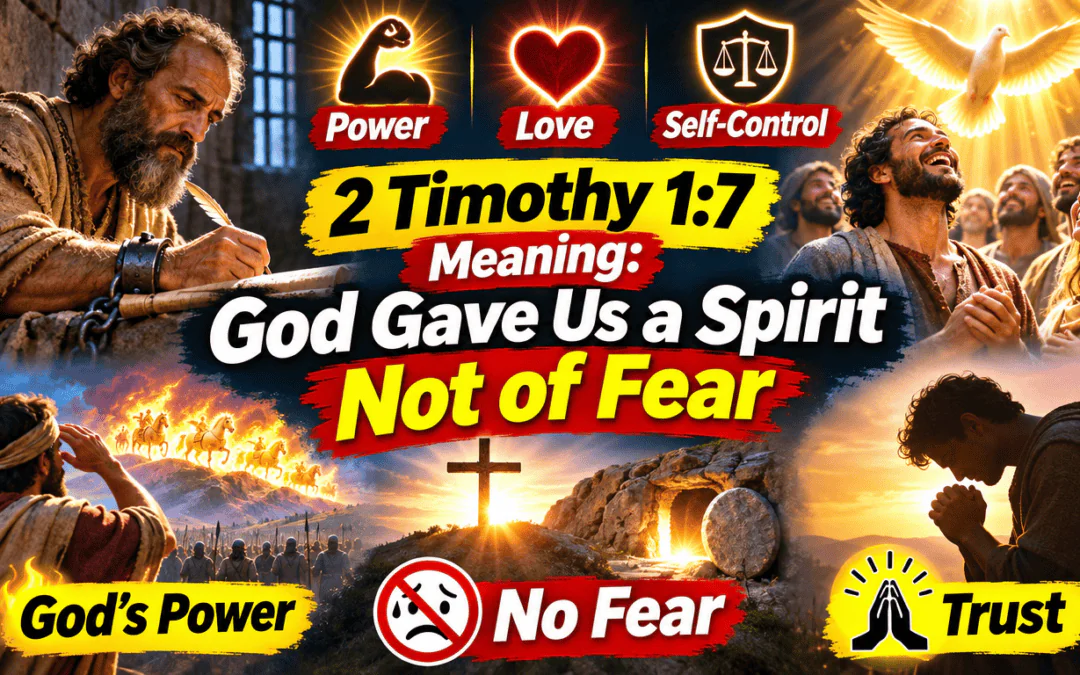
What does 2 Timothy 1:7 mean? 2 Timothy 1:7 means God did not give us a spirit of fear; He gave His people a spirit of power, love and self-control. Paul wrote it from prison to Timothy, a young pastor under pressure, to remind him that the courage he needed had already been given by the Holy Spirit.
Test yourself: two 2 Timothy 1:7 trivia questions are at the end of this article.
▶ Read the Full Day 1 Teaching: Not a Spirit of Fear
2 Timothy 1:7 in Context
Paul wrote 2 Timothy from a Roman prison near the end of his life, to Timothy, a young pastor leading a church under pressure. The letter opens with tears and with a reminder of where Timothy’s faith came from:
As I remember your tears, I long to see you, that I may be filled with joy. I am reminded of your sincere faith, a faith that dwelt first in your grandmother Lois and your mother Eunice and now, I am sure, dwells in you as well.
Timothy had a real faith and still felt real fear. Paul does not shame him for it. He points him back to a gift God had already given:
For this reason I remind you to fan into flame the gift of God, which is in you through the laying on of my hands,
What Does 2 Timothy 1:7 Mean?
for God gave us a spirit not of fear but of power and love and self-control.
The meaning of 2 Timothy 1:7 starts with the word “gave.” Courage is not something a believer has to work up alone; God has already given His people a spirit of power, love and self-control. This is the verse people look for when they search for the place where the Bible says God has not given us a spirit of fear.
Power comes from the Holy Spirit. Jesus promised it just before He ascended:
But you will receive power when the Holy Spirit has come upon you, and you will be my witnesses in Jerusalem and in all Judea and Samaria, and to the end of the earth.
The disciples who scattered the night Jesus was arrested, and who met behind locked doors afterward, stood up and preached in Jerusalem once the Spirit came. The Spirit did not take the danger out of Jerusalem. He took the fear out of the disciples.
Love pushes fear out:
There is no fear in love, but perfect love casts out fear. For fear has to do with punishment, and whoever fears has not been perfected in love.
The love that casts out fear is God’s love for His children, poured into their hearts by the Holy Spirit (Romans 5:5). Romans 8:15 calls fear the spirit of slavery; believers have received the Spirit of adoption and call God Father.
Self-control is a sound, disciplined mind that holds up under pressure. Proverbs 25:28 pictures a person without it as a city whose walls are broken down: every rumor and alarm gets through. Self-control rebuilds the wall.
Where Fear Comes From
Fear grows out of what a person is looking at. When the king of Syria surrounded the city of Dothan to capture Elisha, the prophet’s servant saw only the army:
When the servant of the man of God rose early in the morning and went out, behold, an army with horses and chariots was all around the city. And the servant said, “Alas, my master! What shall we do?” He said, “Do not be afraid, for those who are with us are more than those who are with them.”
Then Elisha prayed and said, “O LORD, please open his eyes that he may see.” So the LORD opened the eyes of the young man, and he saw, and behold, the mountain was full of horses and chariots of fire all around Elisha.
Nothing changed on the ground. What changed was what the servant could see. Fear sees the army; faith sees the chariots of fire.
At the edge of the Promised Land, ten of the twelve spies saw giants and said they felt like grasshoppers next to them (Numbers 13:33). Caleb and Joshua saw the same giants and answered differently:
Only do not rebel against the LORD. And do not fear the people of the land, for they are bread for us. Their protection is removed from them, and the LORD is with us; do not fear them.
God said Caleb had a different spirit and had followed Him fully (Numbers 14:24). Fear had left God out of the count, and faith put Him back in.
How to Overcome Fear: Fan the Flame
Paul’s answer to fear is not hiding until things calm down. He told Timothy to step into the work by the power of God:
Therefore do not be ashamed of the testimony about our Lord, nor of me his prisoner, but share in suffering for the gospel by the power of God,
In the next lines Paul gives the reason: Christ Jesus “abolished death and brought life and immortality to light through the gospel” (2 Timothy 1:10). Jesus abolished death, and that answers the fear beneath every other fear. Paul did not know how his own trial would end, but he knew whom he trusted:
which is why I suffer as I do. But I am not ashamed, for I know whom I have believed, and I am convinced that he is able to guard until that day what has been entrusted to me.
David showed the same choice in the moment fear hits:
When I am afraid, I put my trust in you. In God, whose word I praise, in God I trust; I shall not be afraid. What can flesh do to me?
God answers fear with His own presence:
fear not, for I am with you; be not dismayed, for I am your God; I will strengthen you, I will help you, I will uphold you with my righteous right hand.
Paul closes the thought by naming the helper: Timothy guards the gift by the Holy Spirit who lives in us (2 Timothy 1:14). Believers do not guard the gift alone.
Lessons from 2 Timothy 1:7
- Fear is not from God. God gave His people a spirit of power, love and self-control.
- The gift is already given. The verse says “gave,” not “will give.”
- What we look at decides what we feel. Elisha’s servant needed open eyes, not a smaller army.
- Perfect love casts out fear. Children of God are not slaves to fear.
- The answer to fear is stepping in, not stepping back. Paul told Timothy to share in suffering by the power of God and keep doing the work.
Continue the Series
This study comes from Day 1 of Faith Over Fear: Living by the Spirit, Not the Flesh, a three-day Bible teaching on FaithNFreedom Social. Day 2 turns to Romans 8 and where believers set their minds. For more on choosing faith over fear, see Faith Over Fear: What the Bible Says.
▶ Read the Full Day 1 Teaching: Not a Spirit of Fear
Closing Prayer
Father, thank You that You did not give us a spirit of fear. You gave us a spirit of power and love and self-control, and we receive it today. Open our eyes the way You opened the eyes of Elisha’s servant, so we can see that those who are with us are more than those who are against us. When we are afraid, we put our trust in You. Holy Spirit, stir up the gift You have given us until it burns bright again. Keep our minds steady, our hearts full of Your love and our feet moving in the work You have given us. In Jesus’ name, amen.
Bible Teaching and Discussion
Bible teaching and discussion continue in Faith Blogs & Discussions on FaithNFreedom Social, and you can watch FaithNFreedomTV free, 24/7.
Scripture quotations are from the ESV® Bible (The Holy Bible, English Standard Version®), © 2001 by Crossway, a publishing ministry of Good News Publishers. Used by permission. All rights reserved.
Questions About 2 Timothy 1:7
What does 2 Timothy 1:7 mean?
2 Timothy 1:7 means God gave His people a spirit of power, love and self-control instead of a spirit of fear. Paul wrote it from prison to Timothy, a young pastor under pressure. The verse says the gift was already given, so believers do not have to work up courage on their own. Power comes from the Holy Spirit, love casts out fear, and self-control keeps the mind steady.
Where does the Bible say God has not given us a spirit of fear?
The Bible says God has not given us a spirit of fear in 2 Timothy 1:7. The ESV reads, “for God gave us a spirit not of fear but of power and love and self-control.” Paul wrote it to Timothy near the end of his life, and in the same passage he told Timothy to fan into flame the gift of God and to share in suffering for the gospel by the power of God.
What is the spirit of fear in the Bible?
In the Bible, the spirit of fear is a fearful outlook that God does not give His people. Romans 8:15 calls it the spirit of slavery that makes people fall back into fear, and says believers have received the Spirit of adoption instead. 1 John 4:18 adds that fear has to do with punishment, and that perfect love, God’s love for His children, casts fear out.
What does self-control mean in 2 Timothy 1:7?
Self-control in 2 Timothy 1:7 means a sound, disciplined mind that keeps thinking clearly under pressure. It is the third thing God gives in place of fear, after power and love. Proverbs 25:28 pictures a person without self-control as a city broken into and left without walls; self-control rebuilds the wall so that every rumor and alarm does not run the mind.
Who wrote 2 Timothy 1:7, and why?
The apostle Paul wrote 2 Timothy 1:7 to Timothy, his son in the faith, while Paul was a prisoner near the end of his life. Timothy was leading a church under pressure and was tempted to shrink back. Paul reminded him of his sincere faith, told him to fan into flame the gift of God, and urged him to share in suffering for the gospel by the power of God.
How do you overcome fear as a Christian?
Christians overcome fear by looking to God instead of the circumstances and trusting what He has promised. Elisha’s servant stopped fearing when God opened his eyes to the horses and chariots of fire. David told God that when he was afraid, he would put his trust in Him (Psalm 56:3). Paul told Timothy to fan into flame the gift of God and keep doing the work by the power of God.
2 Timothy 1:7 Trivia
1. Paul names two women who passed a sincere faith down to Timothy. Who were they, and how was each one related to him?
Show the answer
His grandmother Lois and his mother Eunice (2 Timothy 1:5).
2. According to 1 John 4:18, what does fear have to do with?
Show the answer
Punishment. John says fear has to do with punishment, and that perfect love casts out fear (1 John 4:18).