
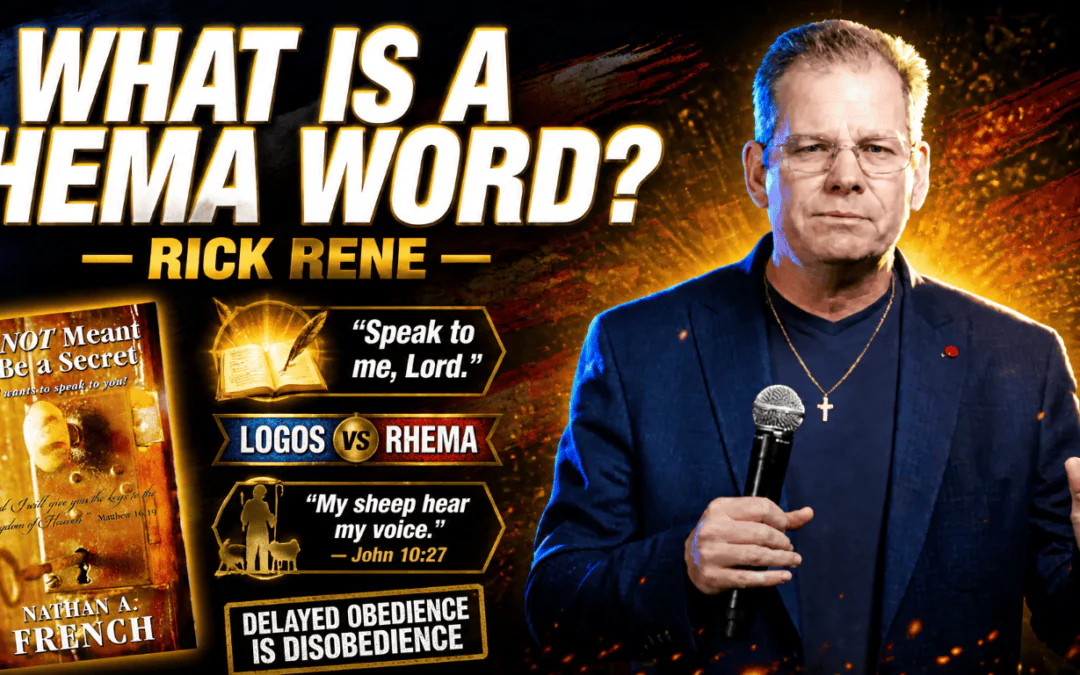
A rhema word is God’s spoken, personal word to an individual believer — distinct from the logos, the written and settled Scripture — and FaithNFreedom founder Rick Rene’s Day 9 teaching in the Hearing from God series walks through exactly what it is, where it appears in the New Testament, and how any believer can begin receiving it. This post covers all three segments of that teaching: the definition and biblical foundation, the practical process for making room to hear, and what to do with a word once it arrives.
The full Hearing from God series — twelve teachings across twelve days — is housed at the series hub on FaithNFreedom.org. This post covers Day 9. For context on the rapture and end-times framework that shapes Rick’s broader teaching, see the Rapture Series.
Segment 1 — What a Rhema Word Is: Definition and Biblical Foundation
Two Greek Words, One Very Practical Difference
The New Testament uses two Greek words that both appear in English as “word.” The first is logos — the written Word, Scripture, settled and finished and true for every reader in every generation. The second is rhema — the spoken word, the utterance, the thing said right now to a particular person in a particular situation.
That distinction carries enormous practical weight the moment a believer faces a decision Scripture does not name by chapter and verse. The Bible declares that God is provider — that is logos, universally true. But it does not specify whether to take the job in Dallas, which child to call before the lights go out, or whether to get up at eleven at night and pray over the house. According to Rick’s teaching, that is precisely what the rhema word is for: God speaking specifically into an actual situation, in real time.
The critical boundary Rick establishes immediately: a rhema word never overrides the written Word. God does not contradict Himself. The logos is the fence; the rhema is His voice inside the fence. Any word that jumps that fence did not originate with Him.
Jesus described the ongoing mechanism the night before the crucifixion:
“When the Spirit of truth comes, he will guide you into all the truth, for he will not speak on his own authority, but whatever he hears he will speak, and he will declare to you the things that are to come.” — John 16:13 ESV
Guiding is not a one-time act. It does not mean handing someone a map and walking away. It means speaking to them along the way. Jesus does not say the Spirit might speak — He says the Spirit will speak, receiving from the Father and delivering to the believer.
The Term Appeared in the Journal Itself
Rick reports that the Lord used the word “rhema” directly in a journal entry dated July 5, 2025, titled Prepare to receive great gifts!. The relevant portion as recorded in Rick’s journal reads: “However, I will also speak directly to most of you through my Rhema words, if you expect to hear from me and learn to listen to my spontaneous flow. Yes, you have to test these words, as I will not give you direction outside my written word, but the evil one will try to do so. So learn to hear my voice. Write down what I am saying to you. Confirm it and move forward.”
Rick highlights three elements embedded in that single passage: the promise extends to most believers, not a gifted few; the condition is expectation, not talent; and the fence — no direction outside the written Word — is stated by God Himself in the same breath as the promise. The instruction that follows is compressed into eleven words: write down what I am saying, confirm it, and move forward.
The same entry opened with a renewed mind and submission before any mention of technique — an ordering Paul states explicitly:
“I appeal to you therefore, brothers, by the mercies of God, to present your bodies as a living sacrifice, holy and acceptable to God, which is your spiritual worship. Do not be conformed to this world, but be transformed by the renewal of your mind, that by testing you may discern what is the will of God, what is good and acceptable and perfect.” — Romans 12:1-2 ESV
The renewed mind in this passage is not about self-improvement — it is the equipment needed to test a spoken word against the written one. A person cannot test a rhema against a logos they do not know.
The Capacity Already Belongs to Every Sheep
The assumption that hearing God directly is reserved for prophets, pastors, or platform holders is flatly contradicted by the grammar of a single verse:
“My sheep hear my voice, and I know them, and they follow me.” — John 10:27 ESV
Present tense. A description of what sheep do, the same way one would say sheep eat grass. The capacity for a believer to receive a rhema word is not a spiritual promotion — it is a baseline description of belonging to the Shepherd. What most believers are missing, according to this teaching, is not the ability but the expectation.
Rick traces his own entry into this practice to Nathan French’s book It’s Not Meant to Be a Secret: God Wants to Speak to You, which he read in morning quiet time before a trip to Israel. On a flight to Tel Aviv he turned to the appendix and found French’s practical steps: get quiet, communicate with the Lord, expect to hear and prepare pen and paper as an act of faith, write down what He says, share as led. The next day alone in a Tel Aviv hotel room, Rick opened his laptop, closed his eyes, placed his hands on the keys, and typed four words — Speak to me, Lord — and reports that God answered, sentence by sentence. That journal has continued ever since.
The act of faith Rick identifies is this: the pen and paper were out before the voice arrived. Preparation preceded reception. That is not technique — it is a small physical declaration that God meant what He said. And He has been holding the conversation open ever since, waiting for the invitation.
Segment 2 — Making Room: The Practice of Quiet Time with God
Inventory the Time-Wasting Activities
In a July 10, 2025 journal entry, Rick records this word: “The enemy has a process to keep you so busy that you won’t have time to listen to me. He makes so much noise that my voice is often drowned out. So, how do you combat the enemy? By choice. Inventory the time-wasting activities that keep you from hearing my voice. The enemy has many methods, and this is why you have to make a choice.”
Inventory is a business word used on purpose — the instruction is not to feel bad about a crowded schedule but to count it. The enemy described in this entry is not pulling the believer toward obvious sin but toward noise: busyness, distraction, time-consuming trouble. Nobody repents of a schedule, which makes this a more effective strategy than temptation toward visible wrongdoing.
Rick ties this to Jesus’ words about the narrow gate:
“Enter by the narrow gate. For the gate is wide and the way is easy that leads to destruction, and those who enter by it are many. For the gate is narrow and the way is hard that leads to life, and those who find it are few.” — Matthew 7:13-14 ESV
Applied to a calendar, the wide gate is easy because it never asks for a no. The narrow gate requires giving something up. But the narrow way leads to life — not deprivation, but arrival somewhere worth arriving.
It Is About Wanting Him, Not Performing for Him
From the same July entry, Rick records this clarifying word: “This is not rocket science, as some would say. It’s also not about spiritual discipline. It’s about loving me and desiring me. It’s about wanting to get close to me and prioritizing your life so you can actually live for me.”
Hearing God is not a skill to be mastered or a bar to clear. The practice that follows — quiet time, armor, journal — is not how a believer earns the conversation. It is what wanting God actually looks like once the wanting is real. The Lord also indicated He is not asking for four hours a day in the manner of Martin Luther — He asked for some dedicated quiet time where a person can record what He is saying.
Counsel in the Quiet Hours
Rick describes being on the Tom Homan Border Tour in Israel — a full, loud, demanding schedule alongside Amanda Grace, her husband Chris, B2T Show scheduling producer Gus, and journalist Sara Carter. The clearest word of the week came alone in a hotel room before anyone else was awake, which Rick connects to a pattern David identified:
“I bless the LORD who gives me counsel; in the night also my heart instructs me.” — Psalm 16:7 ESV
David’s word for what arrives in the quiet is counsel — not a warm feeling but specific guidance from someone who knows more than you do about the decision in front of you. It arrives in the night, when the schedule has stopped making demands. The border tour was the important part of the week by any external measure. The counsel came in the quiet part.
“Be still, and know that I am God. I will be exalted among the nations, I will be exalted in the earth!” — Psalm 46:10 ESV
“Be still” is a command aimed at the busiest part of life. Stillness is not the opposite of action — it is where a believer finds out what the action is supposed to be.
How Rick Opens a Listening Session
Rick’s practice, in his own words from this teaching, runs in this order: prayer and the full armor of God spoken aloud, piece by piece; Bible Memory App to anchor the mind in Scripture; going to his knees; closing his eyes, placing hands on the keyboard, and beginning with specific thanksgiving; then the prayer: Put me in a secret place where I can only hear from you. No spirits, but the Holy Spirit, the Father, and the Son. I submit my eyes and ears to you.
The middle line — naming who is permitted to speak — is the most important sentence in Rick’s practice. Opening the ears deliberately is opening a door, and doors work both ways. Naming the permitted voices is not superstition; James instructs believers to submit to God before resisting the devil, and submitting before listening follows that order. Eyes are submitted as well as ears, because what a person has been looking at all day shapes what they are able to hear.
After confidential direction and specific questions, Rick asks the two questions that produce what appears in the public journal: Lord, what do You want me and Your people to hear today? — or simply, Lord, how are You today? That second question, Rick says, changed the relationship more than any technique, because it moves the whole thing from transaction to friendship.
“Draw near to God, and he will draw near to you. Cleanse your hands, you sinners, and purify your hearts, you double-minded.” — James 4:8 ESV
The direction of movement in that verse is the believer moving first. Not because God is distant, but because He will not force a relationship on someone who has not turned toward Him. Drawing near and submitting are the same motion described two ways.
The armor is not decorative in this sequence. Paul is specific:
“Finally, be strong in the Lord and in the strength of his might. Put on the whole armor of God, that you may be able to stand against the schemes of the devil.” — Ephesians 6:10-11 ESV
A believer deliberately opening their ears is in a room where more than one voice would like to be heard. The armor goes on first. And Paul ends the same passage with an instruction to pray at all times in the Spirit — the armor and the conversation were never two separate disciplines. They belong together in the same moment.
Segment 3 — What to Do With What You Hear: Testing and Acting
Delayed Obedience Is Disobedience
Midway through the Israel trip, Rick reports being woken early, physically exhausted, and hearing a clear word to get up and get his hands on the keyboard. He reasoned with God, laying out why sleep was the responsible choice. The response, he reports, was four words: Delayed obedience is disobedience.
Rick identifies what made that phrase land with authority: God had spoken those exact words to Nathan French on multiple occasions — the same Nathan French whose book had started this entire practice. The phrase arrived carrying a recognizable signature. Rick got up. On June 16 he received the first word not intended for him but for someone else — the day a private devotional practice became, in his words, a ministry. He describes what would have been lost: not a feeling but a message God intended to deliver to another person, through him, that morning, nearly traded for two hours of sleep and a good reason.
“And your ears shall hear a word behind you, saying, ‘This is the way, walk in it,’ when you turn to the right or when you turn to the left.” — Isaiah 30:21 ESV
The timing in that verse is precise: the word comes at the moment of turning, not while the believer is still comfortable. Guidance that specific is worthless filed for later. The heading over that passage — the Lord will be gracious — means the correction is not severity. It is God being kind enough to speak before a wrong road goes further.
Hear, Write, Test, Get Used to It
From an August 9, 2025 journal entry, Rick records this sequence: “My sheep hear my voice, so I invite you to hear from me clearly and with no confusion. Therefore, write down what I am saying. Record it, test it, and get used to being able to hear from me hour by hour during your day.”
Four verbs in order. Hear. Write. Test. Get used to it. The last one is the one most people skip — He is not describing a special occasion but a habit that becomes normal, a running conversation hour by hour. Writing is not optional in that sequence and is not a modern trend:
“And the LORD answered me: ‘Write the vision; make it plain on tablets, so he may run who reads it. For still the vision awaits its appointed time; it hastens to the end—it will not lie. If it seems slow, wait for it; it will surely come; it will not delay.'” — Habakkuk 2:2-3 ESV
The writing is not for archiving — it is so someone can move on it. And the second half of that passage addresses why people give up: if it seems slow, wait for it. A word that has not yet come to pass is not a word that failed. Rick cites Timothy Dixon filing handwritten dreams in cabinets for years before speaking any of them publicly, and Donné Clement Petruska’s father writing a letter in 2015 that went unread until nine years later. Slow is not the same as wrong.
Testing Is Not Optional — Neither Is Continuing
Everything in this teaching is worthless — Rick uses the word dangerous — without testing:
“Beloved, do not believe every spirit, but test the spirits to see whether they are from God, for many false prophets have gone out into the world.” — 1 John 4:1 ESV
John wrote that to ordinary believers, not specialists. Testing is normal Christian equipment. But Paul names both ditches:
“Do not quench the Spirit. Do not despise prophecies, but test everything; hold fast what is good.” — 1 Thessalonians 5:19-21 ESV
Believing everything will wreck a believer. Shutting the whole thing down out of fear of getting it wrong will also wreck them. The instruction is not to stop listening but to test everything and keep what is good.
Rick’s three-filter test, as presented in this teaching: Does it line up with Scripture? God never contradicts His written Word — if the word violates it, that settles the matter. What is the fruit? God produces peace or a clean, specific urgency, never panic, confusion, or self-promotion. Is it confirmed? Through Scripture, through mature believers, through circumstances that line up. Pass all three: move. Fail any: wait.
“Trust in the LORD with all your heart, and do not lean on your own understanding. In all your ways acknowledge him, and he will make straight your paths.” — Proverbs 3:5-6 ESV
The promise in that verse is that He makes the path straight. The believer’s role is to acknowledge Him in all their ways — to keep talking to Him about everything — and the straightening is His work, not theirs. That is the whole posture this teaching aims at: a believer somewhere quiet enough to hear, expecting an answer, writing it down, testing it, and obeying without delay. He has been arranging that moment far longer than any of us have been looking for it.
Questions About the Rhema Word
What is a rhema word and what does it mean in the Bible?
A rhema word is the spoken, personal word of God to an individual believer — the Greek term rhema appears throughout the New Testament and refers to a specific utterance in the present moment, as distinct from logos, the settled written Scripture. When God speaks a rhema word, He is applying His truth to a specific person’s specific situation right now. The term appears in Jesus’ teaching on the Spirit’s ongoing guidance in John 16:13 and in Paul’s instructions about the armor of God in Ephesians 6:17, where the sword of the Spirit is identified as the rhema of God.
What is the difference between logos and rhema?
Logos refers to the complete, written, unchanging Word of God — Scripture as a whole, settled and true for every believer in every generation. Rhema refers to a specific spoken word from God to a particular person in a particular moment. The two are not in competition: the logos is the fence and the standard, and the rhema is God’s voice operating inside that fence. A rhema word never contradicts, adds to, or overrides Scripture. If something a person hears violates the written Word, by definition it is not a rhema from God. The logos is how you test the rhema.
Does God still give rhema words today?
According to this teaching, yes — and God’s own stated scope in Rick Rene’s July 5, 2025 journal entry is “most of you,” not a select prophetic tier. Jesus described the Holy Spirit as one who will guide believers continuously, not one who gave a final word at the close of the apostolic era. The practice of recording what God speaks, testing it against Scripture, and acting on it is described in this series as a normal dimension of the believer’s life, available to any believer who belongs to the Shepherd — not a special gift allocated to a few.
How do you receive a rhema word from God?
The practical process Rick Rene describes involves five elements: getting genuinely quiet and removing noise and distraction by choice; anchoring the mind in Scripture first; praying the armor of God aloud and naming who is permitted to speak; preparing to write before anything is heard, as a physical act of expectant faith; and then asking God a real, specific question — or simply asking how He is — and writing down what comes without editing it. Writing is not optional: God told Habakkuk to write the vision so that someone could run with it. The pen and paper come out before the voice arrives.
What is the still small voice of God, and how does it relate to the rhema word?
The still small voice — referenced in 1 Kings 19 in the account of Elijah at Horeb — is one of the ways Scripture describes God communicating outside of dramatic signs. In the context of this teaching, it is the quiet, personal, internal voice that the rhema word arrives through. It is not a booming audible announcement but a specific, clear utterance that comes in the quiet, when distractions are removed and the believer’s ears and heart are pointed deliberately toward God. The pattern David names in Psalm 16:7 — counsel arriving in the night — is the same dynamic: the loud and busy hours produce activity, and the quiet hours produce direction.
How do you test a rhema word before acting on it?
Rick Rene presents three filters applied every time. First, does the word align with Scripture? God never contradicts His written Word, and a word that violates it is disqualified immediately — no further testing needed. Second, what is the fruit of it? A word from God produces peace or a clean, specific urgency, never panic, confusion, or self-promotion. Third, is it confirmed? Confirmation can come through Scripture, through mature believers, or through circumstances that line up with what was heard. A word that passes all three filters is something to act on quickly. A word that fails any of them should be waited on or rebuked.
Why is it important to write down what God speaks?
Writing a rhema word down serves several purposes at once: it is an act of faith that God meant what He said about speaking to His people; it creates a record that can be tested and confirmed over time; and it makes the word available to others whom God may intend it for. In Habakkuk 2:2-3, God explicitly tells Habakkuk to write the vision plainly so that the reader can run with it. Rick Rene’s entire public journal — Rick’s Alone Time with God — exists because he began writing down what he heard. The first word intended for someone other than himself came on June 16, 2023, on the morning he almost stayed in bed instead of getting up to write.
What is the Hearing from God series on FaithNFreedom?
The Hearing from God series is a twelve-part teaching series on FaithNFreedom featuring a different teacher each day — Amanda Grace, Nathan French, Stacy Whited, Meri Crouley, Donné Clement Petruska, Timothy Dixon, Emanuel Johnson, Greg Locke and Scott Bitcon, Rick Rene, Julie Green, Jason and Elisabeth Miller, and Marty Grisham. Each teacher brings a different angle on how believers hear God, test what they hear, and act on it. Day 9, covered in this post, is Rick Rene’s own teaching on the rhema word — what it is, how to make room for it, and what to do when it comes. The full series hub is at FaithNFreedom.org.