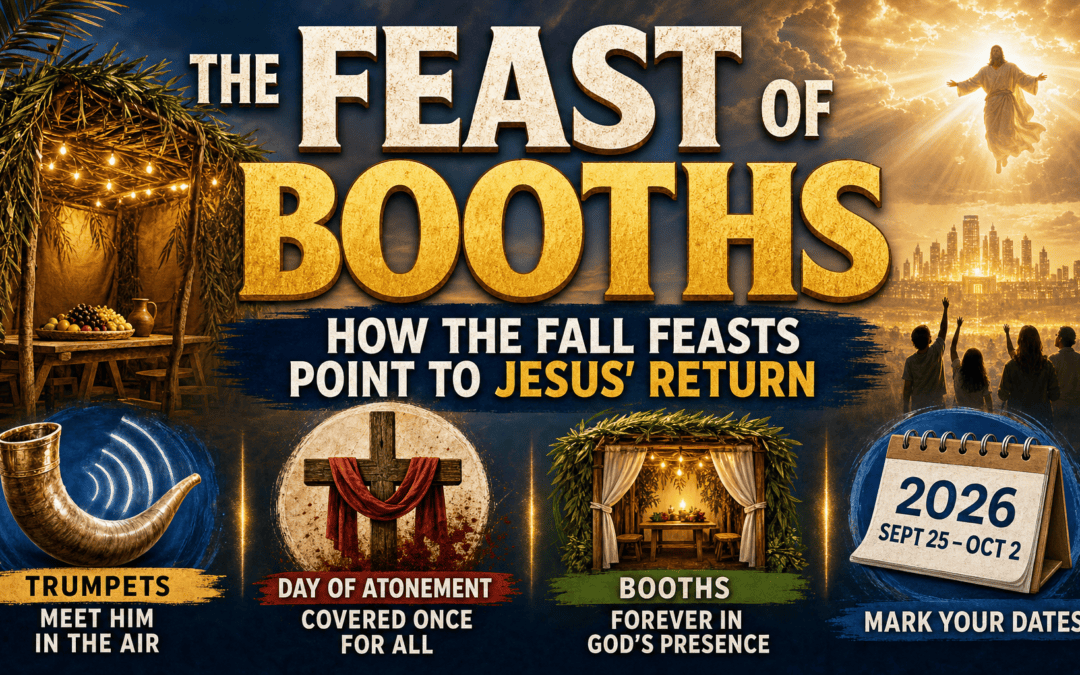
The fall feasts — the Feast of Trumpets, the Day of Atonement, and the Feast of Booths (Sukkot, also called the Feast of Tabernacles) — are God’s own prophetic calendar pointing to the return of Jesus Christ. Where the four spring feasts were fulfilled at His first coming, these three remain ahead of us, and every detail has been placed with precision.
How Do the Fall Feasts Point to the Return of Jesus?
God does not call these Israel’s holidays. In Leviticus 23:2 He calls them His own: “These are the appointed feasts of the Lord that you shall proclaim as holy convocations; they are my appointed feasts.” Every one of them points to Christ — past, present, or future.
The four spring feasts were fulfilled at Jesus’ first coming. He was the Passover Lamb sacrificed for sin. He is the Bread of Life for the Feast of Unleavened Bread. He rose as the Firstfruits of resurrection. And fifty days later, at Pentecost, the Holy Spirit fell on the church. Then came a long summer — centuries of harvesting souls for the kingdom of God, a picture of the church age. Now the three fall feasts map what comes next.
Each feast represents a distinct phase of Christ’s return. They are not repeating cycles. They are a sequence, and they are coming.
What Does the Feast of Trumpets Point to in Bible Prophecy?
The fall feasts open on the first day of the seventh month with a blast of trumpets — a holy convocation described in Leviticus 23:24 as “a memorial proclaimed with blast of trumpets.” In 2026 the Feast of Trumpets began at sunset on September 11.
This feast points to the trumpet of God — the moment the church is caught up to meet Jesus in the air. Paul writes in 1 Thessalonians 4:16:
“For the Lord himself will descend from heaven with a cry of command, with the voice of an archangel, and with the sound of the trumpet of God. And the dead in Christ will rise first.”
The next verse finishes the picture: believers who are still alive are caught up with them in the clouds to meet the Lord, and from then on they are with Him forever (1 Thessalonians 4:17). Notice where this happens: in the air. This is the Rapture — a rescue — and the promise at the end is the whole point: we will always be with the Lord.
This is distinct from the Second Coming, when He returns visibly on the clouds for the entire world to see. Matthew 24:30 describes it: “Then will appear in heaven the sign of the Son of Man, and then all the tribes of the earth will mourn, and they will see the Son of Man coming on the clouds of heaven with power and great glory.” Nothing about that day is hidden. At the Rapture, Christ comes for His saints in the air. At the Second Coming, He comes with His saints to the earth. These are two distinct phases of His return — a distinction the Rapture Series walks through in full.
What Do the Ten Days of Awe Point to for Christians?
After the Feast of Trumpets come the ten Days of Awe — ten days set apart to repent and prepare the heart before the holiest day of the year. In 2026 they ran from September 11 to September 20. Some understand this period as pointing to the refining of Israel before the nation is fully saved. Others see it pointing to the millennial reign of Christ. Either way, these days frame the gravity of what follows.
The Day of Atonement — Yom Kippur — arrives at the close of those ten days. In 2026 it ran from sunset on September 20 to nightfall on September 21. Leviticus 23:27 calls it “a time of holy convocation,” a day to afflict yourselves before the Lord. Once a year, only the high priest could enter the Holy of Holies — and never without blood.
The Day of Atonement points to final judgment, and to the one covering that carries anyone through it. The letter to the Hebrews explains what changed. Christ came as high priest through a greater tent, not made with hands (Hebrews 9:11), and:
“he entered once for all into the holy places, not by means of the blood of goats and calves but by means of his own blood, thus securing an eternal redemption.”
Once for all. No more repeated sacrifices, because our High Priest offered His own blood. And the same chapter looks forward: “so Christ, having been offered once to bear the sins of many, will appear a second time, not to deal with sin but to save those who are eagerly waiting for him” (Hebrews 9:28). The covering of Christ’s blood is what anyone needs when the books are opened.
What Does the Feast of Booths Teach Christians About Their Heavenly Dwelling?
Five days after the Day of Atonement, fasting gives way to feasting. The Feast of Booths — Sukkot, also called the Feast of Tabernacles — runs seven days, followed by an eighth day of solemn assembly. In 2026 it began at sunset on September 25 and ran through October 2, with the eighth day closing at nightfall on October 3.
Leviticus 23:34 announces it directly from God: “On the fifteenth day of this seventh month and for seven days is the Feast of Booths to the Lord.” And a few verses later, the permanence of it: “You shall celebrate it as a feast to the Lord for seven days in the year. It is a statute forever throughout your generations; you shall celebrate it in the seventh month” (Leviticus 23:41). The reason God gives two verses later is worth sitting with (Leviticus 23:43): so every generation would know He made His people dwell in booths when He brought them out of Egypt. A trip that should have taken weeks stretched to forty years because of sin and unbelief — yet His presence never left them, a pillar of cloud by day and fire by night. The booth remembers the journey and the God who carried them through it.
Keeping this feast is not how anyone earns heaven. Matthew 5:17 records Jesus saying He came not to abolish the Law but to fulfill it, and Romans 10:4 tells us that Christ is the end of the law for righteousness to everyone who believes. We keep the feast to celebrate Him.
The booth points to the temporary nature of earthly life. 2 Corinthians 5:1 puts it plainly: “For we know that if the tent that is our earthly home is destroyed, we have a building from God, a house not made with hands, eternal in the heavens.” Abraham himself lived in tents because he was looking for something more permanent — “the city that has foundations, whose designer and builder is God” (Hebrews 11:10). The pilgrim posture of the booth is the posture every believer takes toward this earth.
Jesus told His disciples there are many rooms in His Father’s house, and that He was going to prepare a place for them (John 14:2). Then He promised: “And if I go and prepare a place for you, I will come again and will take you to myself, that where I am you may be also” (John 14:3). He is preparing the place, and He is coming again.
When Jesus kept the Feast of Booths (John 7:2), He walked into Jerusalem while families all around the city lived outside in booths for the week. On the last and greatest day of the feast — after the people had prayed for rain and read from Isaiah 12:3, “With joy you will draw water from the wells of salvation” — Jesus stood and cried out, inviting anyone who thirsts to come to Him and drink (John 7:37). Then He said:
“Whoever believes in me, as the Scripture has said, ‘Out of his heart will flow rivers of living water.'”
They prayed for rain. He offered rivers of living water — and John explains that He said this about the Spirit (John 7:39). Everyone who believes already has those rivers flowing.
Why Will All Nations Keep the Feast of Booths When Jesus Reigns?
The prophet Zechariah saw the feast kept in the age to come. Zechariah 14:16 records the vision: “Then everyone who survives of all the nations that have come against Jerusalem shall go up year after year to worship the King, the Lord of hosts, and to keep the Feast of Booths.”
Nations that once came against Jerusalem — the city God chose — will go up to worship the King. That kind of transformation requires something far larger than political change. It requires the King Himself. This verse places the future observance of the Feast of Booths in the age of Christ’s reign, after the Second Coming, when all the earth is under His authority.
The feast that began as a memory of the wilderness becomes a global celebration of the King who never left His people — and who rules over every nation forever.
And the ultimate fulfillment of everything the booth has ever pictured is spelled out in Revelation 21. John sees the holy city, new Jerusalem, coming down out of heaven from God (Revelation 21:2), and then:
“And I heard a loud voice from the throne saying, ‘Behold, the dwelling place of God is with man. He will dwell with them, and they will be his people, and God himself will be with them as their God.'”
— Revelation 21:3
The ESV footnote on “dwelling place” reads: “Or tabernacle.” God’s own tabernacle with His people — and no one ever has to take it down. No more tears. No more death. No more pain (Revelation 21:4). And further along the same chapter: “And I saw no temple in the city, for its temple is the Lord God the Almighty and the Lamb” (Revelation 21:22). God’s people will live in the very presence of God, every day, forever. That is what the Feast of Booths has been pointing to all along.
How Can Christians Keep the Feast of Booths Today?
Most people who observe the Feast of Booths today build a simple booth near their home rather than traveling to Jerusalem. A booth is built with a roof of branches open enough to see the stars through — not closed in. Every time you look up through the branches, the structure itself is preaching: this earthly tent is not your home, and the King is coming for you.
Decorate a back patio or front porch. Put up outdoor lights, candles, plants, and seasonal produce. Eat meals outside with family for the seven days, share a meal with someone who needs one, and spend more time outdoors than in. Light candles at night. Throw a ball in the yard. Let the season be one of visible, tangible joy.
The booth comes down when the feast is over. So do all the temporary shelters of this life. But the Feast of Booths — the last of the fall feasts, the most joyful of all seven — is a seven-day reminder of where everything is headed: the dwelling place of God with man, where every tear is wiped away and the Lamb is the light. The same God who kept every spring feast at Jesus’ first coming will keep every fall feast at His return. He keeps His appointed times, and He will keep these.
Questions About the Fall Feasts and Bible Prophecy
Are the fall feasts in the Bible meant for Christians to observe?
God calls the appointed feasts — including the fall feasts — “my appointed feasts” in Leviticus 23:2, not merely Israel’s holidays. Christians observe them not as a requirement for salvation, which is entirely through faith in Christ alone (Romans 10:4), but as a celebration of what Jesus has done and what He is coming to do. Each feast points to Him, and recognizing that connection deepens both Scripture study and prophetic expectation.
What trumpet sound does the Feast of Trumpets connect to in the New Testament?
The Feast of Trumpets is linked to the trumpet of God described in 1 Thessalonians 4:16–17, when the Lord descends with a cry of command and both the dead in Christ and living believers are caught up to meet Him in the air. This is understood as the Rapture — Christ coming for His saints — which is a distinct event from the visible Second Coming described in Matthew 24:30, when every tribe on earth will see Him coming with power and great glory.
What is the Hebrew word Sukkot and what does it mean in the Bible?
Sukkot is the Hebrew plural of sukkah, meaning booths or temporary shelters. The Feast of Sukkot — also called the Feast of Booths or the Feast of Tabernacles — takes its name from the temporary structures God commanded Israel to dwell in for seven days. In 2026, Sukkot began at sunset on September 25 and runs through October 2. The booths were a memorial of the forty years God’s people spent in the wilderness, with His presence going before them as a pillar of cloud and fire.
Why is the Feast of Booths called the Season of Our Joy?
Of all seven biblical feasts, the Feast of Booths is the most joyful. It falls during the autumn harvest of figs, pomegranates, dates, and grapes, and it celebrates God’s sustained provision and presence across the wilderness journey. The fasting of the Day of Atonement has passed; the trumpets have sounded; and now the people feast for seven full days. Nehemiah 8:17 records that when the returning exiles kept this feast for the first time since Joshua’s days, “there was very great rejoicing.”
What did Jesus do at the Feast of Booths in John 7?
Jesus kept the Feast of Booths and came to Jerusalem for it, as recorded in John 7. On the last and greatest day of the feast — when the people traditionally prayed for rain and read from Isaiah 12:3, “With joy you will draw water from the wells of salvation” — Jesus stood up and declared that anyone who thirsts should come to Him and drink, and that rivers of living water would flow from those who believe. John explains that He said this about the Holy Spirit. His declaration on that specific day was a direct fulfillment of what the feast anticipated.
What does Zechariah 14 say will happen at the Feast of Booths in the future?
Zechariah 14:16 describes a time after the final battle for Jerusalem when survivors from all the nations that had attacked the city will go up year after year to worship the King, the Lord of hosts, and to keep the Feast of Booths. This places a future, global observance of the feast in the age of Christ’s reign on earth — the Millennial Kingdom that follows the Second Coming. Nations once hostile to God’s purposes will come to worship the King who defeated them and rules in peace.
How is the Feast of Booths ultimately fulfilled in the book of Revelation?
Revelation 21:2 describes the new Jerusalem coming down from God, and in Revelation 21:3 a loud voice from the throne declares, “Behold, the dwelling place of God is with man.” The ESV footnote on “dwelling place” reads “Or tabernacle” — the same concept behind the Feast of Booths. In the New Jerusalem, God will dwell with His people permanently, wipe away every tear, and abolish death, mourning, and pain. Revelation 21:22 adds that there will be no temple in that city, because God and the Lamb are its temple, and every believer will dwell in the Holy of Holies forever.