
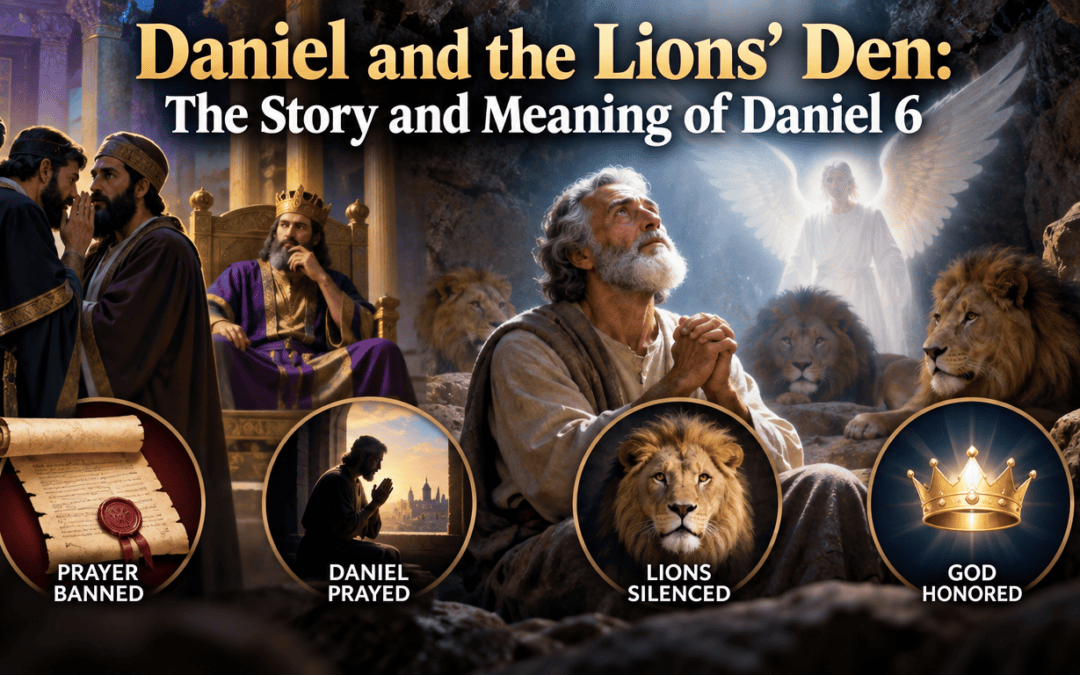
What is the story of Daniel and the lions’ den? In Daniel 6, jealous officials tricked King Darius into signing a law that no one could pray to any god or man but the king for thirty days. Daniel kept praying three times a day at his open window toward Jerusalem, as he had done before. He was thrown into the lions’ den, and God sent His angel and shut the lions’ mouths, so Daniel came out unharmed.
▶ Read the Full Day 4 Teaching: Praying When Prayer Is Outlawed
Who Was Daniel When Daniel 6 Begins?
Daniel 6 opens in a new empire. Babylon has fallen, as Daniel 5 records, and Darius the Mede has received the kingdom. Daniel is no longer the young captive of Daniel 1. He was taken from Jerusalem as a youth around 605 BC, and Babylon fell in 539 BC, so by the time of the lions’ den he was an old man, most likely in his eighties. He had served Babylon’s kings for about sixty-six years, and now a Persian-era king wanted him too.
Darius organized the kingdom under 120 satraps, with three high officials over them, and Daniel was one of the three (Daniel 6:1–2). He did not stay one of three for long:
Then this Daniel became distinguished above all the other high officials and satraps, because an excellent spirit was in him. And the king planned to set him over the whole kingdom.
Daniel rose by doing excellent work while he stayed faithful to God. That made the other officials jealous, and they went looking for something to use against him. They searched his record as a public servant and came back empty-handed:
Then the high officials and the satraps sought to find a ground for complaint against Daniel with regard to the kingdom, but they could find no ground for complaint or any fault, because he was faithful, and no error or fault was found in him. Then these men said, “We shall not find any ground for complaint against this Daniel unless we find it in connection with the law of his God.”
No bribe, no lie, no missing money. The text is speaking of Daniel’s service to the kingdom: his enemies could find nothing wrong in how he did his job. The only thing they could use against Daniel was his faithfulness to God.
The Law Against Prayer in Daniel 6
Since Daniel would not do wrong, his rivals decided to make doing right illegal. They came to the king together, by agreement (Daniel 6:6), and flattered him with a proposal:
All the high officials of the kingdom, the prefects and the satraps, the counselors and the governors are agreed that the king should establish an ordinance and enforce an injunction, that whoever makes petition to any god or man for thirty days, except to you, O king, shall be cast into the den of lions. Now, O king, establish the injunction and sign the document, so that it cannot be changed, according to the law of the Medes and the Persians, which cannot be revoked.” Therefore King Darius signed the document and injunction.
Two details stand out. First, the officials told the king that all the high officials were agreed. Daniel was one of the three high officials, and he had agreed to nothing. Second, the law of the Medes and the Persians could not be revoked. Once Darius signed it, not even the king could undo it. The law was written for thirty days and aimed at one man.
The apostle Peter later told believers to live the way Daniel lived, so that accusations against them would not stick:
Keep your conduct among the Gentiles honorable, so that when they speak against you as evildoers, they may see your good deeds and glorify God on the day of visitation.
Daniel’s enemies proved Peter’s point centuries before he wrote it. Honorable conduct did not stop the attack, but it left the attackers with only one charge: that Daniel prayed.
Daniel Prayed Three Times a Day
The verse at the center of Daniel 6 tells what Daniel did when he learned the law had been signed:
When Daniel knew that the document had been signed, he went to his house where he had windows in his upper chamber open toward Jerusalem. He got down on his knees three times a day and prayed and gave thanks before his God, as he had done previously.
Daniel did not close his windows, and he did not stage a protest. He went to the same room, at the same times, and did what he had always done. The key words are the last ones: “as he had done previously.” Daniel did not begin praying because of the law. He kept praying in spite of it, and he gave thanks while he prayed, on the day a death sentence was signed with his name on it.
Praying three times a day was not Daniel’s invention. David described the same rhythm:
But I call to God,
and the LORD will save me.
Evening and morning and at noon
I utter my complaint and moan,
and he hears my voice.
Why did Daniel pray toward Jerusalem? The answer goes back to Solomon’s prayer at the dedication of the temple. Solomon asked God what would happen if His people sinned and were carried away captive, and he asked God to hear them when they turned back to Him from a foreign land:
if they repent with all their heart and with all their soul in the land of their enemies, who carried them captive, and pray to you toward their land, which you gave to their fathers, the city that you have chosen, and the house that I have built for your name, then hear in heaven your dwelling place their prayer and their plea, and maintain their cause
Daniel was doing exactly what Solomon described. He was a captive in the land of his enemies, the temple lay in ruins, and he turned toward the city God had chosen. Daniel’s open window was an act of faith that God had not forgotten His promise to His people. Daniel 9 shows the same faith, when Daniel reads Jeremiah’s prophecy of seventy years and turns to God in prayer for his nation.
Why Was Daniel Thrown Into the Lions’ Den?
The officials did not have to wait long. They came by agreement and found Daniel making petition and plea before his God (Daniel 6:11), and they went straight to the king:
Then they answered and said before the king, “Daniel, who is one of the exiles from Judah, pays no attention to you, O king, or the injunction you have signed, but makes his petition three times a day.”
They did not call him the king’s most trusted official. They called him “one of the exiles from Judah,” an outsider. Darius saw the trap at once. He was deeply distressed, set his mind on rescuing Daniel, and worked until sundown to find a way out (Daniel 6:14). There was none. The officials reminded him that no law of the Medes and Persians could be changed (Daniel 6:15), and the king gave the order:
Then the king commanded, and Daniel was brought and cast into the den of lions. The king declared to Daniel, “May your God, whom you serve continually, deliver you!” And a stone was brought and laid on the mouth of the den, and the king sealed it with his own signet and with the signet of his lords, that nothing might be changed concerning Daniel.
Daniel was thrown into the lions’ den for praying to God. Even the king who signed the law knew Daniel as a man who served his God “continually.” The den was sealed with a stone and with the king’s own signet. As far as the empire was concerned, the matter was closed.
God Shut the Lions’ Mouths
Darius spent the night fasting. No entertainment was brought to him, and he could not sleep (Daniel 6:18). At break of day he hurried to the den and cried out in anguish, calling Daniel “servant of the living God” and asking whether his God had been able to deliver him from the lions (Daniel 6:19–20).
Darius asked the question Nebuchadnezzar asked in Daniel 3, when he wanted to know which god could deliver from his hand. Daniel answered from inside the den:
Then Daniel said to the king, “O king, live forever! My God sent his angel and shut the lions’ mouths, and they have not harmed me, because I was found blameless before him; and also before you, O king, I have done no harm.”
God did not keep Daniel out of the lions’ den. He met him inside it, as He met Shadrach, Meshach and Abednego inside the fire. Daniel was taken up out of the den with no harm on him, “because he had trusted in his God” (Daniel 6:23). The lions were real: the men who had accused Daniel were thrown into the same den, and the lions overpowered them before they reached the bottom (Daniel 6:24).
Then Darius, who had signed a law forbidding prayer to any god but himself, wrote to all the peoples of his kingdom:
I make a decree, that in all my royal dominion people are to tremble and fear before the God of Daniel,
for he is the living God,
enduring forever;
his kingdom shall never be destroyed,
and his dominion shall be to the end.
He delivers and rescues;
he works signs and wonders
in heaven and on earth,
he who has saved Daniel
from the power of the lions.”
A law written to silence Daniel’s prayers ended with a king telling the world about Daniel’s God. It is the same truth Daniel 2 shows in the statue and the stone: every kingdom of man comes to an end, and God’s kingdom never does. Daniel 6 closes by noting that Daniel prospered during the reign of Darius and the reign of Cyrus the Persian (Daniel 6:28).
Was Daniel Sinless? What “Found Blameless” Means
Daniel’s words, “I was found blameless before him,” answer the charge he was condemned for. The law said he deserved the lions for praying; God’s verdict was that Daniel had done no wrong in the matter, and he adds that he had done no harm to the king either. The verse does not say Daniel never sinned. In Daniel 9 the same man confesses, “we have sinned and done wrong” (Daniel 9:5), counting himself among his people, and the New Testament says that if we say we have no sin, we deceive ourselves (1 John 1:8). Daniel was innocent of the charge, and he trusted God; the Bible does not present him as a man without sin.
What Daniel and the Lions’ Den Teaches Christians Today
The story of Daniel in the lions’ den is often told to children, and it is a true story. It is also a lesson for believers under pressure to keep their faith private:
- Settle the habit before the test. Daniel’s prayers were not a reaction to the law; they were a practice the law could not break.
- Do excellent, honest work. Daniel’s enemies could find no fault in his service, so faith was the only charge left.
- Keep praying, and give thanks. Daniel gave thanks on the day the law was signed.
- Pray for those in authority. Daniel served Darius well, and Darius wanted him saved (see 1 Timothy 2:1–2).
- Trust God in the den. God may not keep a believer out of trouble, but He does not leave His people alone in it.
Paul tells believers what prayer does for a heart under pressure:
do not be anxious about anything, but in everything by prayer and supplication with thanksgiving let your requests be made known to God. And the peace of God, which surpasses all understanding, will guard your hearts and your minds in Christ Jesus.
Peter warns that there is still a lion on the prowl, and tells believers how to stand against him:
Be sober-minded; be watchful. Your adversary the devil prowls around like a roaring lion, seeking someone to devour. Resist him, firm in your faith, knowing that the same kinds of suffering are being experienced by your brotherhood throughout the world.
And Paul, standing trial near the end of his life with no one beside him, wrote that the Lord stood by him and strengthened him: “So I was rescued from the lion’s mouth” (2 Timothy 4:17). The God who shut the lions’ mouths for Daniel is the same God who stood by Paul and stands by His people today. For more on a life of steady prayer, see Ephesians 6:18: Praying at All Times in the Spirit.
Continue the Series
This study comes from Day 4 of Faithful in Babylon: Lessons from Daniel, a seven-day Bible teaching on FaithNFreedom Social. Read the full teaching and join the discussion, then continue the series through Daniel 9, 4–5 and 7. See the whole Faithful in Babylon series, or start with Day 1 on Daniel 1:8.
▶ Read the Full Day 4 Teaching: Praying When Prayer Is Outlawed
Closing Prayer
Father, You are the living God, enduring forever, and Your kingdom shall never be destroyed. Thank You for hearing Daniel in his upper room and for shutting the lions’ mouths. Give us Daniel’s steady habit of prayer, so that when the world tells us to close our windows, we keep praying and giving thanks as we have done before. Help us do our work so honestly that the only thing anyone can find against us is our faith in You. We pray for those in authority over us, and we ask You to deliver us from every den we face. Guard our hearts with Your peace, and let our lives bring honor to You. In Jesus’ name, amen.
Bible Teaching and Discussion
Bible teaching and discussion continue in Faith Blogs & Discussions on FaithNFreedom Social, and you can watch FaithNFreedomTV free, 24/7.
Scripture quotations are from the ESV® Bible (The Holy Bible, English Standard Version®), © 2001 by Crossway, a publishing ministry of Good News Publishers. Used by permission. All rights reserved.
Questions About Daniel and the Lions’ Den
What is the story of Daniel and the lions’ den?
The story of Daniel and the lions’ den is told in Daniel 6. Jealous officials persuaded King Darius to sign a law forbidding prayer to anyone but the king for thirty days. Daniel kept praying three times a day, as he had done before, and was thrown to the lions. God sent His angel and shut the lions’ mouths, and Darius then honored Daniel’s God before the whole kingdom.
Why was Daniel thrown into the lions’ den?
Daniel was thrown into the lions’ den because he kept praying to God after King Darius signed a law forbidding it. Officials jealous of Daniel could find no fault in his work, so they targeted his faith (Daniel 6:4–5). They persuaded the king to sign a thirty-day ban on prayer to anyone but the king, and the law of the Medes and Persians could not be revoked.
Why did Daniel pray three times a day toward Jerusalem?
Daniel prayed three times a day because it was his long habit; Daniel 6:10 says he prayed “as he had done previously.” David described praying evening, morning and noon (Psalm 55:17). Daniel faced Jerusalem because Solomon had asked God to hear His captive people when they prayed toward their land and the city He had chosen (1 Kings 8:48–49).
How old was Daniel in the lions’ den?
Daniel was most likely in his eighties when he was thrown into the lions’ den. He was taken to Babylon as a youth around 605 BC (Daniel 1), and the events of Daniel 6 take place after Babylon fell to the Medes and Persians in 539 BC. By then Daniel had served in the royal court for more than sixty years, under Babylonian and Persian-era kings.
Who was Darius the Mede?
Darius the Mede is the king who received the Babylonian kingdom after Babylon fell, at about sixty-two years old (Daniel 5:31). He organized the kingdom under 120 satraps and three high officials, with Daniel among them (Daniel 6:1–2). Historians and Bible scholars have proposed several identifications for him, including a governor under Cyrus or another name for Cyrus himself; Daniel gives no further detail.
Was Daniel sinless?
No, the Bible does not say Daniel was sinless. In Daniel 6:22 he says he was “found blameless” before God, meaning innocent of the charge that sent him to the lions. In Daniel 9:5 the same Daniel confesses, “we have sinned and done wrong,” counting himself among his people, and 1 John 1:8 teaches that no one can claim to be without sin.
What does Daniel and the lions’ den teach Christians today?
Daniel and the lions’ den teaches Christians to settle the habit of prayer before pressure comes and to keep it when prayer is opposed. Daniel did honest work, prayed and gave thanks as before, and trusted God with the outcome. God did not keep him out of the den, but He shut the lions’ mouths. Philippians 4:6–7 promises God’s peace to those who pray.