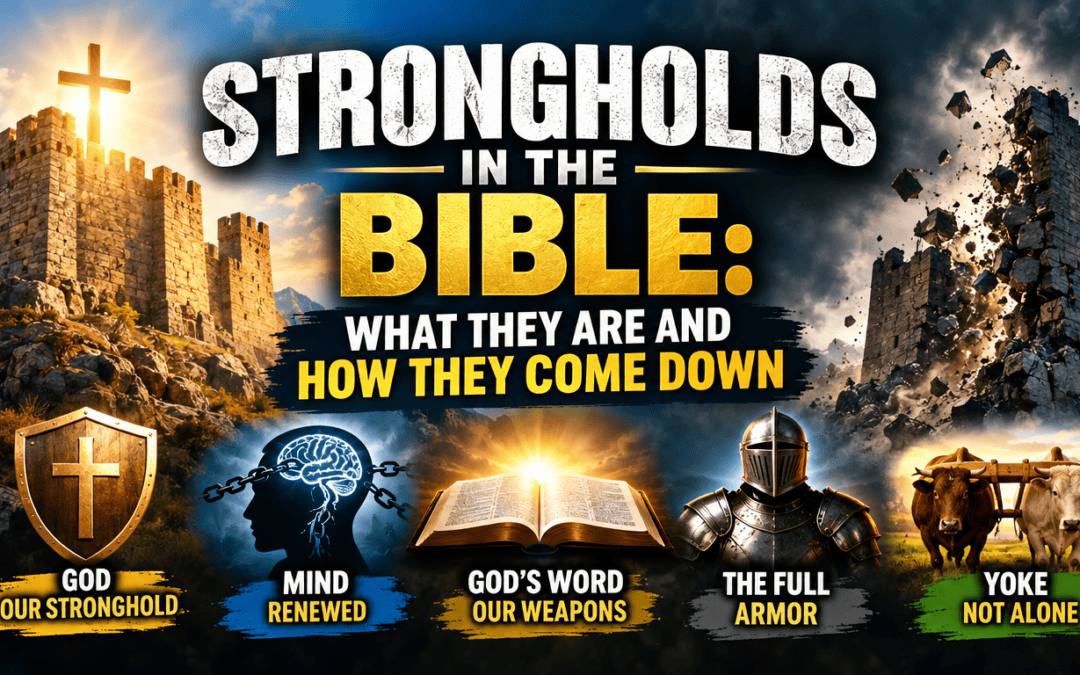
What are strongholds in the Bible? Strongholds in the Bible are fortresses, and Scripture uses the word two ways. In the Psalms and the Prophets, God Himself is a stronghold, a safe high place for those who trust Him (Psalm 18:2; Nahum 1:7). In 2 Corinthians 10:4–5, strongholds are arguments and lofty opinions raised against the knowledge of God, and believers tear them down with weapons that are not of the flesh but have divine power.
▶ Read the Word: Look at What the Lord Has Done
A Stronghold Can Be Good: God Himself
Before the Bible ever speaks of strongholds that must come down, it calls God Himself a stronghold. In the Old Testament a stronghold was a high, walled place a person ran to when the enemy came. David, who spent years hiding in the wilderness from King Saul, used every word for safety he knew to describe the Lord:
The LORD is my rock and my fortress and my deliverer, my God, my rock, in whom I take refuge, my shield, and the horn of my salvation, my stronghold.
The prophet Nahum said the same thing to a people under threat from the cruelest empire of their day:
The LORD is good, a stronghold in the day of trouble; he knows those who take refuge in him.
So the first thing the Bible teaches about strongholds is comforting. The safest place a believer can stand is inside the Lord. When the pressure of the world rises, He is the high wall His people run to, and He knows each one who takes refuge in Him.
Strongholds That Must Come Down
The New Testament uses the same picture the other way around. Paul wrote to a church in Corinth that was being pulled toward the thinking of the world around it, and he described a different kind of stronghold:
For though we walk in the flesh, we are not waging war according to the flesh. For the weapons of our warfare are not of the flesh but have divine power to destroy strongholds.
We destroy arguments and every lofty opinion raised against the knowledge of God, and take every thought captive to obey Christ,
Here a stronghold is a fortress built against God. Paul names what it is made of: arguments and lofty opinions raised against the knowledge of God. It is a way of thinking that has walls around it, a set of ideas the world has built up and defends, so that the truth of God cannot get in. The battle is real, but it is not fought with fists, money or human cleverness. It is fought with weapons that have divine power.
How the World Builds Strongholds in the Mind
Strongholds rarely go up in a day. They are built one idea at a time, as the world presses its pattern on God’s people. Paul tells believers not to let that happen:
Do not be conformed to this world, but be transformed by the renewal of your mind, that by testing you may discern what is the will of God, what is good and acceptable and perfect.
The same letter that tells believers to take thoughts captive also tells them what to build in place of the old walls:
Finally, brothers, whatever is true, whatever is honorable, whatever is just, whatever is pure, whatever is lovely, whatever is commendable, if there is any excellence, if there is anything worthy of praise, think about these things.
The world will keep handing out its opinions. A renewed mind tests every one of them against what God has said, keeps what is true and lets the rest fall. That is how a stronghold stops growing, and how a new way of thinking takes its place.
The Weapons of Our Warfare
If the weapons are not of the flesh, what are they? Paul lists them in the armor passage he wrote to the Ephesians:
Put on the whole armor of God, that you may be able to stand against the schemes of the devil.
and take the helmet of salvation, and the sword of the Spirit, which is the word of God,
The sword of the Spirit is the word of God, and it is the one piece of the armor that cuts. A lofty opinion falls when it meets what God has actually said. Prayer, truth, righteousness, faith and the gospel stand alongside it, and the whole set is laid out in the full armor of God in Ephesians 6:10–18. These weapons have divine power because God Himself stands behind them.
Take Every Thought Captive
Paul says believers take every thought captive to obey Christ. That is a soldier’s phrase. A captive is brought in under a new authority. A thought that rises against the knowledge of God is not argued with forever; it is brought to Christ and made to answer to Him. James gives the order of battle in two short commands:
Submit yourselves therefore to God. Resist the devil, and he will flee from you.
Submission comes first, then resistance. A believer who tries to resist without first submitting to God is fighting alone. A believer who submits to God first does not fight alone, and the enemy flees.
Jesus described that submission with a farmer’s picture, the yoke that joins two animals to pull together, with the stronger one leading:
“Come to me, all who labor and are heavy laden, and I will give you rest. Take my yoke upon you, and learn from me, for I am gentle and lowly in heart, and you will find rest for your souls. For my yoke is easy, and my burden is light.”
To be yoked to Christ is to stop pulling alone. He leads, He carries the weight, and He gives rest in the middle of the battle.
An Army That Cannot Be Defeated
The war against strongholds is not a hopeless one. Paul ends his great chapter on the believer’s security with a question that answers itself:
What then shall we say to these things? If God is for us, who can be against us?
And when God brings His people through, they look back and see His hand in all of it, the way Israel did when the exiles came home:
The LORD has done great things for us; we are glad.
Strongholds that took years to build can come down, because the One who fights for His people has never lost a battle. The world will keep building its walls. God’s people do not have to live behind them.
A Word from the Lord on Strongholds
A Word from the Lord shared on FaithNFreedom Social, received on October 19, 2026, carries the language of this passage. It includes these lines:
Understand my instructions, and you will destroy strongholds with the weapons of warfare I give you that are not of the flesh.
— Word from the Lord, October 19, 2026
And do not experiment with fighting these battles without your yoke.
— Word from the Lord, October 19, 2026
Read the whole word, and the Scripture it stands on, on FaithNFreedom Social.
▶ Read the Word: Look at What the Lord Has Done
Closing Prayer
Father, thank You that You are our stronghold, a refuge in the day of trouble, and that You know each one who takes refuge in You. Where the world has built walls of argument and opinion against the knowledge of You, give us the weapons of Your Word and Your Spirit to bring them down. Renew our minds. Teach us to take every thought captive to obey Christ. We submit ourselves to You first, and we take the yoke of Jesus, so that we never fight alone. You are for us, so no one can stand against us. Let us one day look back and say that You have done great things for us. In Jesus’ name, amen.
Bible Teaching and Discussion
Bible teaching and discussion continue in Faith Blogs & Discussions on FaithNFreedom Social, and you can watch FaithNFreedomTV free, 24/7.
Scripture quotations are from the ESV® Bible (The Holy Bible, English Standard Version®), © 2001 by Crossway, a publishing ministry of Good News Publishers. ESV Text Edition: 2025. The ESV text may not be quoted in any publication made available to the public by a Creative Commons license. The ESV may not be translated in whole or in part into any other language. Used by permission. All rights reserved.
Questions About Strongholds in the Bible
What are strongholds in the Bible?
Strongholds in the Bible are fortresses, and Scripture uses the word in two ways. In the Psalms and the Prophets, God Himself is a stronghold, a high, safe place for those who trust Him (Psalm 18:2; Nahum 1:7). In 2 Corinthians 10:4–5, strongholds are arguments and lofty opinions raised against the knowledge of God, which believers tear down with weapons that have divine power.
What does 2 Corinthians 10:4 mean?
Second Corinthians 10:4 means the Christian’s battle is not fought with human weapons. Paul says, “the weapons of our warfare are not of the flesh but have divine power to destroy strongholds.” Verse 5 explains what those strongholds are: arguments and every lofty opinion raised against the knowledge of God. Believers bring them down by God’s truth and power, taking every thought captive to obey Christ.
What are the weapons of our warfare?
Paul says the weapons of our warfare are not of the flesh. Ephesians 6 describes the armor God gives: truth, righteousness, the gospel of peace, faith, salvation and the sword of the Spirit, which is the word of God, along with prayer. The sword is the one piece that cuts; an argument raised against God falls when it meets what God has actually said in Scripture.
What does it mean to take every thought captive?
To take every thought captive (2 Corinthians 10:5) means bringing each idea under the authority of Christ instead of letting it rule unchecked. A thought that rises against the knowledge of God is tested against Scripture and made to obey Christ. Romans 12:2 describes the same work as the renewal of the mind, and Philippians 4:8 lists what to think about in its place.
Is a stronghold always bad in the Bible?
No. In the Old Testament, a stronghold is often good. David calls the Lord “my stronghold” in Psalm 18:2, and Nahum 1:7 says, “The LORD is good, a stronghold in the day of trouble.” The word becomes negative in 2 Corinthians 10, where Paul uses it for fortresses of argument and opinion raised against God. The same picture describes the safest refuge and the strongest resistance.
How are strongholds torn down?
Scripture describes strongholds being torn down by God’s power, not human strength. Believers submit to God and resist the devil (James 4:7), put on the whole armor of God (Ephesians 6:11), use the word of God as the sword of the Spirit, and take every thought captive to obey Christ (2 Corinthians 10:5). Jesus invites His people to take His yoke, so they never fight alone (Matthew 11:29).
What does “take my yoke upon you” mean?
In Matthew 11:29 Jesus says, “Take my yoke upon you, and learn from me.” A yoke joined two animals to pull together, with the stronger one leading. Jesus invites the weary to be joined to Him, to follow His lead and share His strength, and promises rest for their souls. He adds, “my yoke is easy, and my burden is light.” Being yoked to Him means no believer fights alone.