
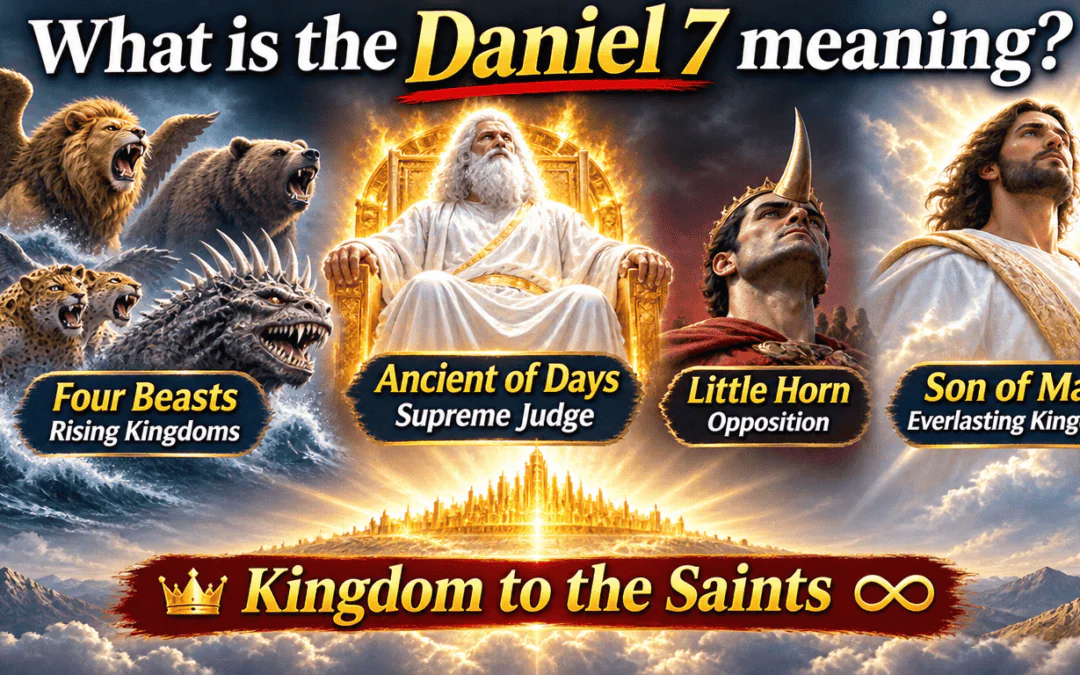
What is the Daniel 7 meaning? Daniel 7 means that the kingdoms of this world rise and fall like beasts, and the kingdom God gives to the Son of Man will never be destroyed. Daniel saw four beasts come up out of the sea, then the Ancient of Days take His throne, judge the fourth beast and its boasting little horn, and give an everlasting kingdom to one like a son of man and to the saints of the Most High.
Test yourself: two Daniel 7 trivia questions are at the end of this article.
▶ Read the Full Day 7 Teaching: One Like a Son of Man
When Daniel 7 Takes Place
Daniel 7 is the hinge of the book. Chapters 1 through 6 are mostly accounts of Daniel and his friends in the courts of Babylon and Persia; chapters 7 through 12 are visions given to Daniel himself. Daniel 7 steps back in time to the first year of Belshazzar, years before the feast and the writing on the wall (see Daniel 4 and 5 explained). Daniel lay in bed, saw the vision, and wrote it down (Daniel 7:1).
The Daniel 7 meaning in one sentence: the kingdoms of this world rise and fall like beasts, and the kingdom given to the Son of Man will never be destroyed. The chapter tells the same history as the statue in Daniel 2, seen this time from heaven’s side.
The Four Beasts in Daniel 7 (Daniel 7:1–8)
I saw in my vision by night, and behold, the four winds of heaven were stirring up the great sea. And four great beasts came up out of the sea, different from one another.
The angel later explains that “these four great beasts are four kings who shall arise out of the earth” (Daniel 7:17). The first was like a lion with eagles’ wings, whose wings were plucked off and who was given the mind of a man (7:4). The second was like a bear, raised up on one side, with “three ribs in its mouth between its teeth” (7:5). The third was like a leopard with four wings and four heads, and “dominion was given to it” (7:6). Then came a fourth beast unlike the others:
After this I saw in the night visions, and behold, a fourth beast, terrifying and dreadful and exceedingly strong. It had great iron teeth; it devoured and broke in pieces and stamped what was left with its feet. It was different from all the beasts that were before it, and it had ten horns.
Most Bible teachers across church history read the four beasts as Babylon, Medo-Persia, Greece and Rome, the same four kingdoms as the gold, silver, bronze and iron of Daniel 2. The lion brought low and given a man’s mind matches Nebuchadnezzar’s humbling in Daniel 4; the bear raised on one side fits Persia rising over Media; the four heads fit the division of Alexander’s empire among four of his generals after his death in 323 BC. Many academic scholars instead count Media and Persia as two kingdoms and end the four with Greece. Revelation 13:2 describes John’s beast from the sea with Daniel’s animals: “like a leopard; its feet were like a bear’s, and its mouth was like a lion’s mouth.”
Who Is the Ancient of Days? (Daniel 7:9–12)
As I looked, thrones were placed, and the Ancient of Days took his seat; his clothing was white as snow, and the hair of his head like pure wool; his throne was fiery flames; its wheels were burning fire.
The Ancient of Days in Daniel 7 is God Himself, seated as Judge over every kingdom. The beasts are new; He is older than every king. His white clothing speaks of purity, and His throne of fire of holiness. Then the court opens:
A stream of fire issued and came out from before him; a thousand thousands served him, and ten thousand times ten thousand stood before him; the court sat in judgment, and the books were opened.
The fourth beast was killed and burned while the horn was still speaking great words (Daniel 7:11). The other beasts lost their dominion, but their lives were prolonged for a season and a time (7:12), as each empire was absorbed into the next.
Who Is the Son of Man in Daniel 7? (Daniel 7:13–14)
I saw in the night visions, and behold, with the clouds of heaven there came one like a son of man, and he came to the Ancient of Days and was presented before him. And to him was given dominion and glory and a kingdom, that all peoples, nations, and languages should serve him; his dominion is an everlasting dominion, which shall not pass away, and his kingdom one that shall not be destroyed.
After four beasts, Daniel sees a man. Yet this man comes “with the clouds of heaven,” and in the Old Testament it is the LORD who rides on the clouds. Christians read the son of man in Daniel 7 as Jesus Christ, because Jesus applied the passage to Himself. When the high priest asked whether He was the Christ, He answered:
And Jesus said, “I am, and you will see the Son of Man seated at the right hand of Power, and coming with the clouds of heaven.”
The high priest tore his robes and the council called it blasphemy, because they understood the claim. In Revelation 1:13–14, John sees “one like a son of man” whose hair is “white, like white wool, like snow,” the description Daniel gave of the Ancient of Days. Revelation 11:15 shows the moment the whole world sees the kingdom: “The kingdom of the world has become the kingdom of our Lord and of his Christ, and he shall reign forever and ever.”
The Little Horn and the Saints (Daniel 7:15–28)
The vision left Daniel anxious and alarmed (Daniel 7:15), so he asked one of those standing by for its meaning. The first answer was how it ends: “the saints of the Most High shall receive the kingdom and possess the kingdom forever, forever and ever” (7:18). Then Daniel asked about the horn that rose among the ten:
As I looked, this horn made war with the saints and prevailed over them, until the Ancient of Days came, and judgment was given for the saints of the Most High, and the time came when the saints possessed the kingdom.
The angel said ten kings would arise from the fourth kingdom, and another after them who would put down three kings (Daniel 7:24). He described what that ruler does:
He shall speak words against the Most High, and shall wear out the saints of the Most High, and shall think to change the times and the law; and they shall be given into his hand for a time, times, and half a time.
The little horn speaks against God, wears out God’s people, tries to change the times and the law, and holds power for a set time. Then “the court shall sit in judgment, and his dominion shall be taken away,” and the kingdom “under the whole heaven” is given to the people of the saints of the Most High (Daniel 7:26–27). Daniel ended by keeping the matter in his heart (7:28).
What Does Time, Times and Half a Time Mean?
Bible-believing Christians read the little horn and “a time, times, and half a time” (Daniel 7:25) in four main ways.
- A future Antichrist for three and a half years. “A time” is one year, “times” two years and “half a time” half a year: three and a half years. Revelation counts the same period as 42 months (13:5) and as “a time, and times, and half a time” (12:14), and Paul’s man of lawlessness, destroyed at Christ’s coming (2 Thessalonians 2:3–8), fits the horn. Holders of this view place the period at the end of the age; Faithful in Babylon teaches this view, reading the three and a half years as the Great Tribulation after the Church is caught up (1 Thessalonians 4:17). Those who hold it differ on that timing: some place the Rapture mid-way or just before God’s wrath, others after the Tribulation (Matthew 24:29–31).
- Antiochus IV Epiphanes. Many scholars read the horn as the Greek king who outlawed Jewish worship and defiled the temple in 167 BC, pointing to Daniel 8:9–14 and 11:31. Others answer that Daniel 8:20 pictures Media and Persia as one ram, and that Daniel 7’s horn grows from the fourth beast; many in the first view see Antiochus as a preview of the Antichrist.
- A power across 1,260 years. Many Protestant Reformers applied a day-for-a-year principle from Numbers 14:34 and Ezekiel 4:6, turning 1,260 days into 1,260 years, and applied the horn to the medieval papacy. Others answer that Numbers 14:34 was a single judgment on Israel, not a rule for reading prophecy.
- A picture of the whole church age. Some read the phrase as a symbol of a limited season of pressure on God’s people between Christ’s first and second coming, pointing to Revelation 12:14 and John 16:33.
Every view agrees on the core: the horn is real, it opposes God and persecutes His people, its time is limited and measured by God, and it ends when the court sits and the kingdom is given to the saints. The number itself climbs from one to two and breaks off at half.
Lessons from Daniel 7
- Empires are beasts, and God rules the sea they rise from. No kingdom in Daniel 7 rises without God’s permission or lasts a day longer than He allows.
- Heaven keeps records. The court is seated and the books are open; nothing done by any power escapes God’s judgment.
- Evil has an “until.” The horn prevails “until the Ancient of Days came” (7:22).
- The kingdom belongs to the Son of Man. Jesus claimed Daniel 7:13 at His trial, and His kingdom shall not be destroyed.
- Keep the vision in the heart. Daniel did not turn the vision into an argument; he kept it and went on serving faithfully.
Continue the Series
This study comes from Day 7 of Faithful in Babylon: Lessons from Daniel, the final day of a seven-day Bible teaching on FaithNFreedom Social. See the whole Faithful in Babylon series, or go back to Day 6, Daniel 4.
▶ Read the Full Day 7 Teaching: One Like a Son of Man
Closing Prayer
Father, You are the Ancient of Days, and You sit on the throne above every kingdom of this world. Thank You that no power rises without Your permission and none lasts one day longer than You allow. Lord Jesus, You are the Son of Man, and the kingdom is Yours. When evil seems to win, help us remember that it always has an “until.” Make us faithful where we live, like Daniel, and keep this vision in our hearts. We look for Your kingdom that will never be destroyed. In Jesus’ name, amen.
Bible Teaching and Discussion
Bible teaching and discussion continue in Faith Blogs & Discussions on FaithNFreedom Social, and you can watch FaithNFreedomTV free, 24/7.
Scripture quotations are from the ESV® Bible (The Holy Bible, English Standard Version®), © 2001 by Crossway, a publishing ministry of Good News Publishers. Used by permission. All rights reserved.
Questions About Daniel 7
What is the meaning of Daniel 7?
Daniel 7 means the kingdoms of this world rise and fall like beasts, while the kingdom given to the Son of Man is never destroyed. Daniel saw four beasts rise from the sea, the Ancient of Days take His throne, the court open its books, and one like a son of man receive an everlasting kingdom. The chapter ends with that kingdom given to the saints of the Most High (Daniel 7:27).
Who are the four beasts in Daniel 7?
The four beasts in Daniel 7 are four kings or kingdoms, as the angel explains in Daniel 7:17. Most Bible teachers across church history read them as Babylon, Medo-Persia, Greece and Rome, the same four kingdoms as the statue in Daniel 2. Many academic scholars instead count Media and Persia separately and end the four with Greece. The fourth beast, with iron teeth and ten horns, is different from all the others.
Who is the Ancient of Days in Daniel 7?
The Ancient of Days in Daniel 7 is God, seated as Judge over all the kingdoms of the earth. Daniel saw His clothing white as snow, His hair like pure wool and His throne of fiery flames, with ten thousand times ten thousand standing before Him. The court sat, the books were opened, the fourth beast was destroyed, and an everlasting kingdom was given to one like a son of man.
Who is the son of man in Daniel 7?
Christians read the son of man in Daniel 7 as Jesus Christ, because Jesus applied the passage to Himself. Daniel saw one like a son of man coming with the clouds of heaven to receive an everlasting kingdom. At His trial Jesus told the high priest they would see the Son of Man coming with the clouds of heaven (Mark 14:62), and John saw Him with the Ancient of Days’ white hair (Revelation 1:14).
Who is the little horn in Daniel 7?
The little horn in Daniel 7 is a ruler who rises among the fourth beast’s ten horns, speaks against God and wears out the saints. Christians identify him in several ways: a future Antichrist, the Greek king Antiochus IV, a power across 1,260 years, or a picture of opposition through the church age. Every reading agrees his time is limited and ends when the court sits and the kingdom goes to the saints.
What does time, times and half a time mean in Daniel 7:25?
“A time, times, and half a time” in Daniel 7:25 most likely means three and a half years. That is one year, two years and half a year. Revelation counts the same period as 42 months and 1,260 days. Faithful in Babylon reads it as the Great Tribulation under a future Antichrist; others read it as Antiochus IV’s persecution, as 1,260 years, or as a symbol of the whole church age.
What can Christians learn from Daniel 7?
Christians learn from Daniel 7 that God rules over every power on earth and that His kingdom outlasts them all. The beasts rise only by His permission, the court is seated and the books are open, and every victory of evil has an “until” (Daniel 7:22). Daniel kept the vision in his heart and kept serving faithfully, and believers are called to live today in the light of the kingdom that is coming.
Daniel 7 Trivia
1. How many stood before the Ancient of Days when the court sat in judgment?
Show the answer
Ten thousand times ten thousand, and a thousand thousands served Him (Daniel 7:10).
2. In Revelation 13 the beast from the sea was like a leopard. Which of Daniel’s beasts gave it its feet, and which gave it its mouth?
Show the answer
Its feet were like a bear’s, and its mouth was like a lion’s mouth (Revelation 13:2), Daniel’s second and first beasts.