
By Rick Rene
What does Joe Oltmann’s new report claim?
In his 75-page 18 U.S.C. 2381 Report and his 20-page Brief to the President (November 2026), Oltmann says:
- The same engineers and software moved from Smartmatic to Sequoia to Dominion.
- They kept remote access to county election servers.
- On election night 2020, results were worked on a server the federal sensors could not see.
- The machines had Chinese-made boards and firmware handled in Shanghai.
- The people involved later denied that access under oath.
His evidence: Dominion’s own emails and depositions from two federal lawsuits, sealed by the court in March 2024.
“I know him personally. I know he is a Christian and wants what is best for the country and all people in the US. He has proven that to me personally in several circumstances over the years.”
Rick Rene, founder of FaithNFreedomTV, on Joe Oltmann
of slide 1
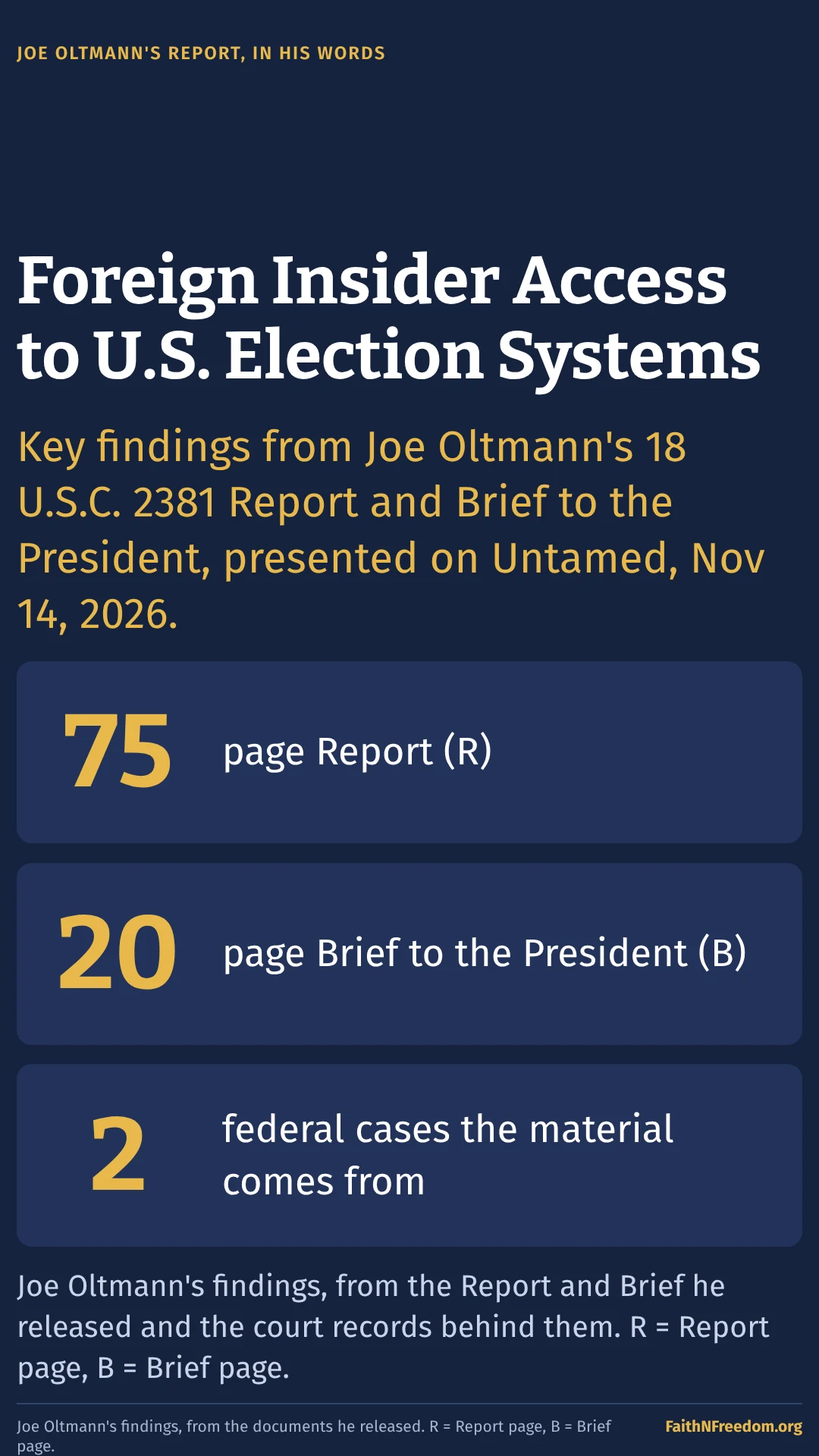
1. Foreign Insider Access to U.S. Election Systems
Key findings from Joe Oltmann’s 18 U.S.C. 2381 Report and Brief to the President, presented on Untamed, Nov 14, 2026.
75page Report (R)
20page Brief to the President (B)
2federal cases the material comes from
Joe Oltmann’s findings, from the Report and Brief he released and the court records behind them. R = Report page, B = Brief page.
of slide 2
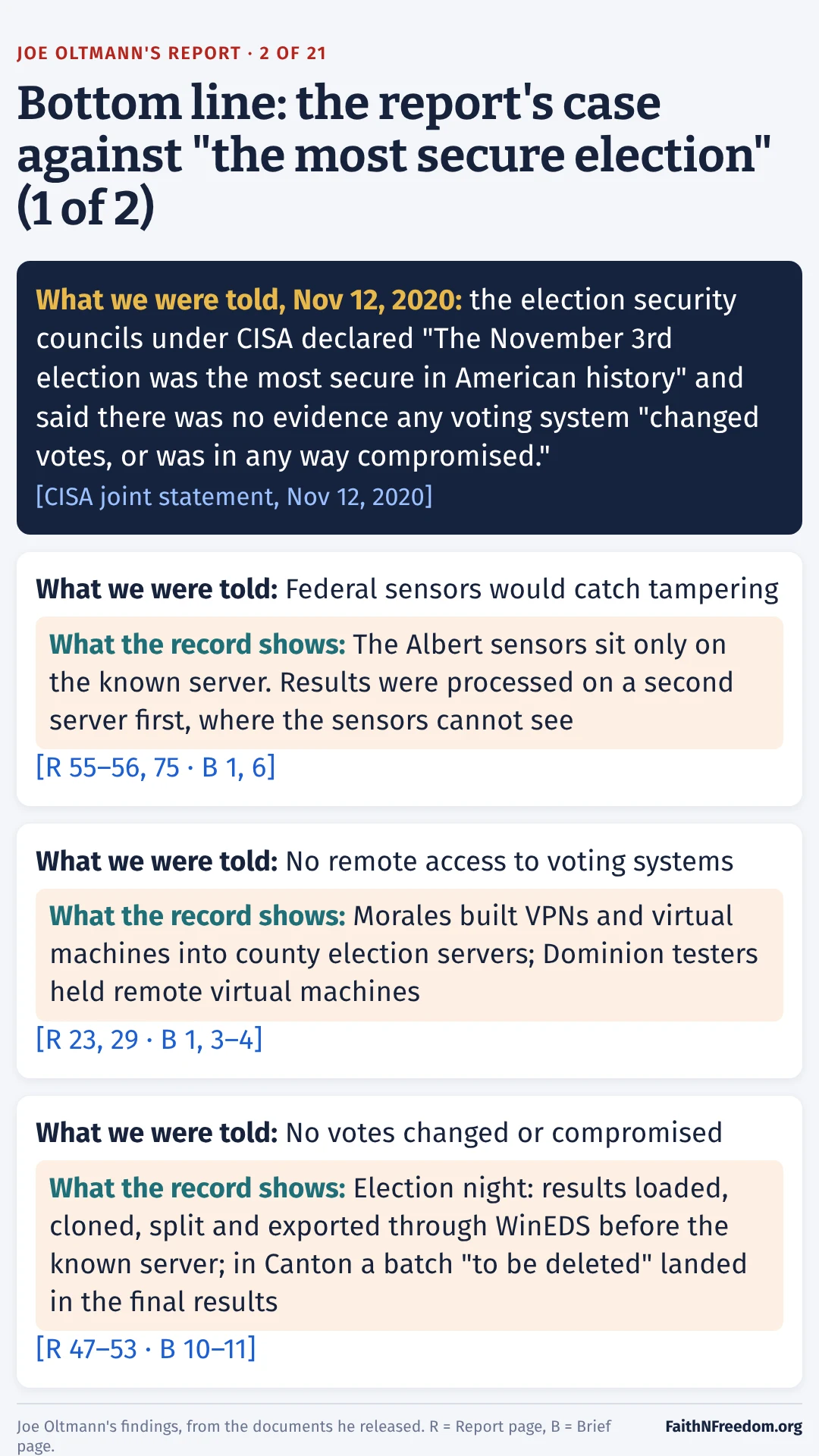
2. Bottom line: the report’s case against “the most secure election” (1 of 2)
What we were told, Nov 12, 2020: the election security councils under CISA declared “The November 3rd election was the most secure in American history” and said there was no evidence any voting system “changed votes, or was in any way compromised.” [CISA joint statement, Nov 12, 2020]
What we were told: Federal sensors would catch tampering
What the record shows: The Albert sensors sit only on the known server. Results were processed on a second server first, where the sensors cannot see
[R 55–56, 75 · B 1, 6]
What we were told: No remote access to voting systems
What the record shows: Morales built VPNs and virtual machines into county election servers; Dominion testers held remote virtual machines
[R 23, 29 · B 1, 3–4]
What we were told: No votes changed or compromised
What the record shows: Election night: results loaded, cloned, split and exported through WinEDS before the known server; in Canton a batch “to be deleted” landed in the final results
[R 47–53 · B 10–11]
of slide 3
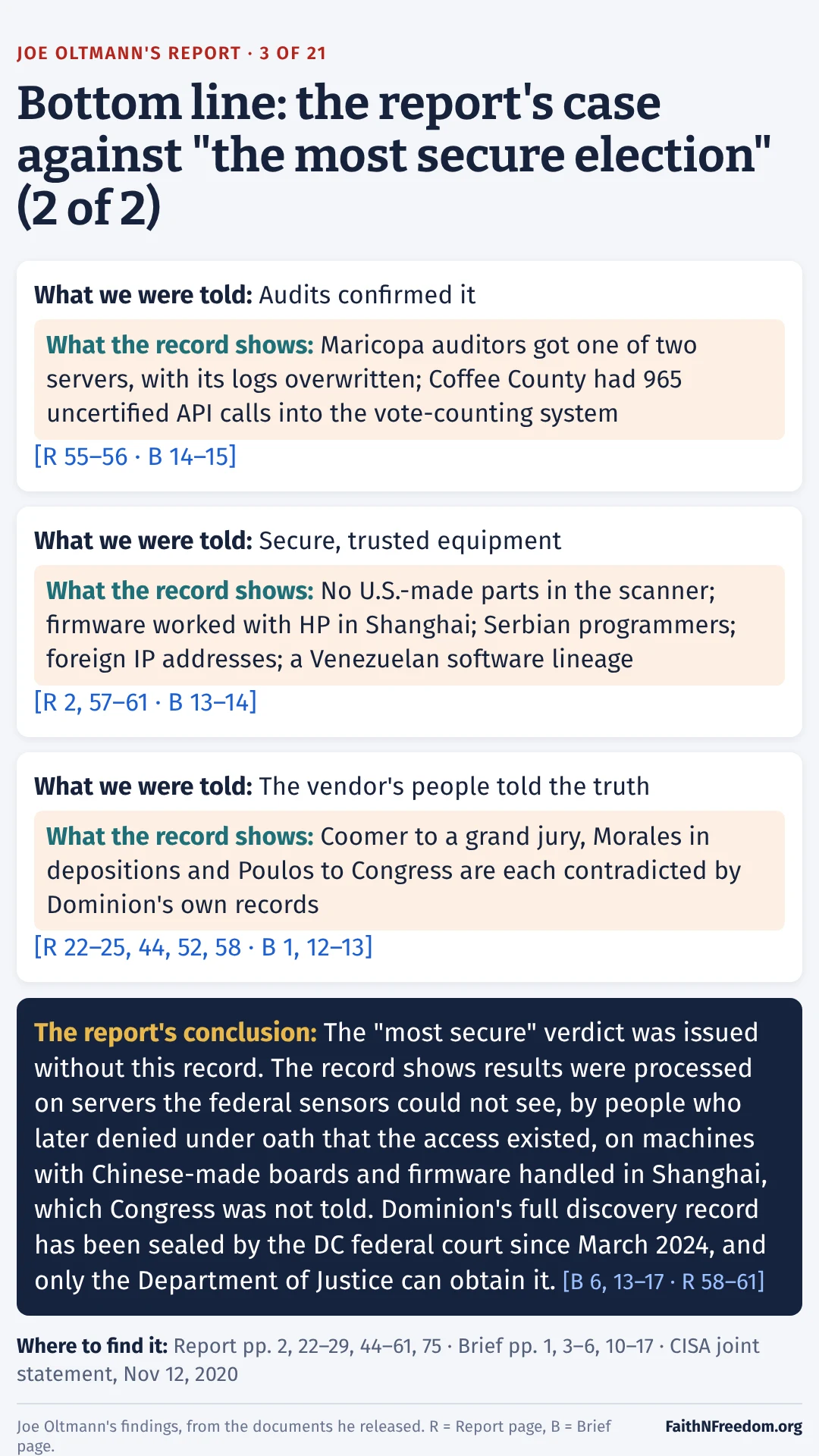
3. Bottom line: the report’s case against “the most secure election” (2 of 2)
What we were told: Audits confirmed it
What the record shows: Maricopa auditors got one of two servers, with its logs overwritten; Coffee County had 965 uncertified API calls into the vote-counting system
[R 55–56 · B 14–15]
What we were told: Secure, trusted equipment
What the record shows: No U.S.-made parts in the scanner; firmware worked with HP in Shanghai; Serbian programmers; foreign IP addresses; a Venezuelan software lineage
[R 2, 57–61 · B 13–14]
What we were told: The vendor’s people told the truth
What the record shows: Coomer to a grand jury, Morales in depositions and Poulos to Congress are each contradicted by Dominion’s own records
[R 22–25, 44, 52, 58 · B 1, 12–13]
The report’s conclusion: The “most secure” verdict was issued without this record. The record shows results were processed on servers the federal sensors could not see, by people who later denied under oath that the access existed, on machines with Chinese-made boards and firmware handled in Shanghai, which Congress was not told. Dominion’s full discovery record has been sealed by the DC federal court since March 2024, and only the Department of Justice can obtain it. [B 6, 13–17 · R 58–61]
Where to find it: Report pp. 2, 22–29, 44–61, 75 · Brief pp. 1, 3–6, 10–17 · CISA joint statement, Nov 12, 2020
of slide 4
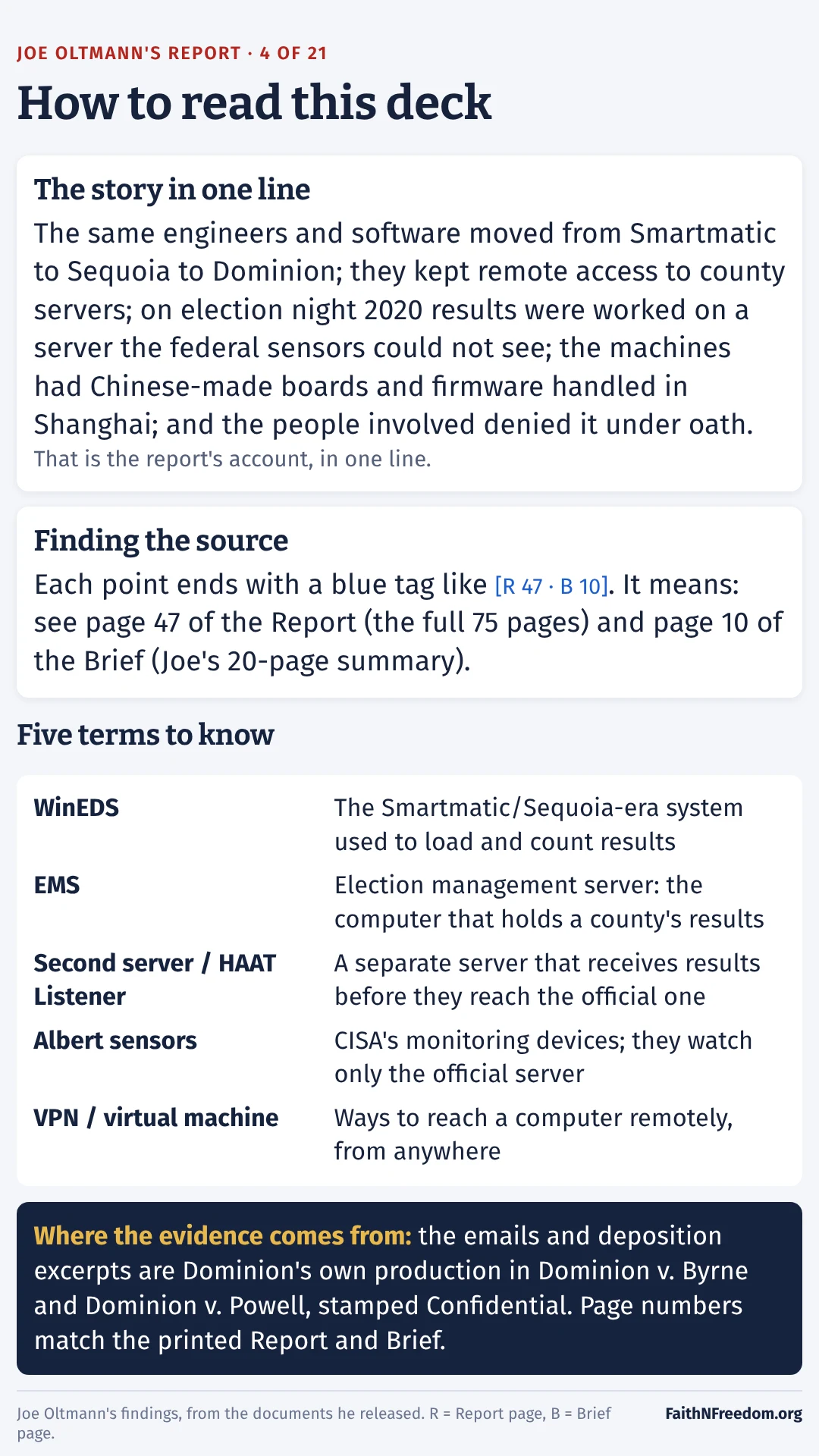
4. How to read this deck
The story in one line
The same engineers and software moved from Smartmatic to Sequoia to Dominion; they kept remote access to county servers; on election night 2020 results were worked on a server the federal sensors could not see; the machines had Chinese-made boards and firmware handled in Shanghai; and the people involved denied it under oath.
That is the report’s account, in one line.
Finding the source
Each point ends with a blue tag like [R 47 · B 10]. It means: see page 47 of the Report (the full 75 pages) and page 10 of the Brief (Joe’s 20-page summary).
Five terms to know
- WinEDS
- The Smartmatic/Sequoia-era system used to load and count results
- EMS
- Election management server: the computer that holds a county’s results
- Second server / HAAT Listener
- A separate server that receives results before they reach the official one
- Albert sensors
- CISA’s monitoring devices; they watch only the official server
- VPN / virtual machine
- Ways to reach a computer remotely, from anywhere
Where the evidence comes from: the emails and deposition excerpts are Dominion’s own production in Dominion v. Byrne and Dominion v. Powell, stamped Confidential. Page numbers match the printed Report and Brief.
of slide 5
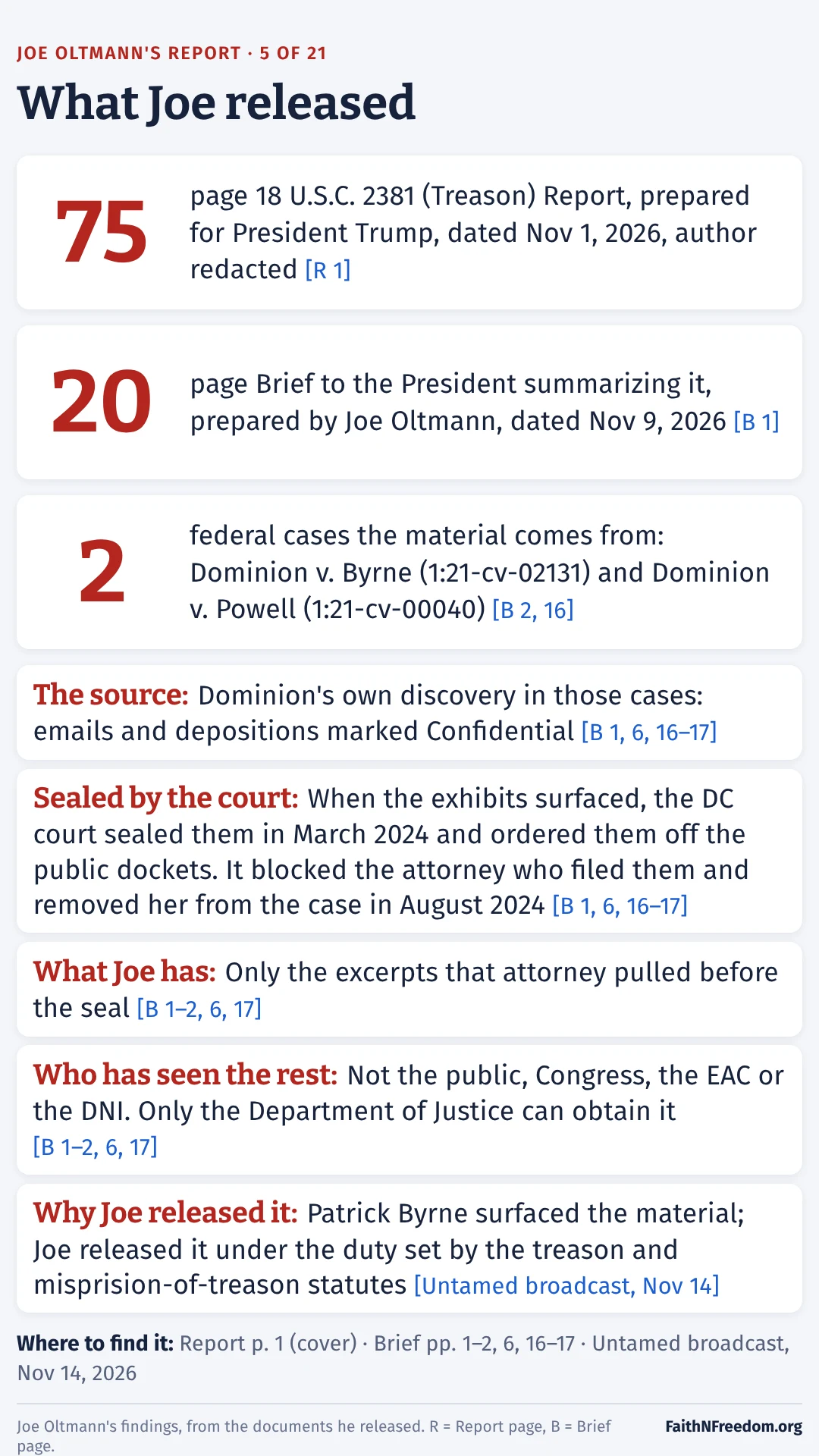
5. What Joe released
75page 18 U.S.C. 2381 (Treason) Report, prepared for President Trump, dated Nov 1, 2026, author redacted [R 1]
20page Brief to the President summarizing it, prepared by Joe Oltmann, dated Nov 9, 2026 [B 1]
2federal cases the material comes from: Dominion v. Byrne (1:21-cv-02131) and Dominion v. Powell (1:21-cv-00040) [B 2, 16]
- The source: Dominion’s own discovery in those cases: emails and depositions marked Confidential [B 1, 6, 16–17]
- Sealed by the court: When the exhibits surfaced, the DC court sealed them in March 2024 and ordered them off the public dockets. It blocked the attorney who filed them and removed her from the case in August 2024 [B 1, 6, 16–17]
- What Joe has: Only the excerpts that attorney pulled before the seal [B 1–2, 6, 17]
- Who has seen the rest: Not the public, Congress, the EAC or the DNI. Only the Department of Justice can obtain it [B 1–2, 6, 17]
- Why Joe released it: Patrick Byrne surfaced the material; Joe released it under the duty set by the treason and misprision-of-treason statutes [Untamed broadcast, Nov 14]
Where to find it: Report p. 1 (cover) · Brief pp. 1–2, 6, 16–17 · Untamed broadcast, Nov 14, 2026
of slide 6
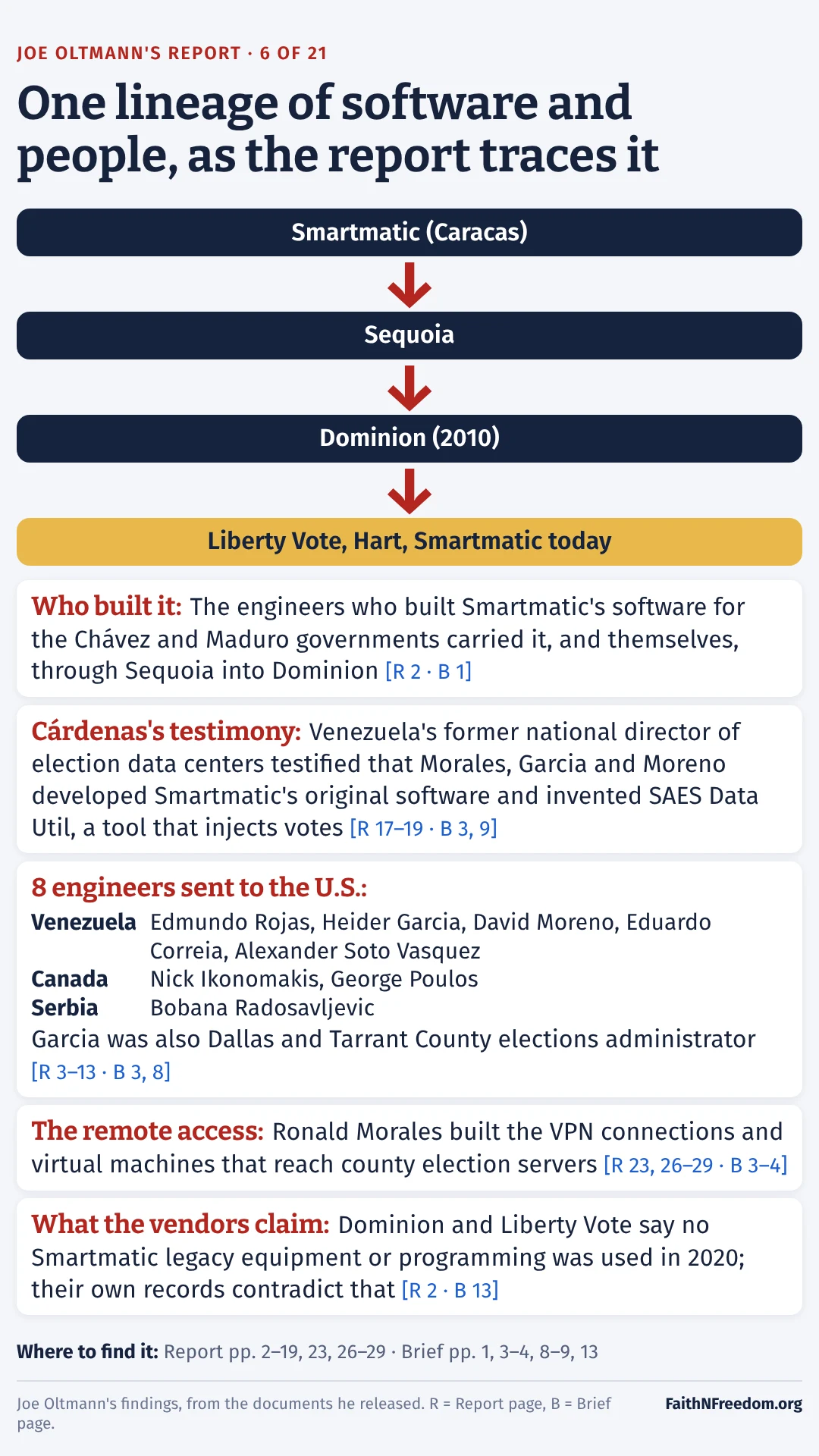
6. One lineage of software and people, as the report traces it
Smartmatic (Caracas) → Sequoia → Dominion (2010) → Liberty Vote, Hart, Smartmatic today
- Who built it: The engineers who built Smartmatic’s software for the Chávez and Maduro governments carried it, and themselves, through Sequoia into Dominion [R 2 · B 1]
- Cárdenas’s testimony: Venezuela’s former national director of election data centers testified that Morales, Garcia and Moreno developed Smartmatic’s original software and invented SAES Data Util, a tool that injects votes [R 17–19 · B 3, 9]
- 8 engineers sent to the U.S.:
- Venezuela: Edmundo Rojas, Heider Garcia, David Moreno, Eduardo Correia, Alexander Soto Vasquez
- Canada: Nick Ikonomakis, George Poulos
- Serbia: Bobana Radosavljevic
Garcia was also Dallas and Tarrant County elections administrator [R 3–13 · B 3, 8]
- The remote access: Ronald Morales built the VPN connections and virtual machines that reach county election servers [R 23, 26–29 · B 3–4]
- What the vendors claim: Dominion and Liberty Vote say no Smartmatic legacy equipment or programming was used in 2020; their own records contradict that [R 2 · B 13]
Where to find it: Report pp. 2–19, 23, 26–29 · Brief pp. 1, 3–4, 8–9, 13
of slide 7
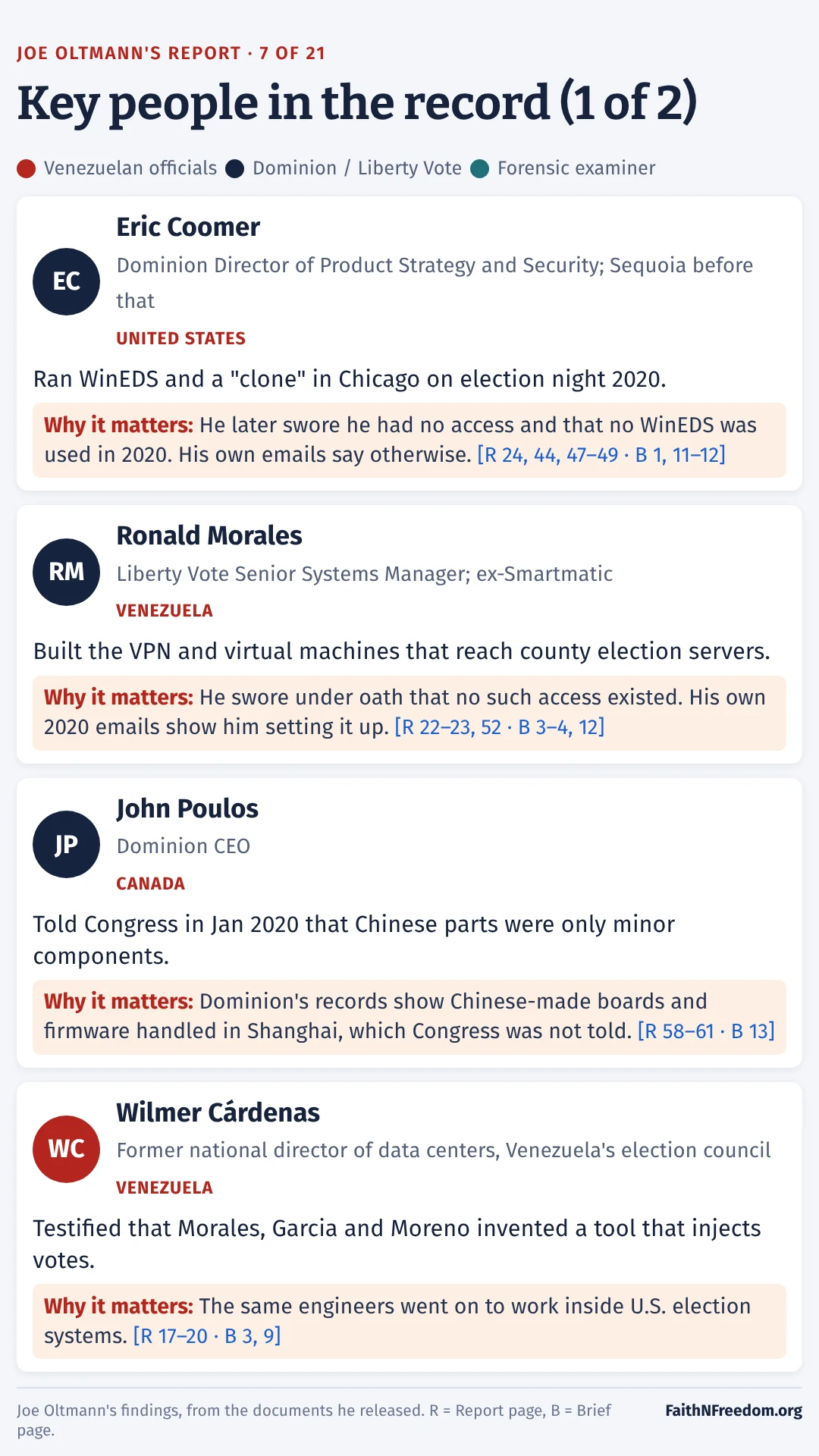
7. Key people in the record (1 of 2)
Eric Coomer · Dominion Director of Product Strategy and Security; Sequoia before that · UNITED STATES
Ran WinEDS and a “clone” in Chicago on election night 2020.
Why it matters: He later swore he had no access and that no WinEDS was used in 2020. His own emails say otherwise. [R 24, 44, 47–49 · B 1, 11–12]
Ronald Morales · Liberty Vote Senior Systems Manager; ex-Smartmatic · VENEZUELA
Built the VPN and virtual machines that reach county election servers.
Why it matters: He swore under oath that no such access existed. His own 2020 emails show him setting it up. [R 22–23, 52 · B 3–4, 12]
John Poulos · Dominion CEO · CANADA
Told Congress in Jan 2020 that Chinese parts were only minor components.
Why it matters: Dominion’s records show Chinese-made boards and firmware handled in Shanghai, which Congress was not told. [R 58–61 · B 13]
Wilmer Cárdenas · Former national director of data centers, Venezuela’s election council · VENEZUELA
Testified that Morales, Garcia and Moreno invented a tool that injects votes.
Why it matters: The same engineers went on to work inside U.S. election systems. [R 17–20 · B 3, 9]
of slide 8
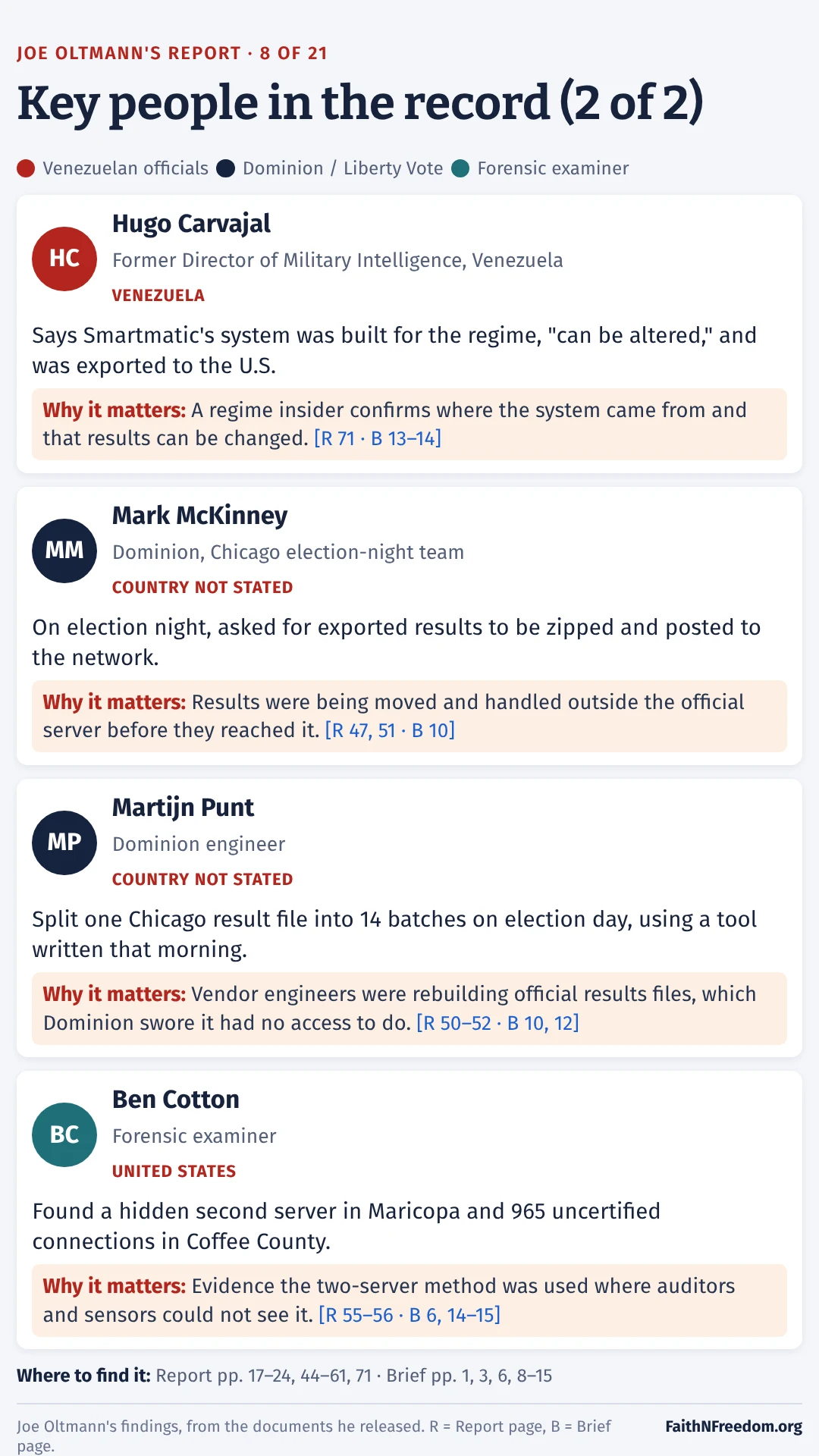
8. Key people in the record (2 of 2)
Hugo Carvajal · Former Director of Military Intelligence, Venezuela · VENEZUELA
Says Smartmatic’s system was built for the regime, “can be altered,” and was exported to the U.S.
Why it matters: A regime insider confirms where the system came from and that results can be changed. [R 71 · B 13–14]
Mark McKinney · Dominion, Chicago election-night team · COUNTRY NOT STATED
On election night, asked for exported results to be zipped and posted to the network.
Why it matters: Results were being moved and handled outside the official server before they reached it. [R 47, 51 · B 10]
Martijn Punt · Dominion engineer · COUNTRY NOT STATED
Split one Chicago result file into 14 batches on election day, using a tool written that morning.
Why it matters: Vendor engineers were rebuilding official results files, which Dominion swore it had no access to do. [R 50–52 · B 10, 12]
Ben Cotton · Forensic examiner · UNITED STATES
Found a hidden second server in Maricopa and 965 uncertified connections in Coffee County.
Why it matters: Evidence the two-server method was used where auditors and sensors could not see it. [R 55–56 · B 6, 14–15]
Where to find it: Report pp. 17–24, 44–61, 71 · Brief pp. 1, 3, 6, 8–15
of slide 9
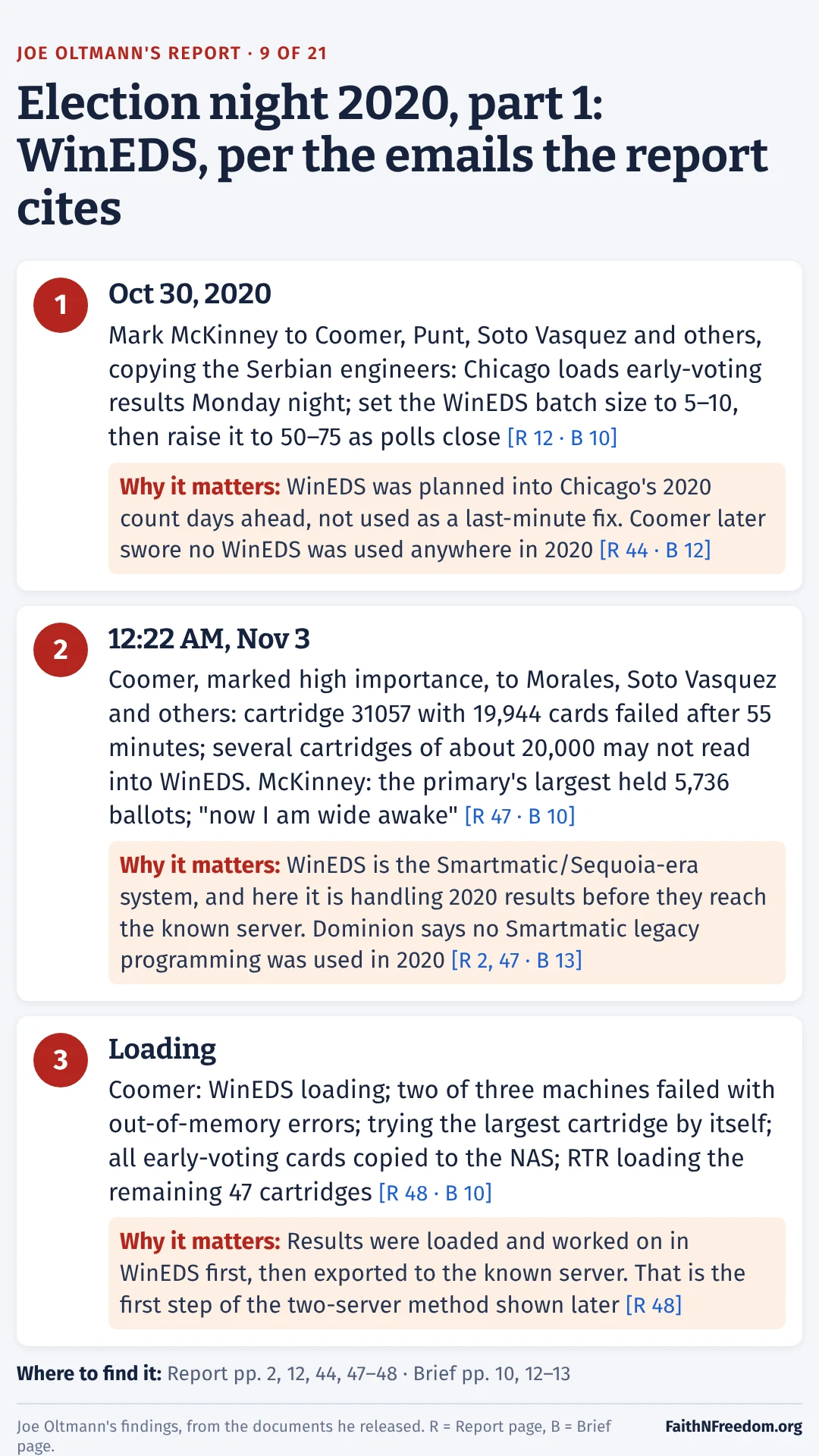
9. Election night 2020, part 1: WinEDS, per the emails the report cites
1. Oct 30, 2020
Mark McKinney to Coomer, Punt, Soto Vasquez and others, copying the Serbian engineers: Chicago loads early-voting results Monday night; set the WinEDS batch size to 5–10, then raise it to 50–75 as polls close [R 12 · B 10]
Why it matters: WinEDS was planned into Chicago’s 2020 count days ahead, not used as a last-minute fix. Coomer later swore no WinEDS was used anywhere in 2020 [R 44 · B 12]
2. 12:22 AM, Nov 3
Coomer, marked high importance, to Morales, Soto Vasquez and others: cartridge 31057 with 19,944 cards failed after 55 minutes; several cartridges of about 20,000 may not read into WinEDS. McKinney: the primary’s largest held 5,736 ballots; “now I am wide awake” [R 47 · B 10]
Why it matters: WinEDS is the Smartmatic/Sequoia-era system, and here it is handling 2020 results before they reach the known server. Dominion says no Smartmatic legacy programming was used in 2020 [R 2, 47 · B 13]
3. Loading
Coomer: WinEDS loading; two of three machines failed with out-of-memory errors; trying the largest cartridge by itself; all early-voting cards copied to the NAS; RTR loading the remaining 47 cartridges [R 48 · B 10]
Why it matters: Results were loaded and worked on in WinEDS first, then exported to the known server. That is the first step of the two-server method shown later [R 48]
Where to find it: Report pp. 2, 12, 44, 47–48 · Brief pp. 10, 12–13
of slide 10
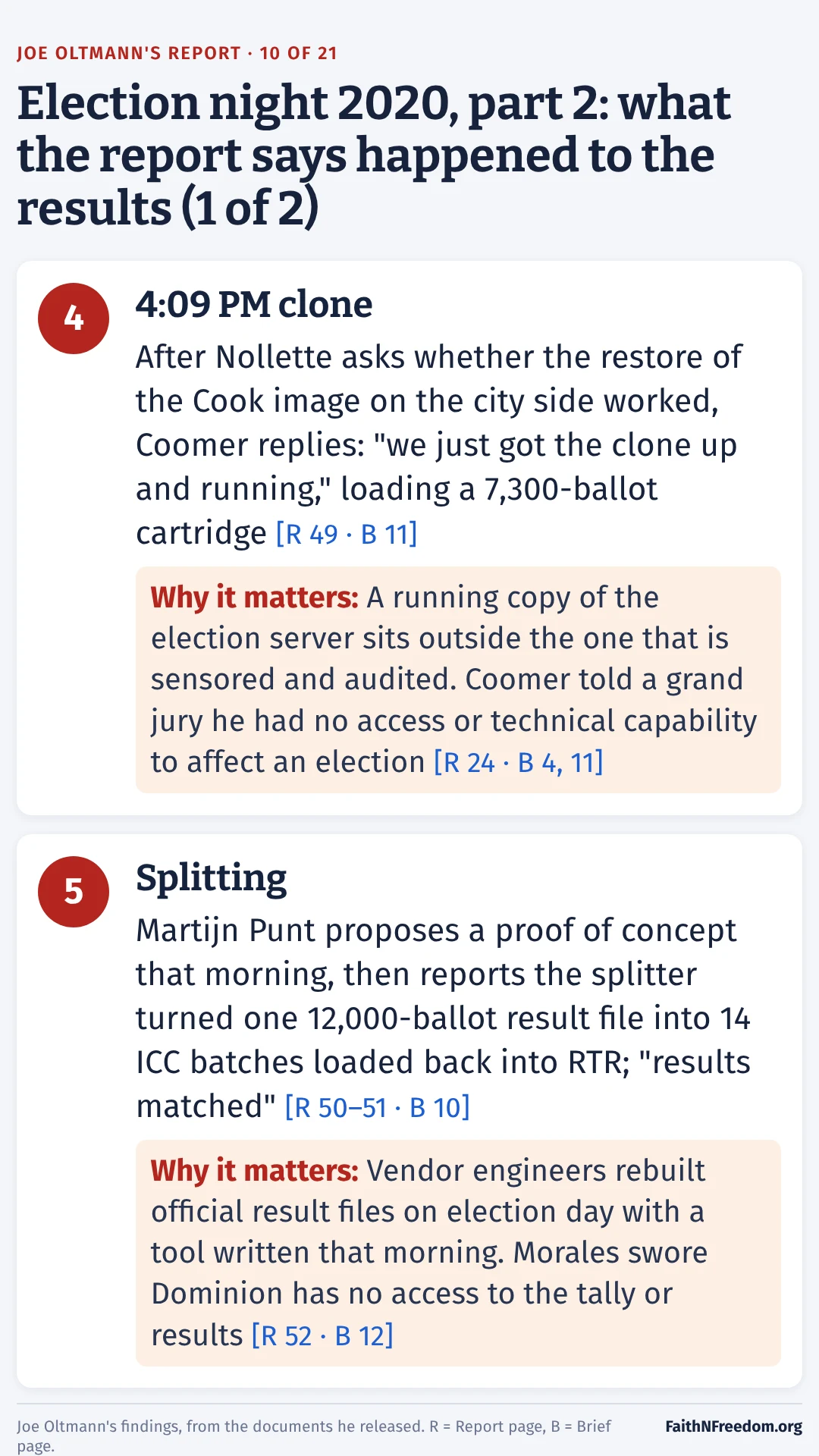
10. Election night 2020, part 2: what the report says happened to the results (1 of 2)
4. 4:09 PM clone
After Nollette asks whether the restore of the Cook image on the city side worked, Coomer replies: “we just got the clone up and running,” loading a 7,300-ballot cartridge [R 49 · B 11]
Why it matters: A running copy of the election server sits outside the one that is sensored and audited. Coomer told a grand jury he had no access or technical capability to affect an election [R 24 · B 4, 11]
5. Splitting
Martijn Punt proposes a proof of concept that morning, then reports the splitter turned one 12,000-ballot result file into 14 ICC batches loaded back into RTR; “results matched” [R 50–51 · B 10]
Why it matters: Vendor engineers rebuilt official result files on election day with a tool written that morning. Morales swore Dominion has no access to the tally or results [R 52 · B 12]
of slide 11
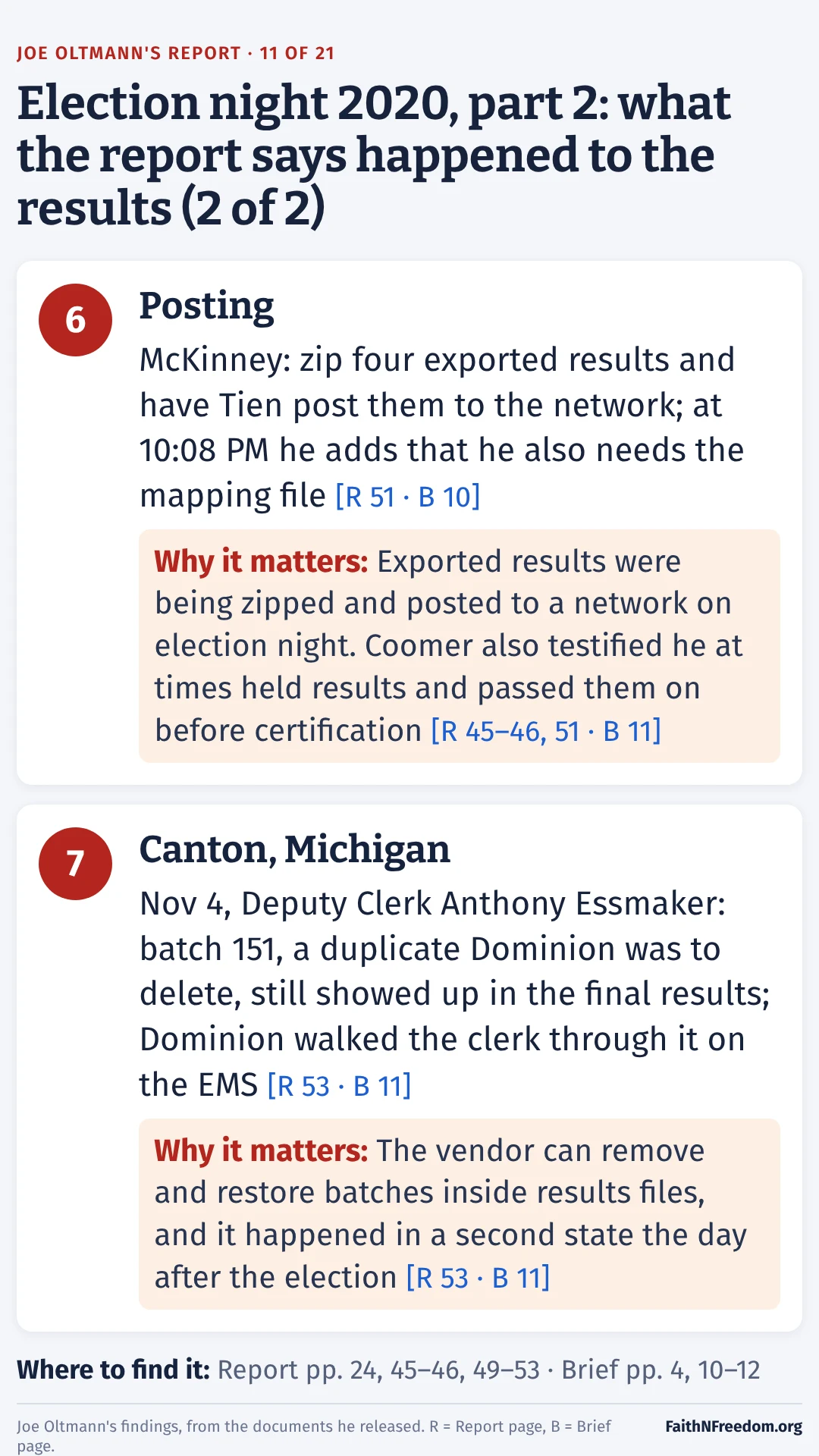
11. Election night 2020, part 2: what the report says happened to the results (2 of 2)
6. Posting
McKinney: zip four exported results and have Tien post them to the network; at 10:08 PM he adds that he also needs the mapping file [R 51 · B 10]
Why it matters: Exported results were being zipped and posted to a network on election night. Coomer also testified he at times held results and passed them on before certification [R 45–46, 51 · B 11]
7. Canton, Michigan
Nov 4, Deputy Clerk Anthony Essmaker: batch 151, a duplicate Dominion was to delete, still showed up in the final results; Dominion walked the clerk through it on the EMS [R 53 · B 11]
Why it matters: The vendor can remove and restore batches inside results files, and it happened in a second state the day after the election [R 53 · B 11]
Where to find it: Report pp. 24, 45–46, 49–53 · Brief pp. 4, 10–12
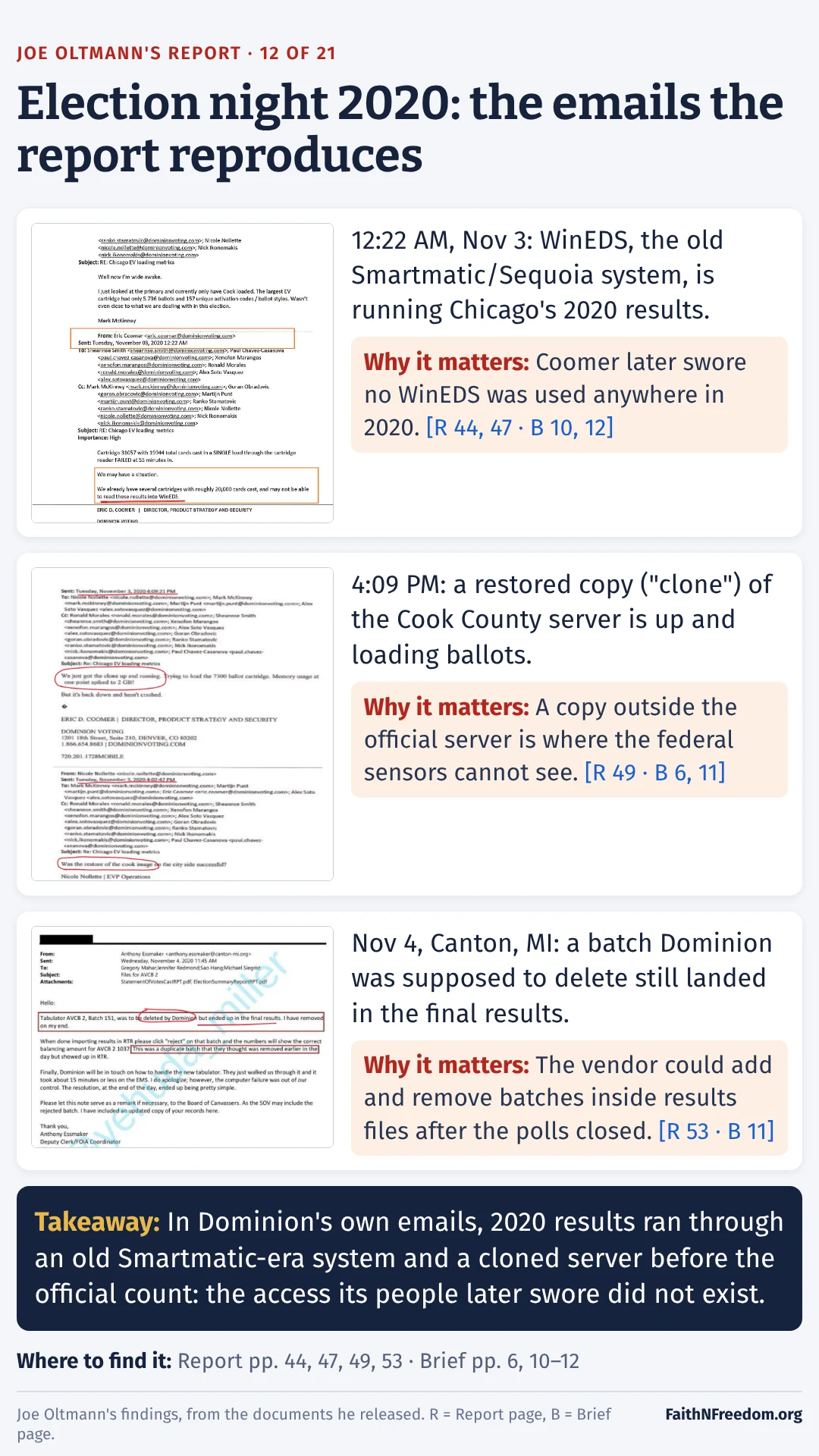
of slide 12
12. Election night 2020: the emails the report reproduces
12:22 AM, Nov 3: WinEDS, the old Smartmatic/Sequoia system, is running Chicago’s 2020 results.
Why it matters: Coomer later swore no WinEDS was used anywhere in 2020. [R 44, 47 · B 10, 12]
4:09 PM: a restored copy (“clone”) of the Cook County server is up and loading ballots.
Why it matters: A copy outside the official server is where the federal sensors cannot see. [R 49 · B 6, 11]
Nov 4, Canton, MI: a batch Dominion was supposed to delete still landed in the final results.
Why it matters: The vendor could add and remove batches inside results files after the polls closed. [R 53 · B 11]
Takeaway: In Dominion’s own emails, 2020 results ran through an old Smartmatic-era system and a cloned server before the official count: the access its people later swore did not exist.
Where to find it: Report pp. 44, 47, 49, 53 · Brief pp. 6, 10–12
of slide 13
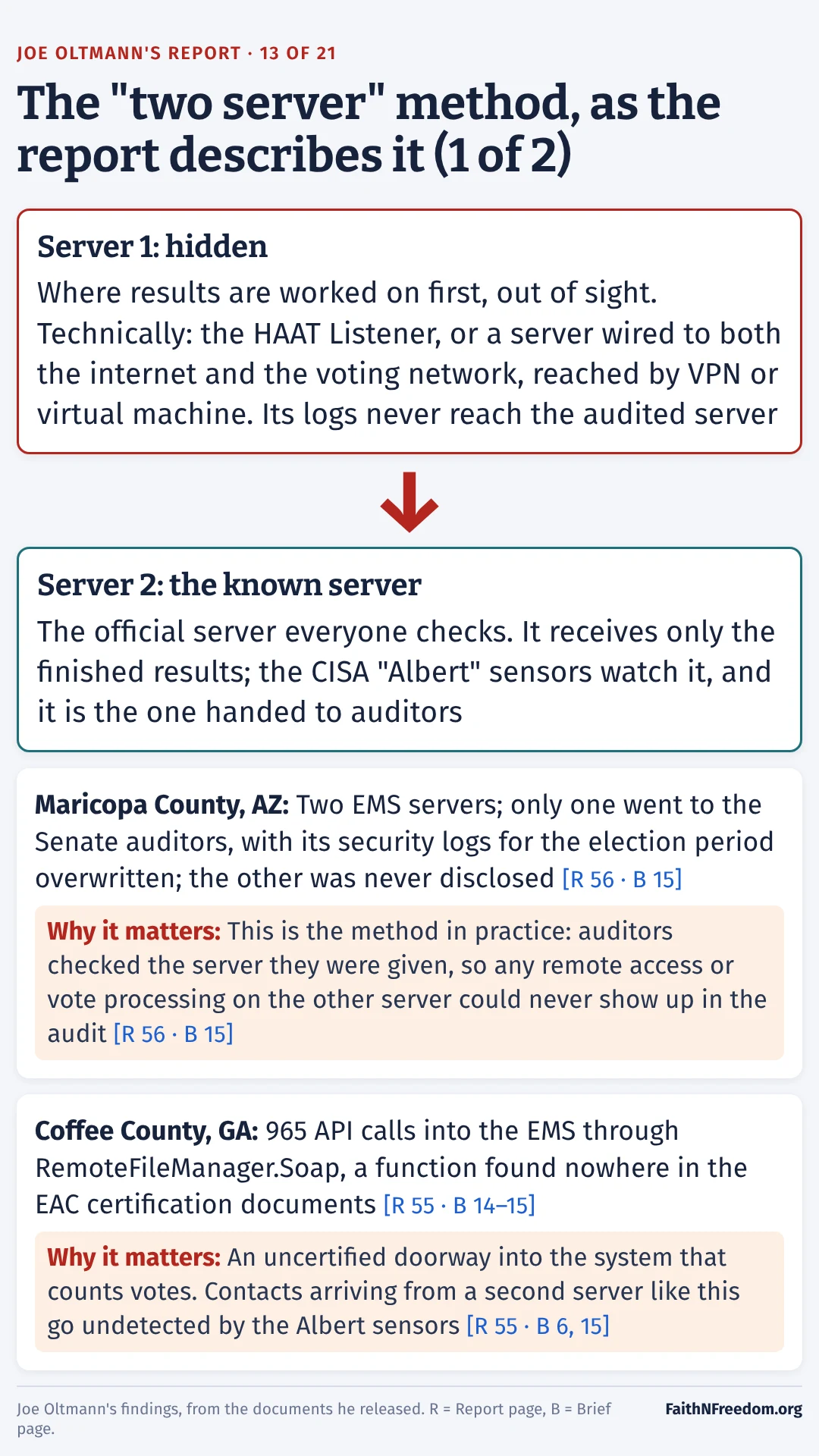
13. The “two server” method, as the report describes it (1 of 2)
Server 1: hidden
Where results are worked on first, out of sight. Technically: the HAAT Listener, or a server wired to both the internet and the voting network, reached by VPN or virtual machine. Its logs never reach the audited server
Server 2: the known server
The official server everyone checks. It receives only the finished results; the CISA “Albert” sensors watch it, and it is the one handed to auditors
Maricopa County, AZ: Two EMS servers; only one went to the Senate auditors, with its security logs for the election period overwritten; the other was never disclosed [R 56 · B 15]
Why it matters: This is the method in practice: auditors checked the server they were given, so any remote access or vote processing on the other server could never show up in the audit [R 56 · B 15]
Coffee County, GA: 965 API calls into the EMS through RemoteFileManager.Soap, a function found nowhere in the EAC certification documents [R 55 · B 14–15]
Why it matters: An uncertified doorway into the system that counts votes. Contacts arriving from a second server like this go undetected by the Albert sensors [R 55 · B 6, 15]
of slide 14
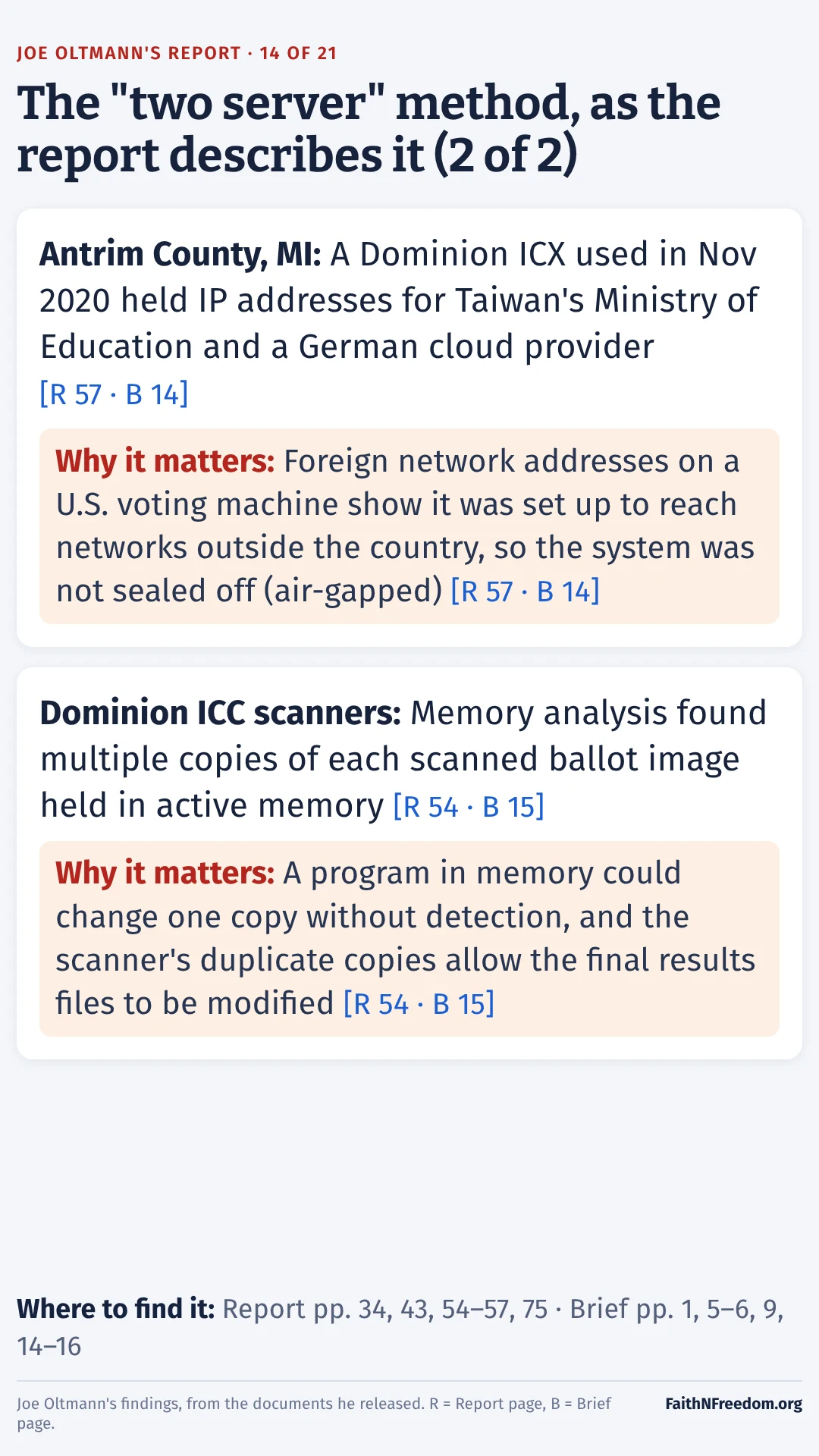
14. The “two server” method, as the report describes it (2 of 2)
Antrim County, MI: A Dominion ICX used in Nov 2020 held IP addresses for Taiwan’s Ministry of Education and a German cloud provider [R 57 · B 14]
Why it matters: Foreign network addresses on a U.S. voting machine show it was set up to reach networks outside the country, so the system was not sealed off (air-gapped) [R 57 · B 14]
Dominion ICC scanners: Memory analysis found multiple copies of each scanned ballot image held in active memory [R 54 · B 15]
Why it matters: A program in memory could change one copy without detection, and the scanner’s duplicate copies allow the final results files to be modified [R 54 · B 15]
Where to find it: Report pp. 34, 43, 54–57, 75 · Brief pp. 1, 5–6, 9, 14–16
of slide 15
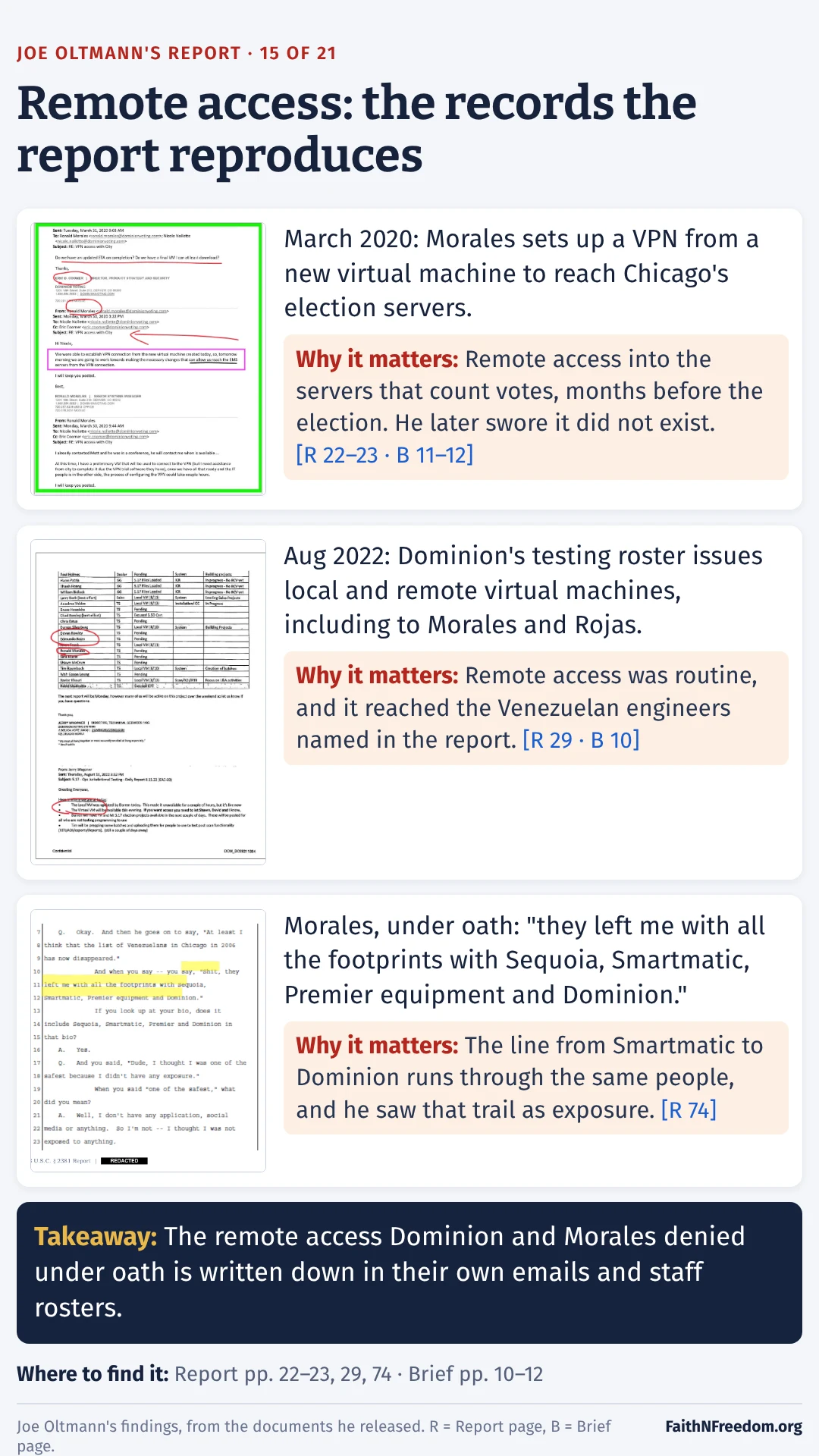
15. Remote access: the records the report reproduces
March 2020: Morales sets up a VPN from a new virtual machine to reach Chicago’s election servers.
Why it matters: Remote access into the servers that count votes, months before the election. He later swore it did not exist. [R 22–23 · B 11–12]
Aug 2022: Dominion’s testing roster issues local and remote virtual machines, including to Morales and Rojas.
Why it matters: Remote access was routine, and it reached the Venezuelan engineers named in the report. [R 29 · B 10]
Morales, under oath: “they left me with all the footprints with Sequoia, Smartmatic, Premier equipment and Dominion.”
Why it matters: The line from Smartmatic to Dominion runs through the same people, and he saw that trail as exposure. [R 74]
Takeaway: The remote access Dominion and Morales denied under oath is written down in their own emails and staff rosters.
Where to find it: Report pp. 22–23, 29, 74 · Brief pp. 10–12
of slide 16
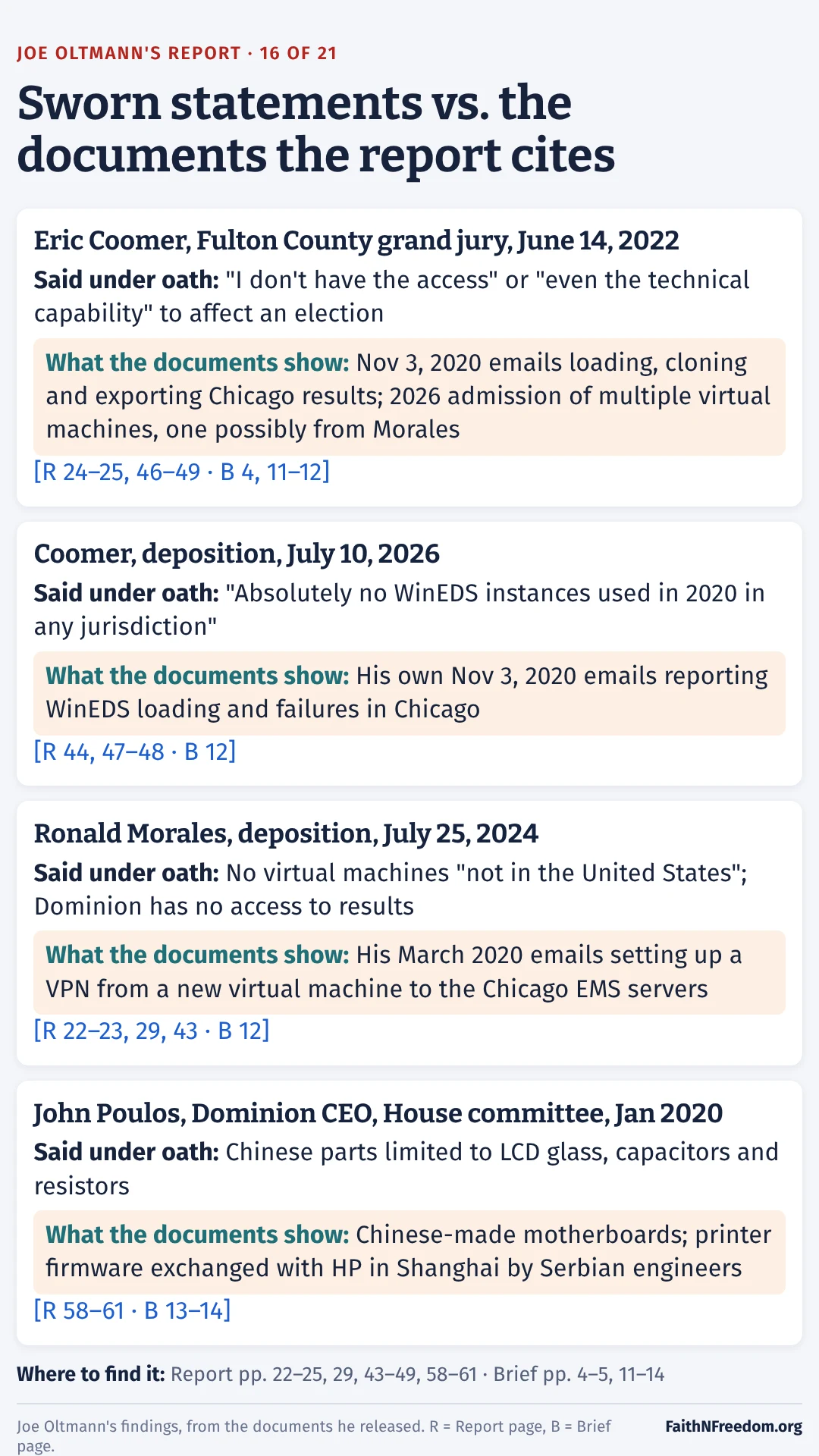
16. Sworn statements vs. the documents the report cites
Eric Coomer, Fulton County grand jury, June 14, 2022
Said under oath: “I don’t have the access” or “even the technical capability” to affect an election
What the documents show: Nov 3, 2020 emails loading, cloning and exporting Chicago results; 2026 admission of multiple virtual machines, one possibly from Morales
[R 24–25, 46–49 · B 4, 11–12]
Coomer, deposition, July 10, 2026
Said under oath: “Absolutely no WinEDS instances used in 2020 in any jurisdiction”
What the documents show: His own Nov 3, 2020 emails reporting WinEDS loading and failures in Chicago
[R 44, 47–48 · B 12]
Ronald Morales, deposition, July 25, 2024
Said under oath: No virtual machines “not in the United States”; Dominion has no access to results
What the documents show: His March 2020 emails setting up a VPN from a new virtual machine to the Chicago EMS servers
[R 22–23, 29, 43 · B 12]
John Poulos, Dominion CEO, House committee, Jan 2020
Said under oath: Chinese parts limited to LCD glass, capacitors and resistors
What the documents show: Chinese-made motherboards; printer firmware exchanged with HP in Shanghai by Serbian engineers
[R 58–61 · B 13–14]
Where to find it: Report pp. 22–25, 29, 43–49, 58–61 · Brief pp. 4–5, 11–14
of slide 17
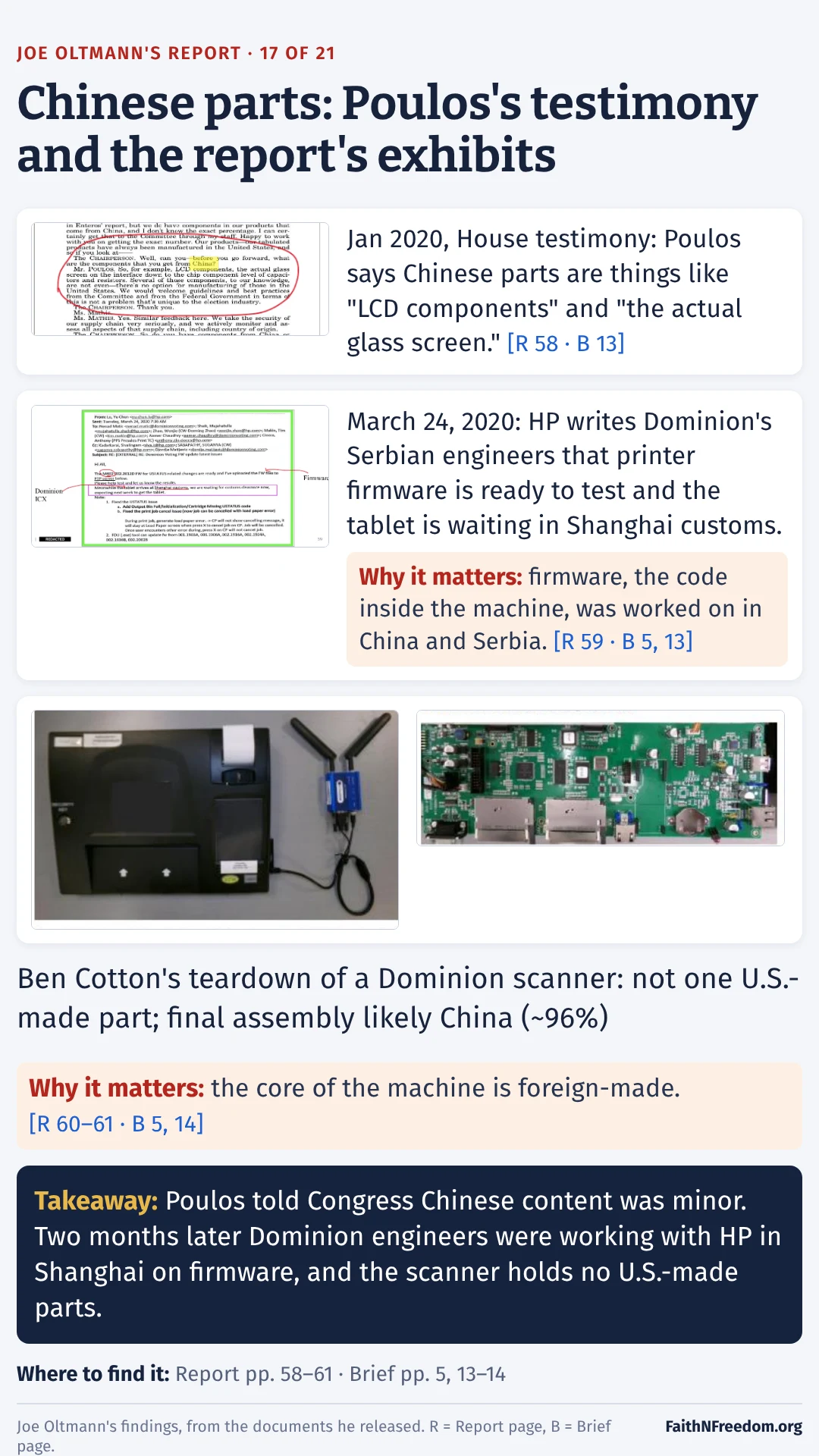
17. Chinese parts: Poulos’s testimony and the report’s exhibits
Jan 2020, House testimony: Poulos says Chinese parts are things like “LCD components” and “the actual glass screen.” [R 58 · B 13]
March 24, 2020: HP writes Dominion’s Serbian engineers that printer firmware is ready to test and the tablet is waiting in Shanghai customs.
Why it matters: firmware, the code inside the machine, was worked on in China and Serbia. [R 59 · B 5, 13]
Ben Cotton’s teardown of a Dominion scanner: not one U.S.-made part; final assembly likely China (~96%)
Why it matters: the core of the machine is foreign-made. [R 60–61 · B 5, 14]
Takeaway: Poulos told Congress Chinese content was minor. Two months later Dominion engineers were working with HP in Shanghai on firmware, and the scanner holds no U.S.-made parts.
Where to find it: Report pp. 58–61 · Brief pp. 5, 13–14
of slide 18
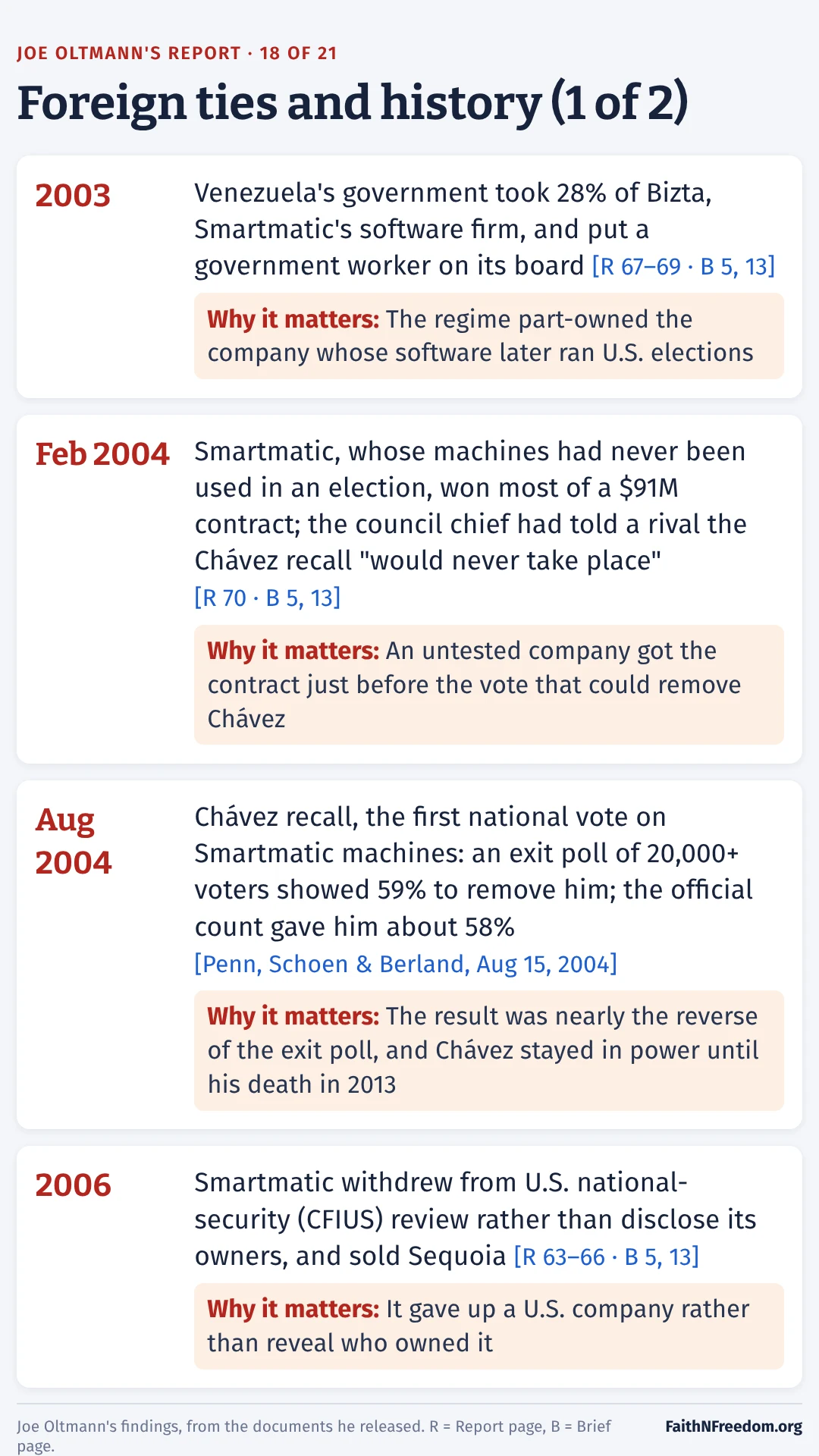
18. Foreign ties and history (1 of 2)
2003
Venezuela’s government took 28% of Bizta, Smartmatic’s software firm, and put a government worker on its board [R 67–69 · B 5, 13]
Why it matters: The regime part-owned the company whose software later ran U.S. elections
Feb 2004
Smartmatic, whose machines had never been used in an election, won most of a $91M contract; the council chief had told a rival the Chávez recall “would never take place” [R 70 · B 5, 13]
Why it matters: An untested company got the contract just before the vote that could remove Chávez
Aug 2004
Chávez recall, the first national vote on Smartmatic machines: an exit poll of 20,000+ voters showed 59% to remove him; the official count gave him about 58% [Penn, Schoen & Berland, Aug 15, 2004]
Why it matters: The result was nearly the reverse of the exit poll, and Chávez stayed in power until his death in 2013
2006
Smartmatic withdrew from U.S. national-security (CFIUS) review rather than disclose its owners, and sold Sequoia [R 63–66 · B 5, 13]
Why it matters: It gave up a U.S. company rather than reveal who owned it
of slide 19
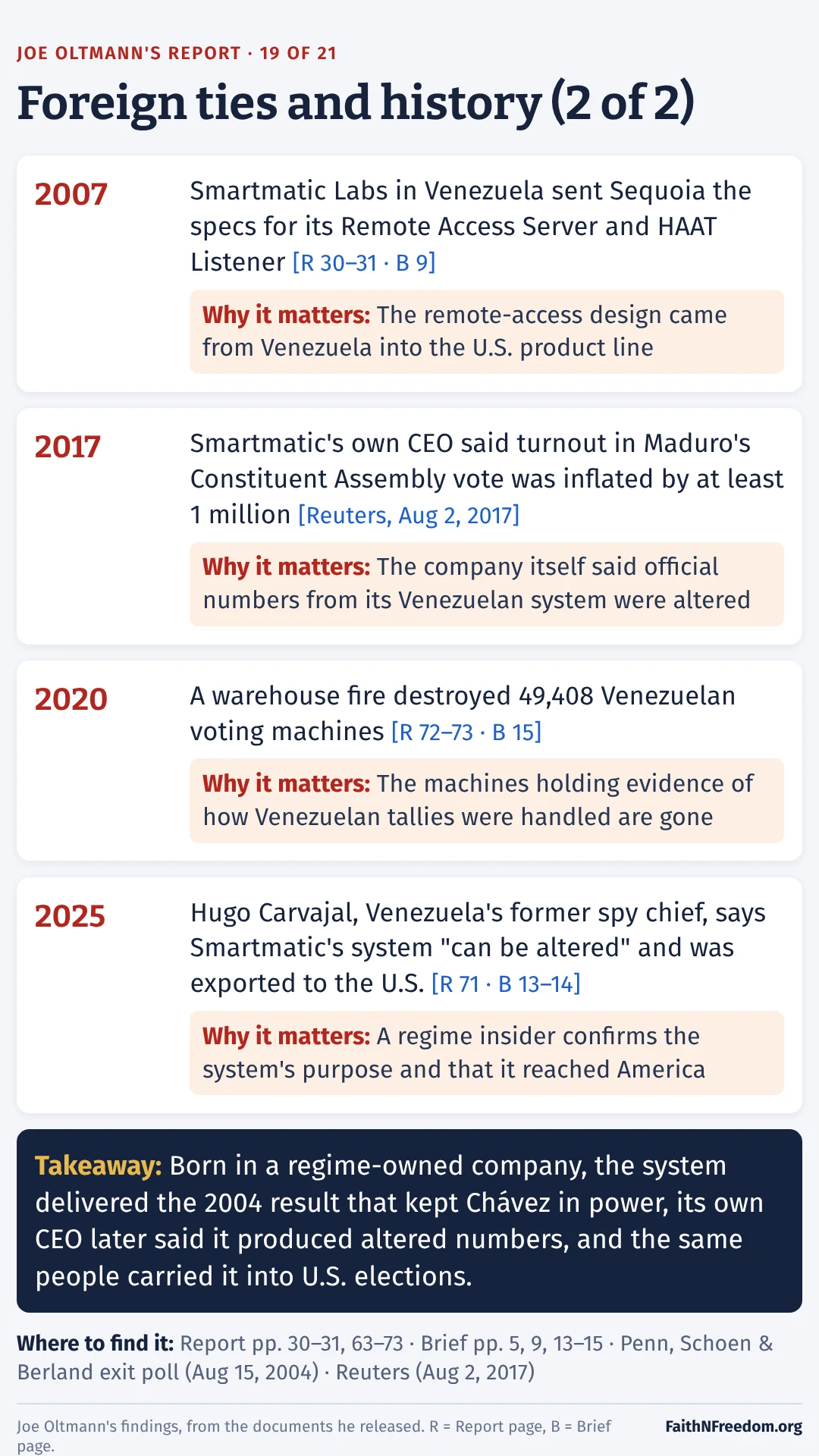
19. Foreign ties and history (2 of 2)
2007
Smartmatic Labs in Venezuela sent Sequoia the specs for its Remote Access Server and HAAT Listener [R 30–31 · B 9]
Why it matters: The remote-access design came from Venezuela into the U.S. product line
2017
Smartmatic’s own CEO said turnout in Maduro’s Constituent Assembly vote was inflated by at least 1 million [Reuters, Aug 2, 2017]
Why it matters: The company itself said official numbers from its Venezuelan system were altered
2020
A warehouse fire destroyed 49,408 Venezuelan voting machines [R 72–73 · B 15]
Why it matters: The machines holding evidence of how Venezuelan tallies were handled are gone
2025
Hugo Carvajal, Venezuela’s former spy chief, says Smartmatic’s system “can be altered” and was exported to the U.S. [R 71 · B 13–14]
Why it matters: A regime insider confirms the system’s purpose and that it reached America
Takeaway: Born in a regime-owned company, the system delivered the 2004 result that kept Chávez in power, its own CEO later said it produced altered numbers, and the same people carried it into U.S. elections.
Where to find it: Report pp. 30–31, 63–73 · Brief pp. 5, 9, 13–15 · Penn, Schoen & Berland exit poll (Aug 15, 2004) · Reuters (Aug 2, 2017)
of slide 20
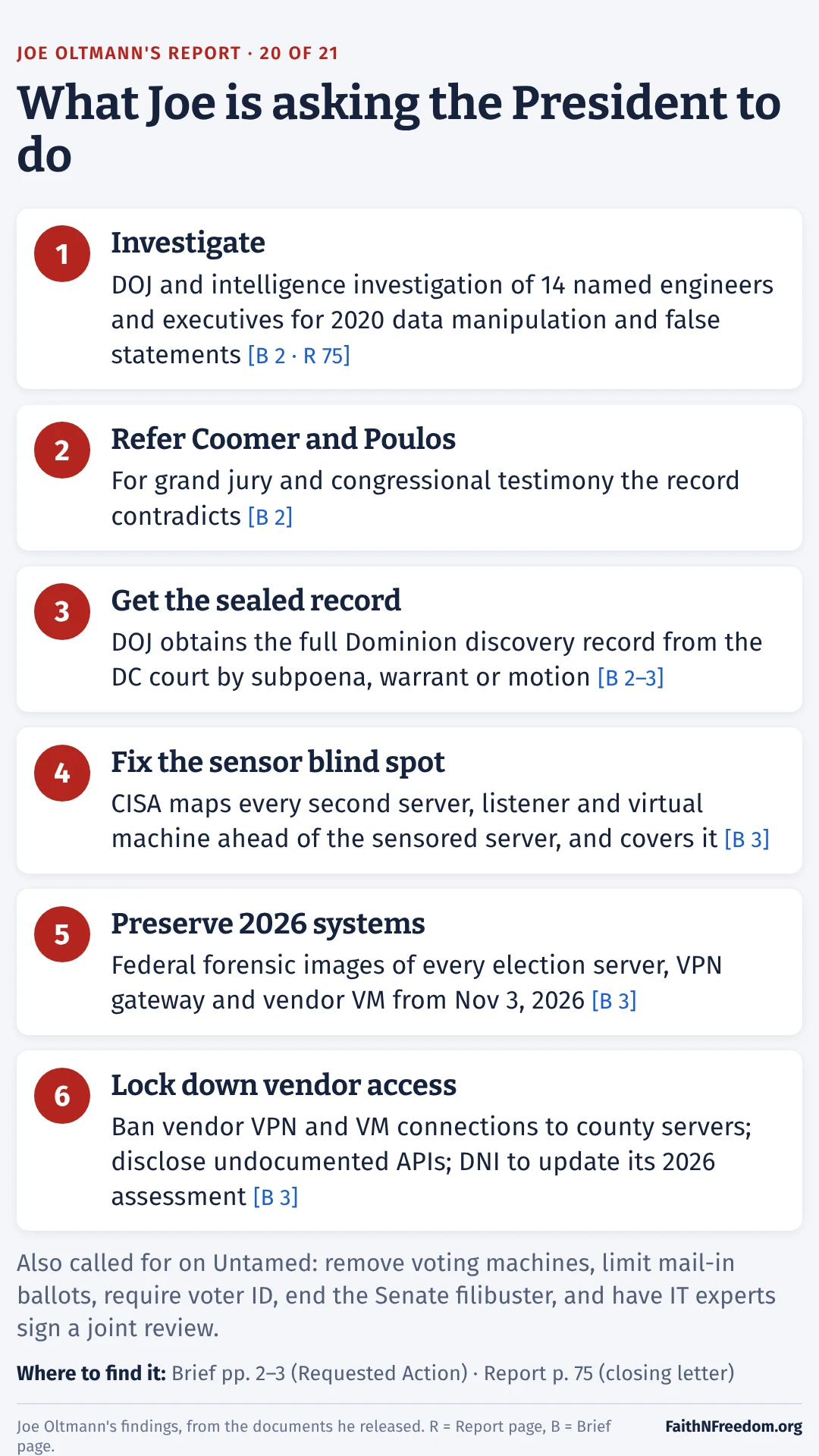
20. What Joe is asking the President to do
1. Investigate
DOJ and intelligence investigation of 14 named engineers and executives for 2020 data manipulation and false statements [B 2 · R 75]
2. Refer Coomer and Poulos
For grand jury and congressional testimony the record contradicts [B 2]
3. Get the sealed record
DOJ obtains the full Dominion discovery record from the DC court by subpoena, warrant or motion [B 2–3]
4. Fix the sensor blind spot
CISA maps every second server, listener and virtual machine ahead of the sensored server, and covers it [B 3]
5. Preserve 2026 systems
Federal forensic images of every election server, VPN gateway and vendor VM from Nov 3, 2026 [B 3]
6. Lock down vendor access
Ban vendor VPN and VM connections to county servers; disclose undocumented APIs; DNI to update its 2026 assessment [B 3]
Also called for on Untamed: remove voting machines, limit mail-in ballots, require voter ID, end the Senate filibuster, and have IT experts sign a joint review.
Where to find it: Brief pp. 2–3 (Requested Action) · Report p. 75 (closing letter)
of slide 21
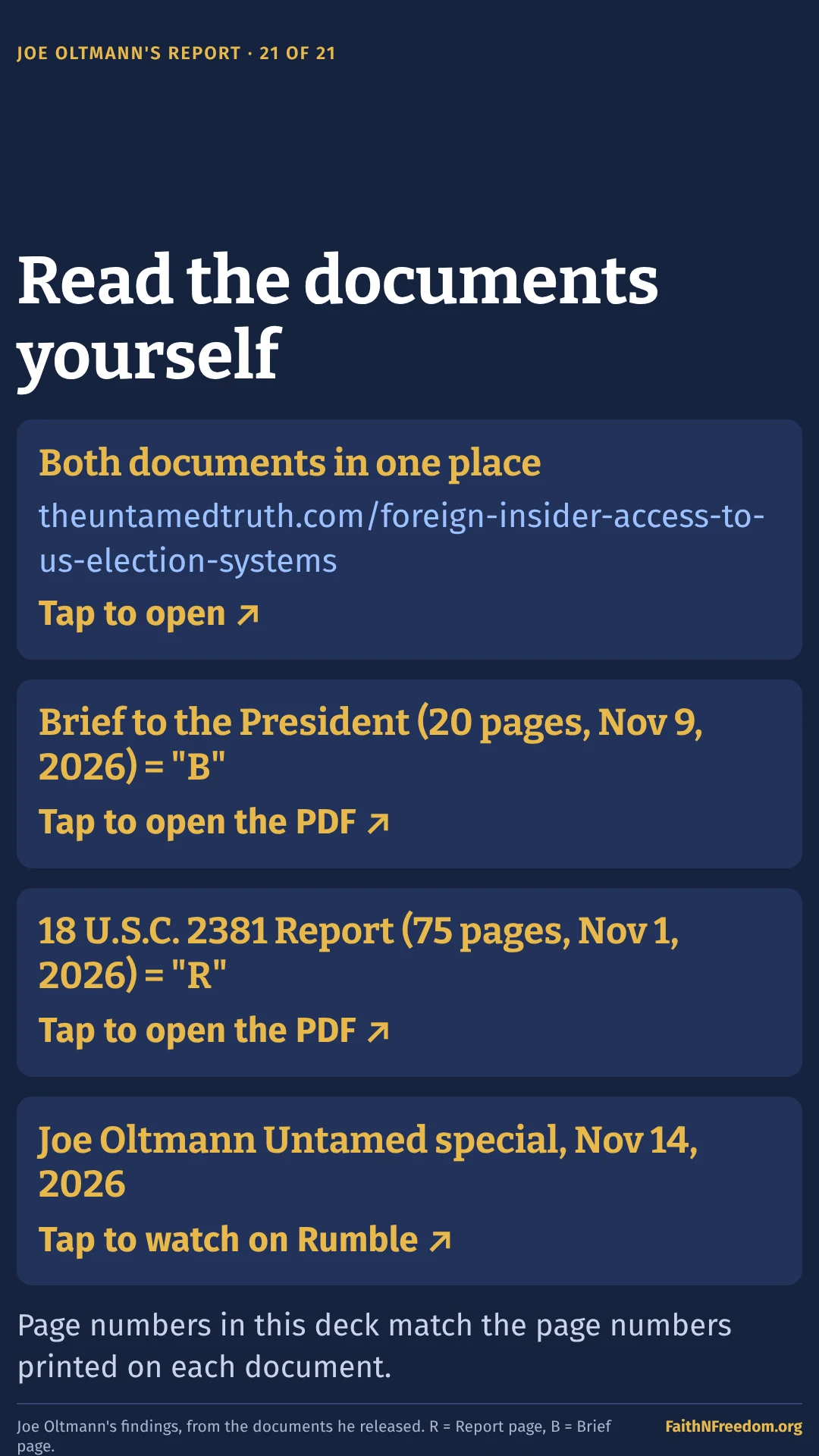
21. Read the documents yourself
- Both documents in one place: theuntamedtruth.com/foreign-insider-access-to-us-election-systems
- Brief to the President (20 pages, Nov 9, 2026) = “B”: open the Brief (PDF)
- 18 U.S.C. 2381 Report (75 pages, Nov 1, 2026) = “R”: open the Report (PDF)
- Joe Oltmann Untamed special, Nov 14, 2026: watch on Rumble
Page numbers on these slides match the page numbers printed on each document.
Questions about the report
What are Joe Oltmann’s Report and Brief to the President?
The 18 U.S.C. 2381 Report is a 75-page document dated November 1, 2026, prepared for President Trump with its author’s name redacted and named after the federal treason statute. The Brief to the President is Oltmann’s own 20-page summary of it, dated November 9, 2026. Oltmann says together they trace Smartmatic’s election software and engineers through Sequoia into Dominion. He presented both on Untamed on November 14, 2026.
Who owns Smartmatic, according to the Report?
Oltmann’s Report says that in 2003 Venezuela’s government took a 28% stake in Bizta, Smartmatic’s software firm, and put a government worker on its board. It also says that in 2006 Smartmatic withdrew from a U.S. national-security review by CFIUS rather than disclose its owners, and sold Sequoia. This page covers only what the Report says about ownership, with its page numbers, not Smartmatic’s ownership today.
Is Dominion owned by Smartmatic?
Oltmann’s Report does not say Smartmatic owns Dominion. It traces one lineage of software and people: Smartmatic (Caracas), then Sequoia, then Dominion from 2010, then Liberty Vote, Hart and Smartmatic today. The Report says the engineers who built Smartmatic’s software moved with it into Dominion. Dominion and Liberty Vote say no Smartmatic legacy equipment or programming was used in 2020; the Report says their own records contradict that.
Where does Oltmann say the evidence comes from?
Oltmann says the emails and deposition excerpts are Dominion’s own documents, produced in discovery in two federal lawsuits in Washington, DC: Dominion v. Byrne and Dominion v. Powell, stamped Confidential. According to the Brief, the court sealed those exhibits in March 2024, and only the excerpts pulled before the seal are in his hands; he says only the Department of Justice can obtain the full record.
What is the “two server” method Oltmann describes?
According to the Report, results are first worked on a hidden server that is reached by VPN or a virtual machine and whose logs never reach the audited system, and only the finished results are sent to the official server. Oltmann says the federal Albert sensors watch only that official server, so activity on the first one would not be seen. He cites Maricopa County, Coffee County and Antrim County as examples.
What does the Report say about Smartmatic and Venezuela?
The Report says Smartmatic’s software was built for the Chávez and Maduro governments and that the same engineers carried it through Sequoia into Dominion. It cites the 2004 Chávez recall, the first national vote on Smartmatic machines, and Smartmatic’s own CEO saying in 2017, as reported by Reuters, that turnout in a Maduro vote was inflated by at least 1 million. These are the Report’s claims and citations.
What is Oltmann asking the President to do?
The Brief asks for six actions: a Justice Department and intelligence investigation of 14 named engineers and executives; referral of Eric Coomer and John Poulos over their testimony; obtaining the sealed Dominion discovery record from the DC court; having CISA cover every second server and virtual machine; forensic images of every election server from November 3, 2026; and a ban on vendor remote access to county servers.
How can I check these findings myself?
Every point on this page carries the page where it appears in the 75-page Report (R) or the 20-page Brief (B), and the page numbers match those printed on each document. Both documents are linked in full on this page, along with Oltmann’s Untamed special from November 14, 2026. The court cases are named with their case numbers, and outside sources such as Reuters and the CISA statement are named with their dates.
Joe Oltmann’s findings, from the documents he released. R = Report page, B = Brief page. Join the discussion at FaithNFreedom.Social.