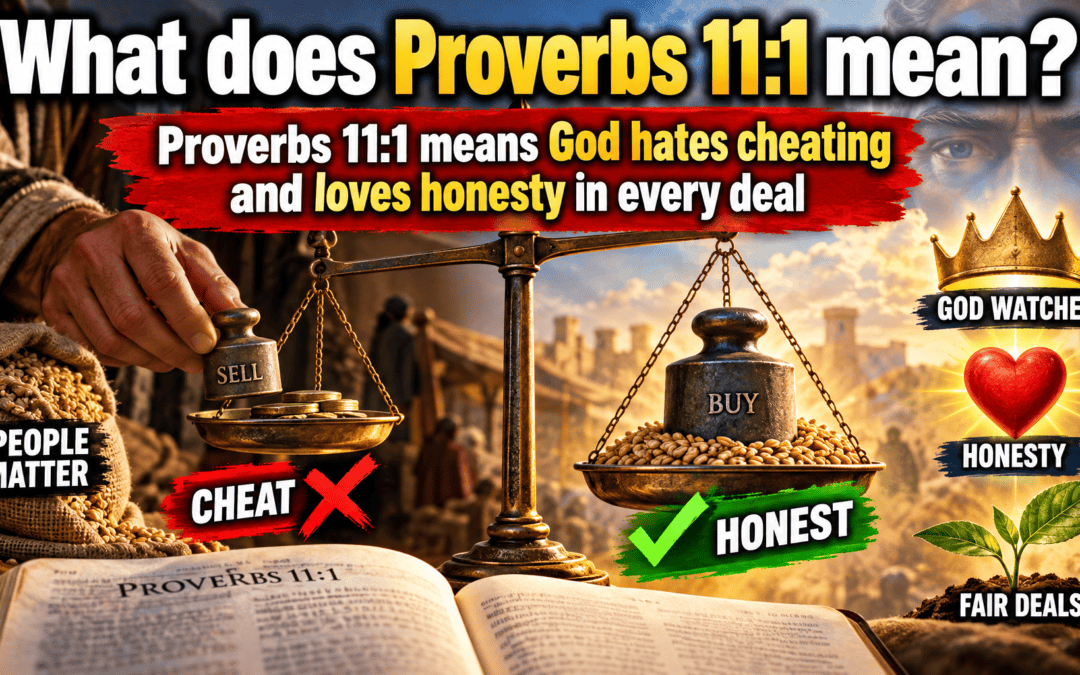
What does Proverbs 11:1 mean? Proverbs 11:1 means God hates cheating and loves honesty in every deal: “A false balance is an abomination to the LORD, but a just weight is his delight.” In Bible times goods were weighed on scales, and a dishonest merchant kept one weight for buying and a lighter one for selling. God calls that an abomination, and He wants His people to deal with one honest measure in business, in money and in life.
▶ Watch the Full Interview: Gavin Mehl on Sound Money
Proverbs 11:1 in the ESV
A false balance is an abomination to the LORD, but a just weight is his delight.
In Solomon’s day there were no price tags or card readers. Silver and grain changed hands on a balance scale, with stone weights set on one side. Whoever owned the scale and the weights controlled the deal. Proverbs 11:1 says God is watching that scale, and He cares how it is used. Solomon says the same thing again a few chapters later:
A just balance and scales are the LORD’s; all the weights in the bag are his work.
Honest measures belong to God. A merchant who cheats on the scale is not only robbing his customer; he is tampering with something God calls His own.
What Was a False Balance?
The trick was simple. A dishonest trader carried two sets of weights: a heavy one for buying and a light one for selling. He got more when he bought and gave less when he sold, and the customer never saw the difference. The law of Moses named the practice and banned it:
You shall not have in your bag two kinds of weights, a large and a small.
A full and fair weight you shall have, a full and fair measure you shall have, that your days may be long in the land that the LORD your God is giving you.
Notice that the law did not only forbid using a false weight. It forbade owning one. God knew that a crooked tool kept in the bag will eventually be used. The same is true of the heart: the safest place to stop dishonesty is before it is packed and ready.
God did not leave honesty to each merchant’s conscience. He wrote it into the law of the nation. Leviticus 19:35 forbids any wrong “in measures of length or weight or quantity,” and the next verse goes down to the size of the measuring baskets:
You shall have just balances, just weights, a just ephah, and a just hin: I am the LORD your God, who brought you out of the land of Egypt.
Why God Calls It an Abomination
Abomination is one of the strongest words in the Old Testament. It is used for idolatry and for the worst sins of the nations. Proverbs uses it for crooked scales here and twice more in chapter 20 (verses 10 and 23):
Unequal weights and unequal measures are both alike an abomination to the LORD.
Why so strong? Look again at how Leviticus 19:36 ends: God signs the law with the name of the One who brought Israel out of Egypt. Israel had been slaves, cheated of their labor for generations. The God who freed them would not let them build a nation on the same kind of theft. A false balance says, quietly, that God is not watching. Deuteronomy answers that directly:
For all who do such things, all who act dishonestly, are an abomination to the LORD your God.
False Balances Hurt the Poor First
The prophets saw where crooked measures lead. Amos heard the merchants of Israel counting the hours until the Sabbath ended so they could get back to cheating:
that we may make the ephah small and the shekel great and deal deceitfully with false balances…
“Make the ephah small and the shekel great”: smaller portions for the same silver, and higher prices for the same goods. The people who feel that first are the ones with the least to spare. Micah asked whether God could look the other way:
Shall I acquit the man with wicked scales and with a bag of deceitful weights?
The answer is no. Cheating on the measure is a sin against people and against God, and Scripture never treats it as just business.
What Does the Bible Say About Money?
Proverbs 11:1 opens a bigger question that many people search for: what does the Bible say about money? Money itself is not evil, but it makes a terrible master. Jesus put the choice plainly:
No one can serve two masters, for either he will hate the one and love the other, or he will be devoted to the one and despise the other. You cannot serve God and money.
Paul warned that the danger is not money but the love of it:
For the love of money is a root of all kinds of evils.
In the same verse Paul adds that this craving has led some to wander away from the faith. The cure is contentment, and it rests on a promise rather than a balance sheet:
Keep your life free from love of money, and be content with what you have, for he has said, “I will never leave you nor forsake you.”
Faithful in a Very Little
The Bible also warns against chasing quick riches. Plenty of believers have been burned by a get-rich-quick scheme, and Proverbs saw it coming three thousand years ago:
Wealth gained hastily will dwindle, but whoever gathers little by little will increase it.
Quick money tempts us because it promises freedom without patience. But wealth that comes fast usually leaves fast, and it often takes our peace with it. The person who saves a little at a time, works honestly and gives faithfully is building something God can bless.
Jesus taught that how we handle small amounts shows what we can be trusted with. Honest weights start in the little things: a fair price, an accurate invoice, a promise kept when no one is checking.
One who is faithful in a very little is also faithful in much, and one who is dishonest in a very little is also dishonest in much.
Proverbs 22:7 adds a warning about debt: the borrower becomes the servant of the lender. Debt is not called sin, but Scripture is honest about what it does. Every dollar borrowed puts a little of your freedom on someone else’s scale, so borrow slowly and pay back faithfully.
Honest Weights and Money Today
Scripture never mentions paper currency or digital dollars, but the principle reaches them. In Bible times the measure of value was silver weighed on a scale. When a nation’s money buys less every year, savers are paid back with a lighter weight than the one they put in. Many Christians, including Rick B2T and his guest on the B2T Show of October 22, 2026, see that as a modern false balance. God’s standard for those who govern measures has not changed:
You shall have just balances, a just ephah, and a just bath.
Some believers also worry about a future system where every purchase can be tracked and switched off. Scripture describes a day when buying and selling will be tied to a mark:
so that no one can buy or sell unless he has the mark, that is, the name of the beast or the number of its name.
On the show, guest Gavin Mehl, who covers the laws and technology of digital money, gave a measured answer when asked whether Christians should be concerned about central bank digital currencies:
You should be aware. Not concerned, but aware.
— Gavin Mehl, on the B2T Show, October 22, 2026
Fear is not the answer to a world that wants to control money, and neither is panic buying or a rush into the next promised fix. The early church lived under Rome, whose coins carried the face of a man who called himself divine. They paid their taxes, dealt honestly and still refused to bow. Their security was never the coin in their hand.
That is the right posture. Be aware, stay honest and keep your trust in God, not in any system of money, old or new.
Proverbs 11:1 for Today
You may never stand behind a merchant’s scale, but you use a balance every day. Here is how to keep it just:
- Use one set of weights. Charge, report and pay the same way whether anyone is watching or not.
- Be faithful in the little things. Small honesty builds the character God trusts with more (Luke 16:10).
- Refuse quick riches. Gather little by little (Proverbs 13:11), and never put your future on one bet.
- Guard your freedom. Borrow carefully, because the borrower serves the lender (Proverbs 22:7).
- Stand up for the poor. Crooked measures hurt them first (Amos 8:5).
- Keep money in its place. Serve God, and let money serve you (Matthew 6:24).
For where your treasure is, there your heart will be also.
Commit your work to the LORD, and your plans will be established.
Watch on FaithNFreedom
This study grows out of the B2T Show of October 22, 2026, where host Rick B2T and guest Gavin Mehl talked about what the Bible says about sound money, the difference between money and currency, and the history of Bitcoin. Watch the full interview and join the discussion on FaithNFreedom Social, or watch FaithNFreedomTV free, 24/7, with no subscription required.
▶ Watch the Full Interview: Gavin Mehl on Sound Money
Closing Prayer
Lord, a just weight is Your delight. Make us people of one honest measure, in our homes, our work and our giving. Guard our hearts from the love of money and from the hunger for quick riches. Teach us to be faithful in very little, generous to the poor, and content with what You provide. When the systems of this world shift and shake, remind us that our treasure is in heaven and that You will never leave us nor forsake us. In Jesus’ name, amen.
Bible Teaching and Discussion
Bible teaching and discussion continue in Faith Blogs & Discussions on FaithNFreedom Social, and you can watch FaithNFreedomTV free, 24/7.
Scripture quotations are from the ESV® Bible (The Holy Bible, English Standard Version®), © 2001 by Crossway, a publishing ministry of Good News Publishers. Used by permission. All rights reserved.
Questions About Proverbs 11:1
What does Proverbs 11:1 mean?
Proverbs 11:1 means God hates cheating and delights in honesty. In Solomon’s day, goods and silver were weighed on balance scales, and dishonest merchants used false weights to take more than they paid for. God calls that an abomination, one of the strongest words in Scripture. A just weight, an honest measure used the same way for everyone, is His delight, in business, in money and in every promise we make.
What is a false balance in the Bible?
A false balance is a scale or set of weights rigged to cheat. Merchants in Bible times carried two kinds of weights, a heavy one for buying and a light one for selling, so they gained on both ends of every deal. Deuteronomy 25:13–16 bans “two kinds of weights, a large and a small,” and Leviticus 19:35–36 requires just balances, just weights and honest measures in Israel.
What does the Bible say about money?
The Bible says money is a tool to use honestly and a master we must never serve. Jesus said, “You cannot serve God and money” (Matthew 6:24). Paul warned that “the love of money is a root of all kinds of evils” (1 Timothy 6:10). Scripture calls for honest measures (Proverbs 11:1), patient saving (Proverbs 13:11), caution with debt (Proverbs 22:7) and contentment (Hebrews 13:5).
Why are unequal weights an abomination to the Lord?
Unequal weights are an abomination because they are theft that pretends to be honest, and they deny that God is watching. Proverbs 20:10 says unequal weights and measures “are both alike an abomination to the LORD.” In Leviticus 19:36, God ties honest measures to His own name and to Israel’s freedom from Egypt. The God who freed slaves would not let His people cheat one another.
Is money the root of all evil?
No, the Bible does not say money is the root of all evil. First Timothy 6:10 says, “For the love of money is a root of all kinds of evils.” The problem is the craving, which Paul says has led some to wander away from the faith. Money handled honestly and generously can serve God’s purposes. Money loved and trusted becomes a master that competes with Him.
What does Proverbs 11:1 say about money that loses value?
Proverbs 11:1 does not mention modern currency, but its principle applies. In Bible times the measure of value was silver weighed on a scale, so a false weight meant paying with less than promised. Many Christians see money that steadily buys less as a modern false balance, because savers get back a lighter weight than they put in. Ezekiel 45:10 calls for “just balances” from those who govern.
Should Christians be worried about digital currency?
Christians should be informed and prayerful, not fearful. Revelation 13:17 describes a coming day when no one can buy or sell without a mark, so many believers watch closely any system that could track and control every purchase. On the B2T Show of October 22, 2026, guest Gavin Mehl said Christians should be “aware. Not concerned, but aware.” Our security rests in God, not in any system of money.