
By Rick Rene
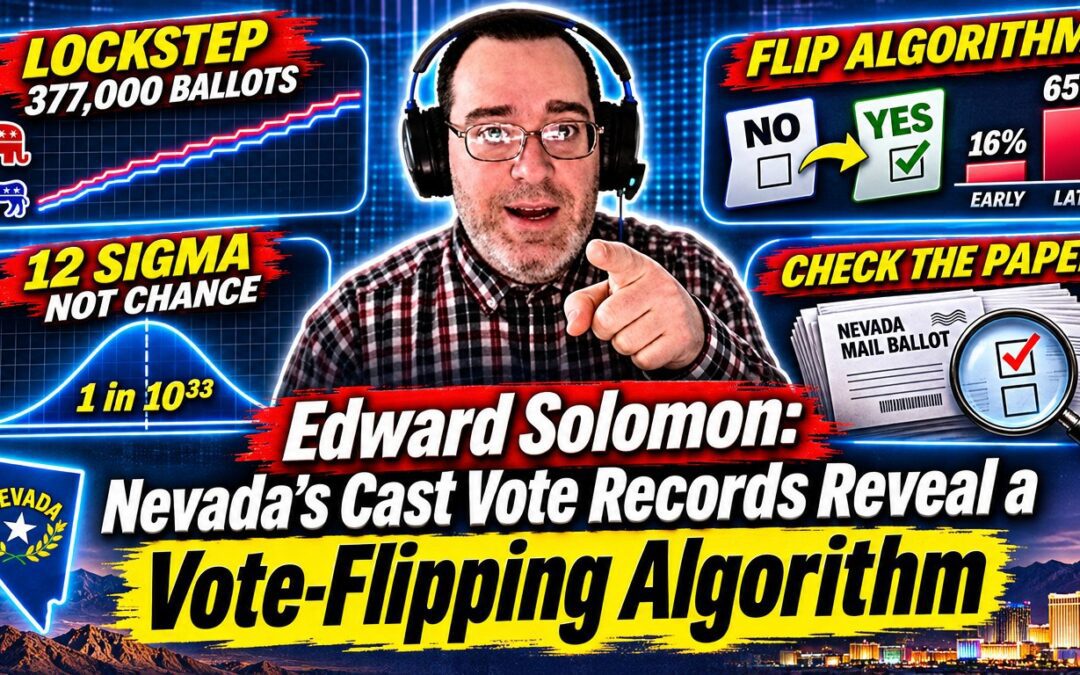
What did Edward Solomon find in Nevada’s vote records?
In his sworn declaration of August 1, 2026, with its November 2026 extension, Solomon finds:
- A vote-flipping algorithm: software flipped No votes to Yes as the ballots were counted, at a rate that climbed from about 16% to 65%.
- 12 sigma, not chance: Republican and Democratic voters moved in exact lockstep for 377,000 Clark County mail ballots in a row. Shuffle them inside their own precincts and the lockstep vanishes. The odds of chance are 1 in 1033.
- Rebuilt from scratch: his simulation of the flip produces exactly the pattern in the state’s record.
- It happened again in 2026: Lombardo voters on abortion moved with Ford voters on voter ID, and 1,700 extra Ford ballots were every one No on voter ID.
His evidence: Nevada’s own certified Cast Vote Records, graphed exactly as recorded.
of slide 1
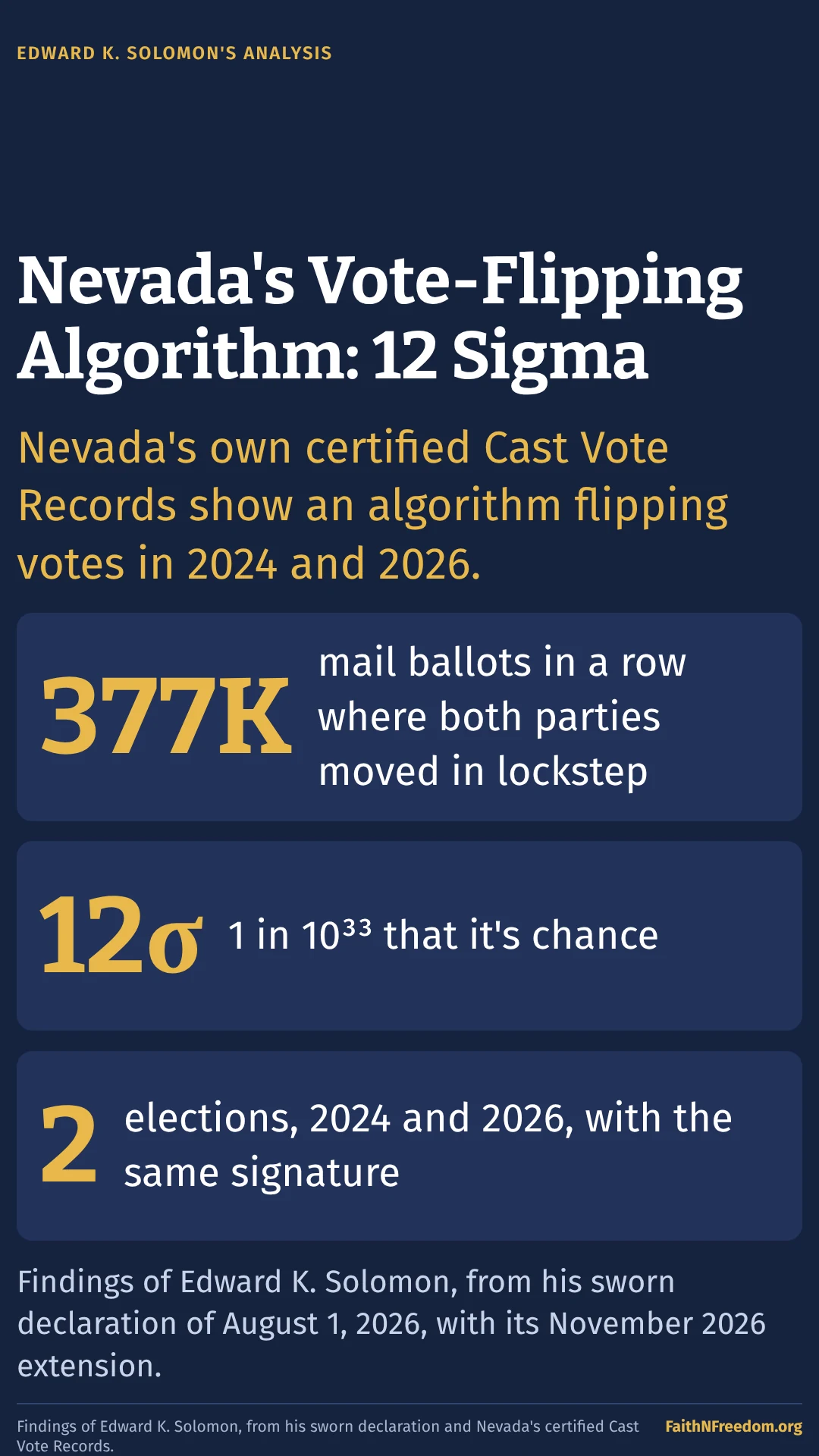
1. Nevada’s Vote-Flipping Algorithm: 12 Sigma
Nevada’s own certified Cast Vote Records show an algorithm flipping votes in 2024 and 2026.
377Kmail ballots in a row where both parties moved in lockstep
12σ1 in 10³³ that it’s chance
2elections, 2024 and 2026, with the same signature
Findings of Edward K. Solomon, from his sworn declaration of August 1, 2026, with its November 2026 extension.
of slide 2
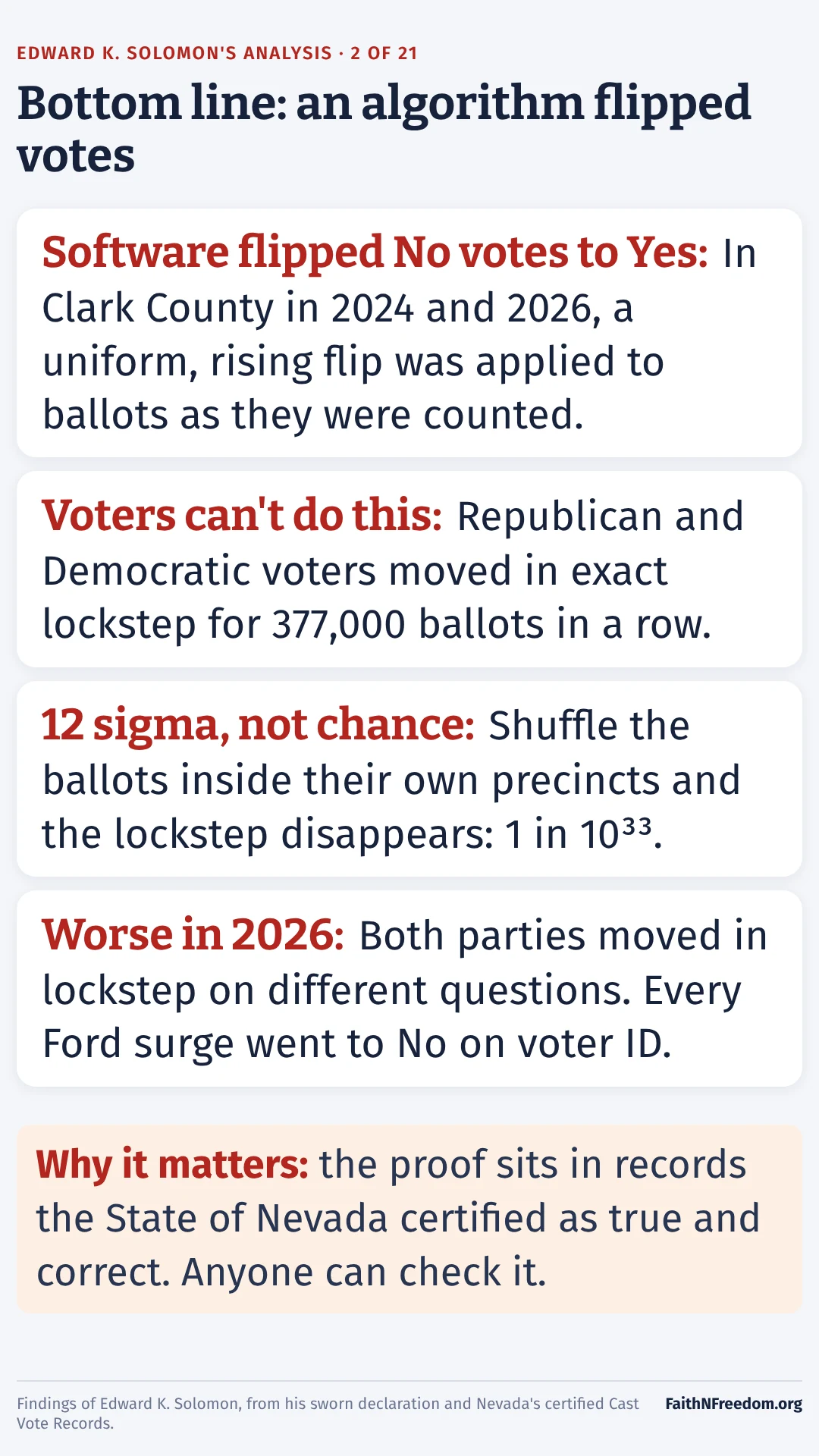
2. Bottom line: an algorithm flipped votes
- Software flipped No votes to Yes: In Clark County in 2024 and 2026, a uniform, rising flip was applied to ballots as they were counted.
- Voters can’t do this: Republican and Democratic voters moved in exact lockstep for 377,000 ballots in a row.
- 12 sigma, not chance: Shuffle the ballots inside their own precincts and the lockstep disappears: 1 in 10³³.
- Worse in 2026: Both parties moved in lockstep on different questions. Every Ford surge went to No on voter ID.
Why it matters: the proof sits in records the State of Nevada certified as true and correct. Anyone can check it.
of slide 3
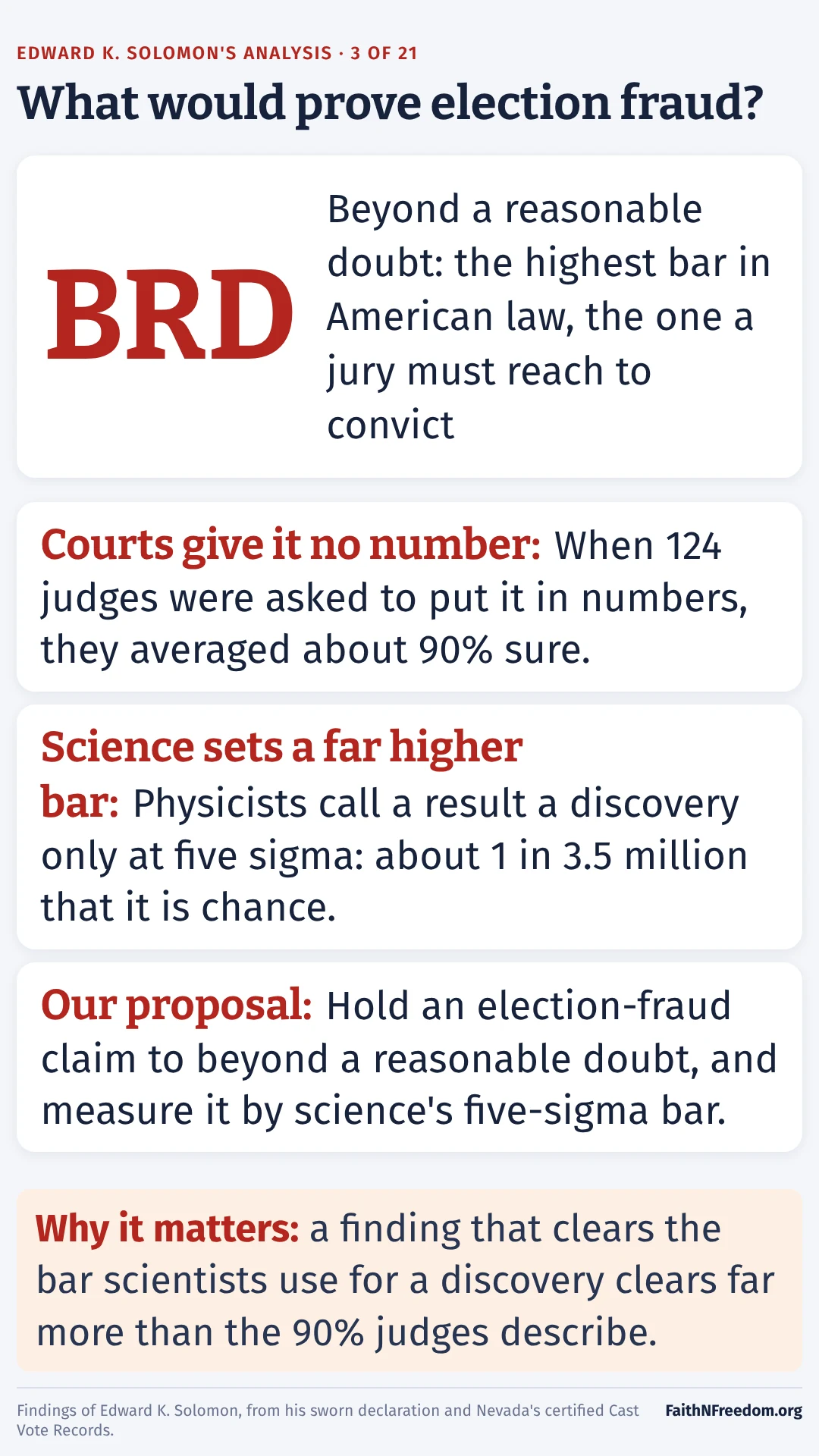
3. What would prove election fraud?
BRDBeyond a reasonable doubt: the highest bar in American law, the one a jury must reach to convict
- Courts give it no number: When 124 judges were asked to put it in numbers, they averaged about 90% sure.
- Science sets a far higher bar: Physicists call a result a discovery only at five sigma: about 1 in 3.5 million that it is chance.
- Our proposal: Hold an election-fraud claim to beyond a reasonable doubt, and measure it by science’s five-sigma bar.
Why it matters: a finding that clears the bar scientists use for a discovery clears far more than the 90% judges describe.
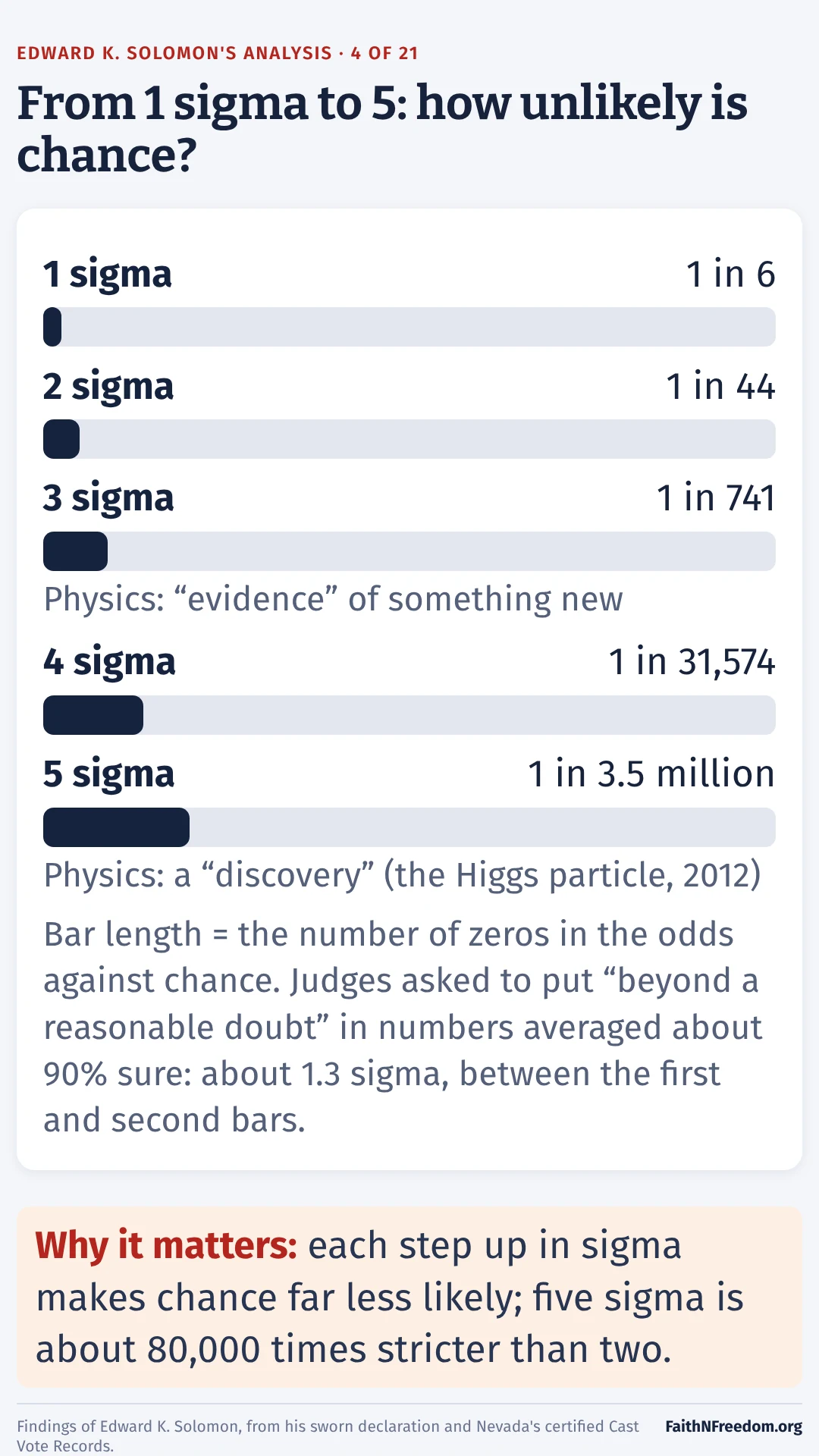
of slide 4
4. From 1 sigma to 5: how unlikely is chance?
1 sigma1 in 62 sigma1 in 443 sigma1 in 741Physics: “evidence” of something new4 sigma1 in 31,5745 sigma1 in 3.5 millionPhysics: a “discovery” (the Higgs particle, 2012)
Bar length = the number of zeros in the odds against chance. Judges asked to put “beyond a reasonable doubt” in numbers averaged about 90% sure: about 1.3 sigma, between the first and second bars.
Why it matters: each step up in sigma makes chance far less likely; five sigma is about 80,000 times stricter than two.
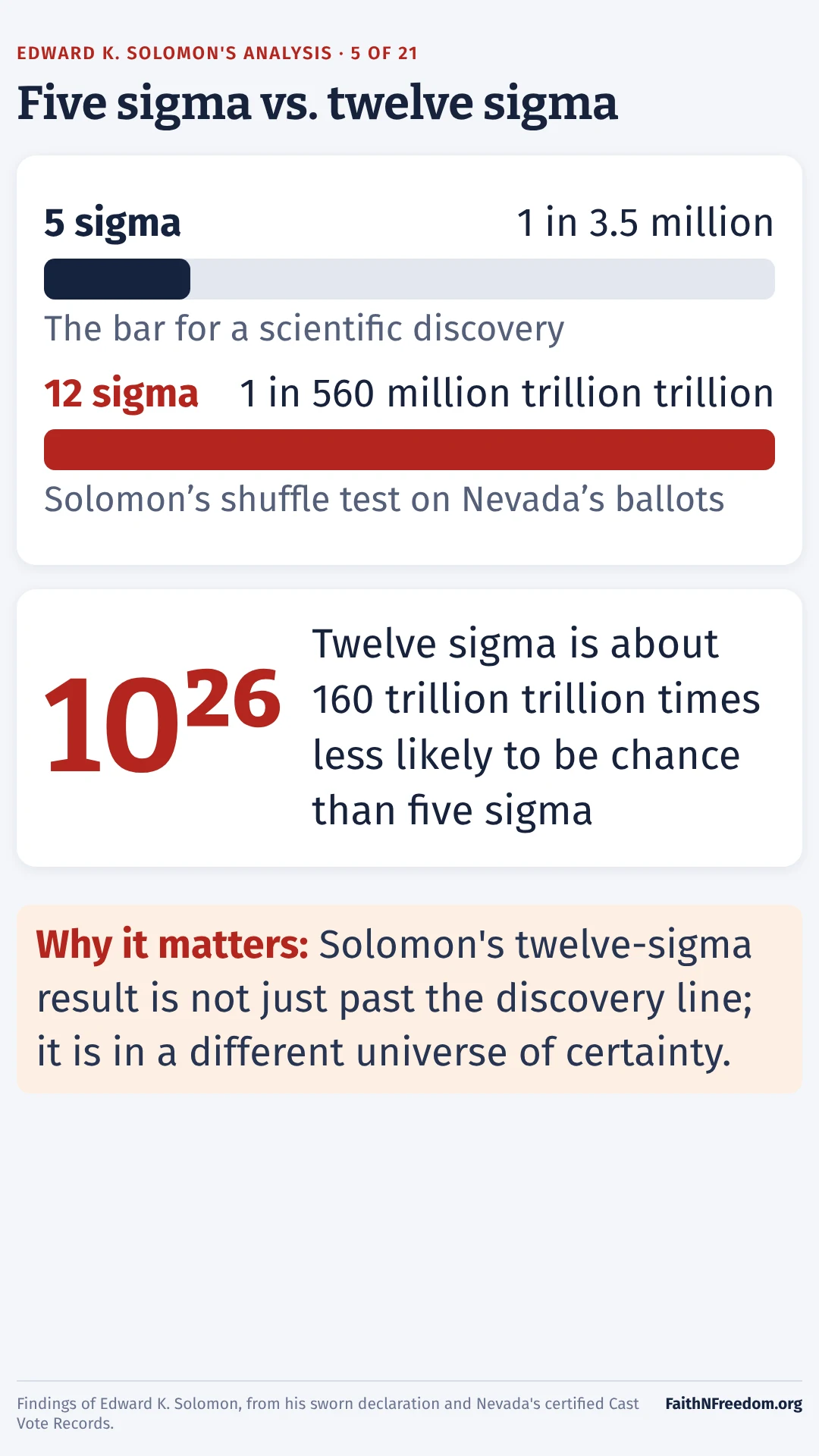
of slide 5
5. Five sigma vs. twelve sigma
5 sigma1 in 3.5 millionThe bar for a scientific discovery12 sigma1 in 560 million trillion trillionSolomon’s shuffle test on Nevada’s ballots
10²⁶Twelve sigma is about 160 trillion trillion times less likely to be chance than five sigma
Why it matters: Solomon’s twelve-sigma result is not just past the discovery line; it is in a different universe of certainty.
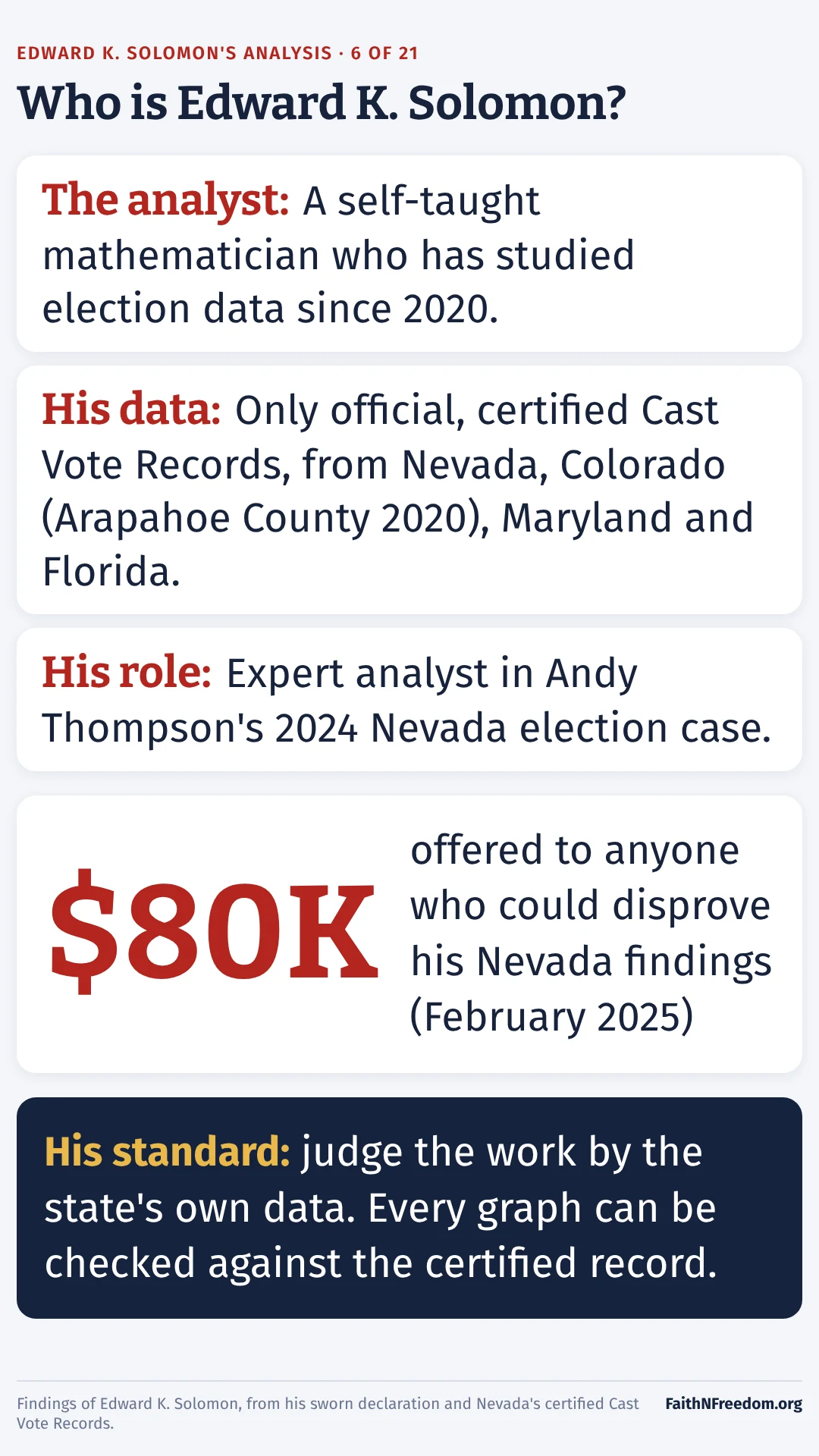
of slide 6
6. Who is Edward K. Solomon?
- The analyst: A self-taught mathematician who has studied election data since 2020.
- His data: Only official, certified Cast Vote Records, from Nevada, Colorado (Arapahoe County 2020), Maryland and Florida.
- His role: Expert analyst in Andy Thompson’s 2024 Nevada election case.
$80Koffered to anyone who could disprove his Nevada findings (February 2025)
His standard: judge the work by the state’s own data. Every graph can be checked against the certified record.
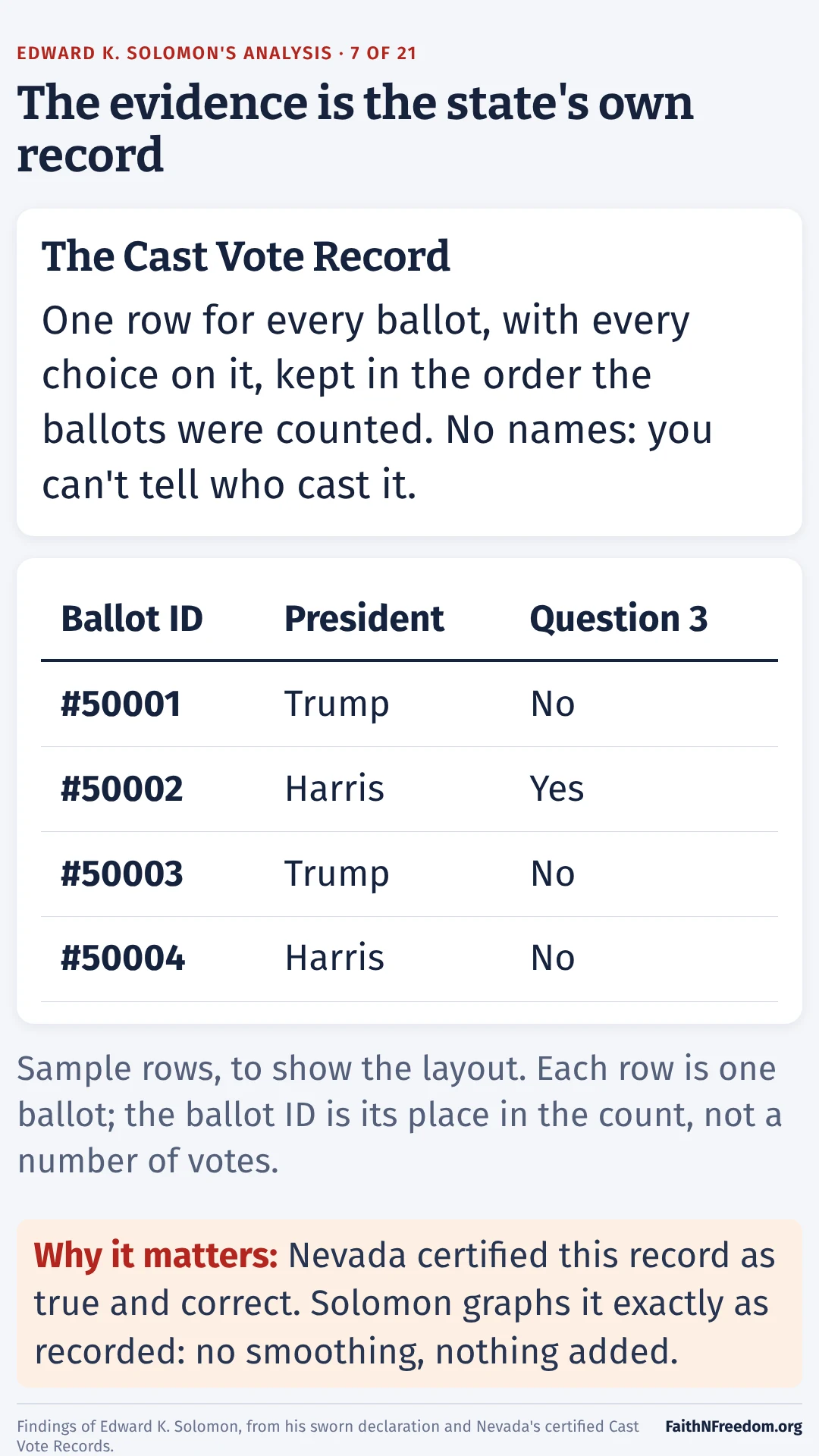
of slide 7
7. The evidence is the state’s own record
The Cast Vote Record
One row for every ballot, with every choice on it, kept in the order the ballots were counted. No names: you can’t tell who cast it.
| Ballot ID | President | Question 3 |
|---|---|---|
| #50001 | Trump | No |
| #50002 | Harris | Yes |
| #50003 | Trump | No |
| #50004 | Harris | No |
Sample rows, to show the layout. Each row is one ballot; the ballot ID is its place in the count, not a number of votes.
Why it matters: Nevada certified this record as true and correct. Solomon graphs it exactly as recorded: no smoothing, nothing added.
of slide 8
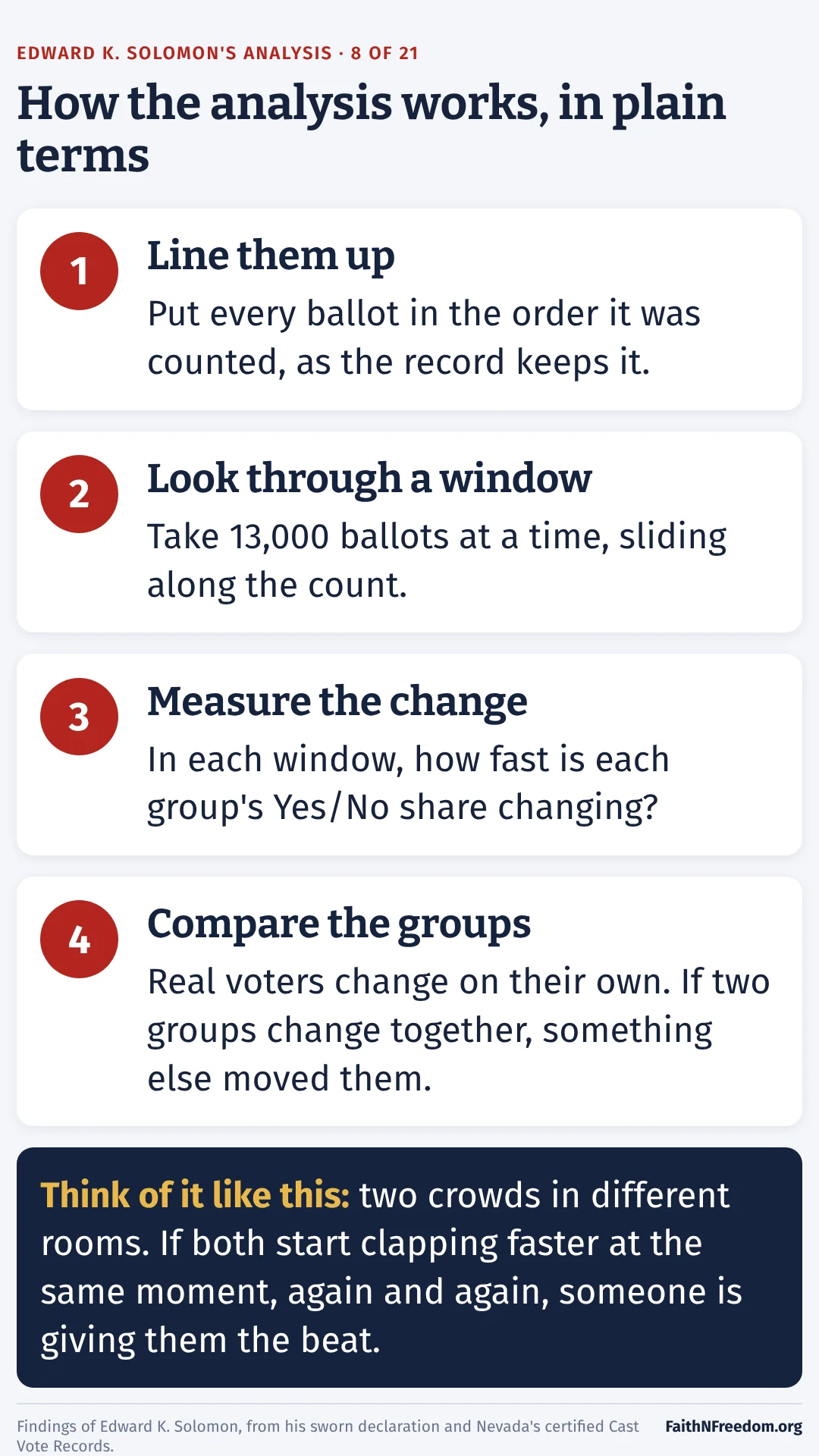
8. How the analysis works, in plain terms
1. Line them up
Put every ballot in the order it was counted, as the record keeps it.
2. Look through a window
Take 13,000 ballots at a time, sliding along the count.
3. Measure the change
In each window, how fast is each group’s Yes/No share changing?
4. Compare the groups
Real voters change on their own. If two groups change together, something else moved them.
Think of it like this: two crowds in different rooms. If both start clapping faster at the same moment, again and again, someone is giving them the beat.
of slide 9
9. A normal question: each party on its own
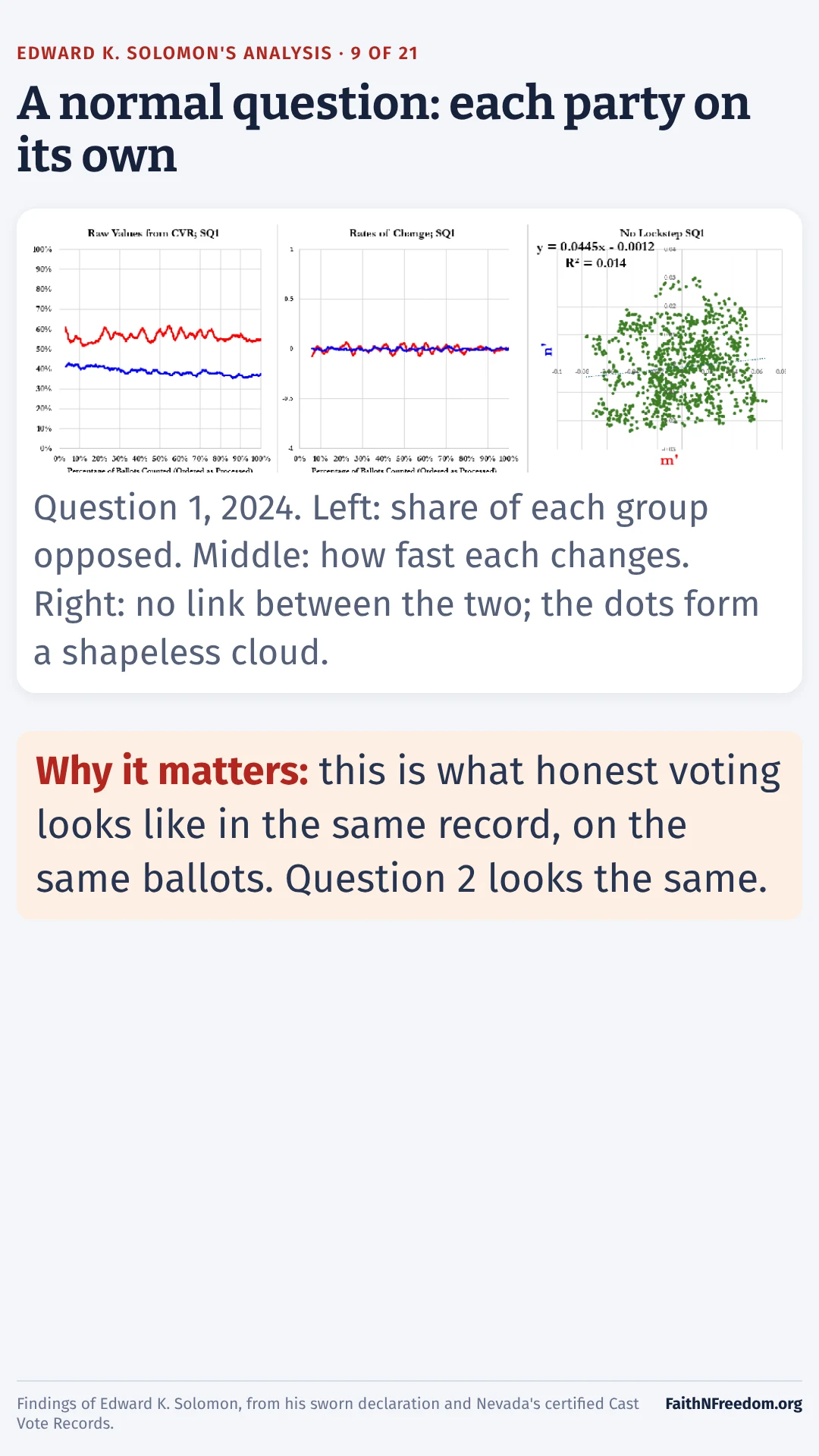
Question 1, 2024. Left: share of each group opposed. Middle: how fast each changes. Right: no link between the two; the dots form a shapeless cloud.
Why it matters: this is what honest voting looks like in the same record, on the same ballots. Question 2 looks the same.
of slide 10
10. Question 3: the two parties move in lockstep
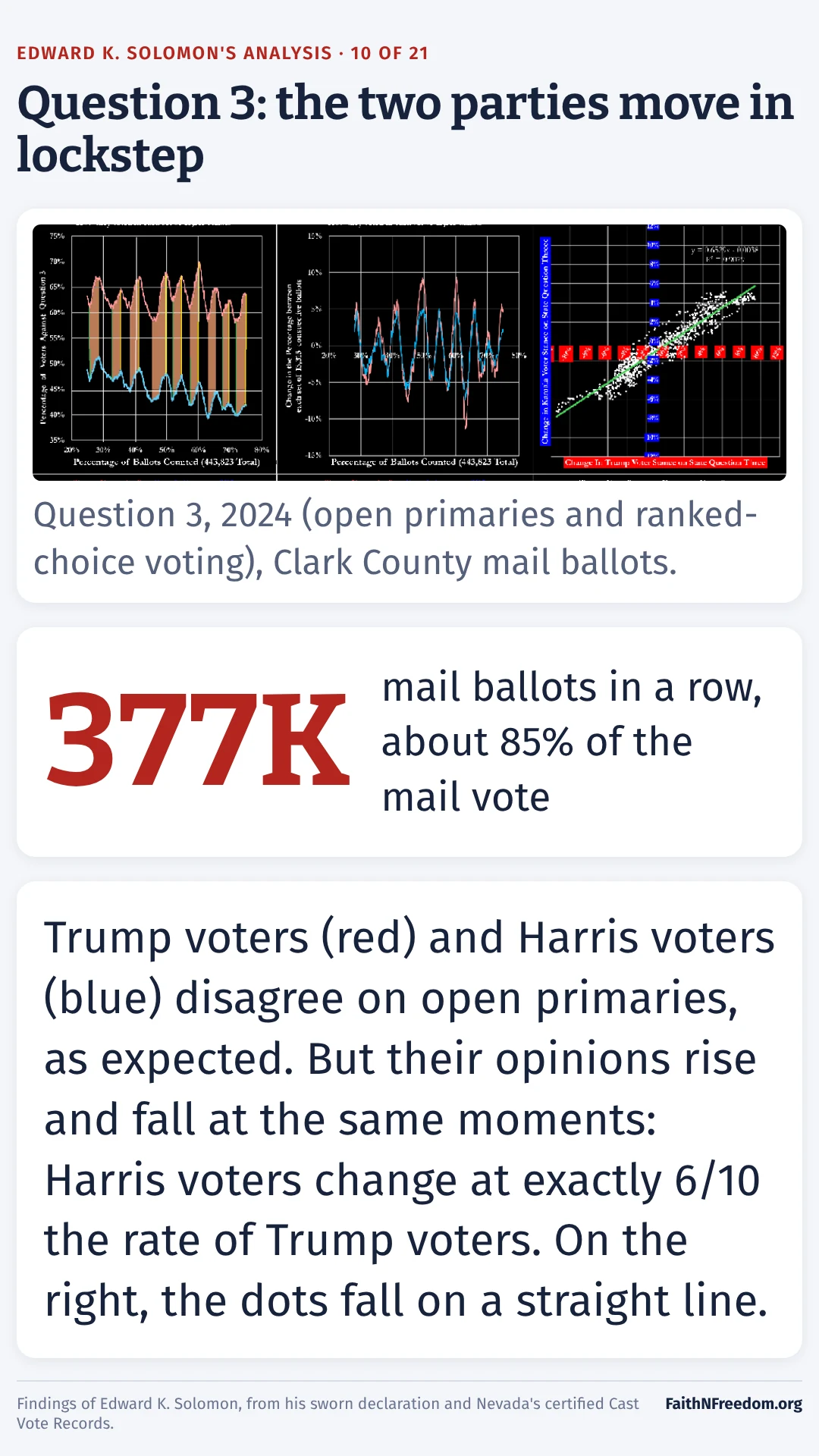
Question 3, 2024 (open primaries and ranked-choice voting), Clark County mail ballots.
377Kmail ballots in a row, about 85% of the mail vote
Trump voters (red) and Harris voters (blue) disagree on open primaries, as expected. But their opinions rise and fall at the same moments: Harris voters change at exactly 6/10 the rate of Trump voters. On the right, the dots fall on a straight line.
of slide 11
11. 12 sigma: chance is ruled out
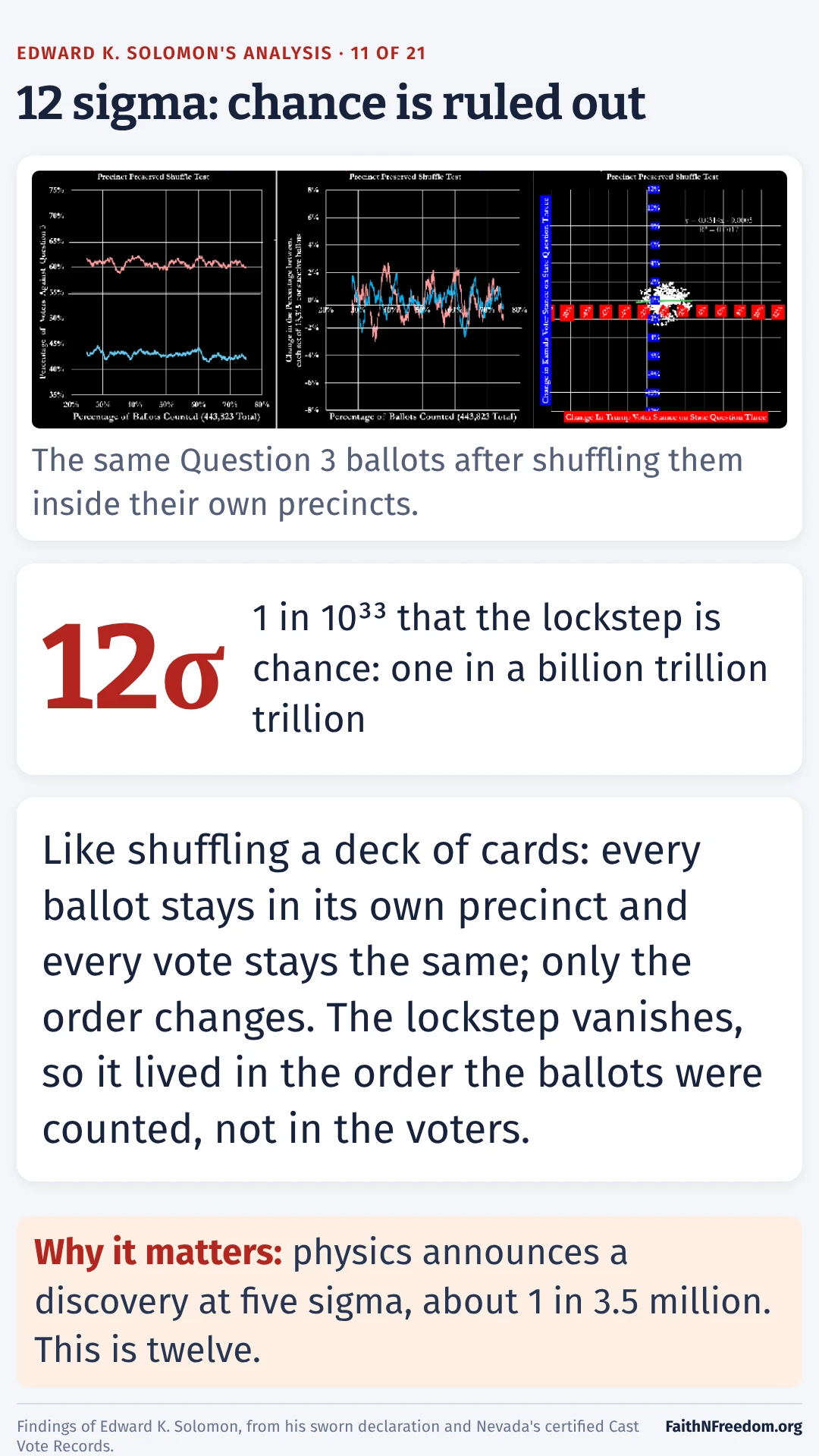
The same Question 3 ballots after shuffling them inside their own precincts.
12σ1 in 10³³ that the lockstep is chance: one in a billion trillion trillion
Like shuffling a deck of cards: every ballot stays in its own precinct and every vote stays the same; only the order changes. The lockstep vanishes, so it lived in the order the ballots were counted, not in the voters.
Why it matters: physics announces a discovery at five sigma, about 1 in 3.5 million. This is twelve.
of slide 12
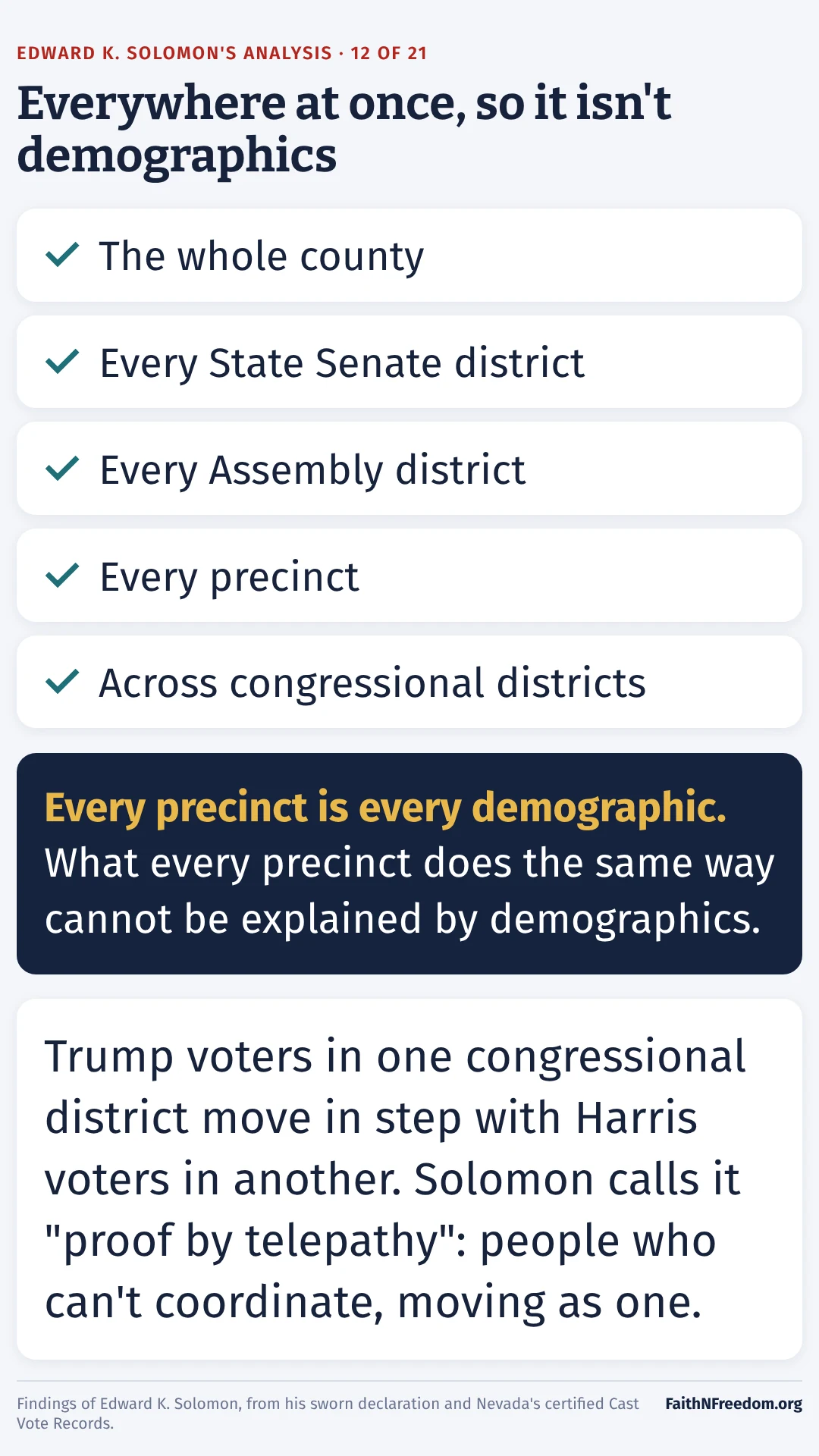
12. Everywhere at once, so it isn’t demographics
- ✓The whole county
- ✓Every State Senate district
- ✓Every Assembly district
- ✓Every precinct
- ✓Across congressional districts
Every precinct is every demographic. What every precinct does the same way cannot be explained by demographics.
Trump voters in one congressional district move in step with Harris voters in another. Solomon calls it “proof by telepathy”: people who can’t coordinate, moving as one.
of slide 13
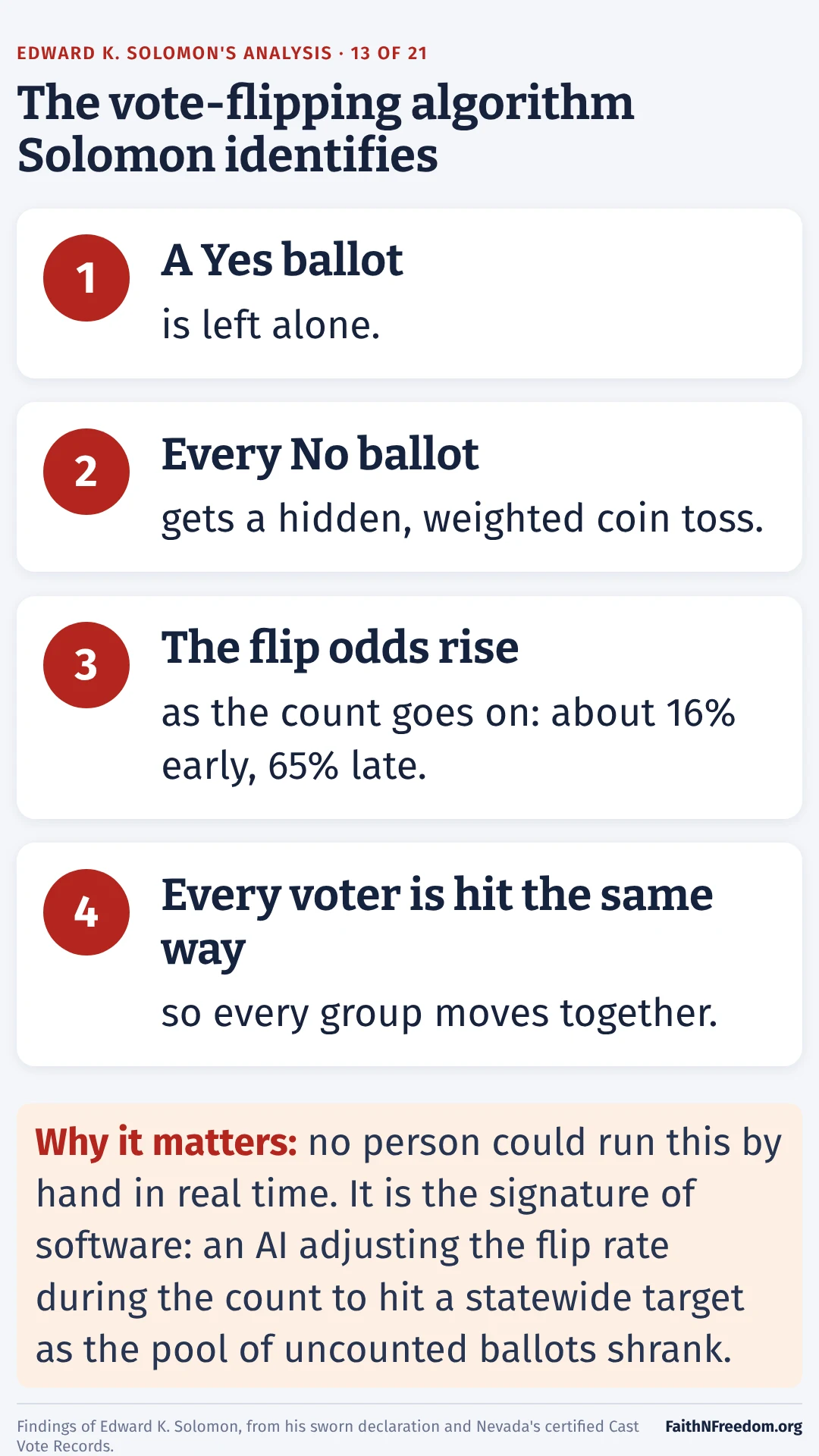
13. The vote-flipping algorithm Solomon identifies
1. A Yes ballot
is left alone.
2. Every No ballot
gets a hidden, weighted coin toss.
3. The flip odds rise
as the count goes on: about 16% early, 65% late.
4. Every voter is hit the same way
so every group moves together.
Why it matters: no person could run this by hand in real time. It is the signature of software: an AI adjusting the flip rate during the count to hit a statewide target as the pool of uncounted ballots shrank.
of slide 14
14. Run the algorithm and the exact pattern appears
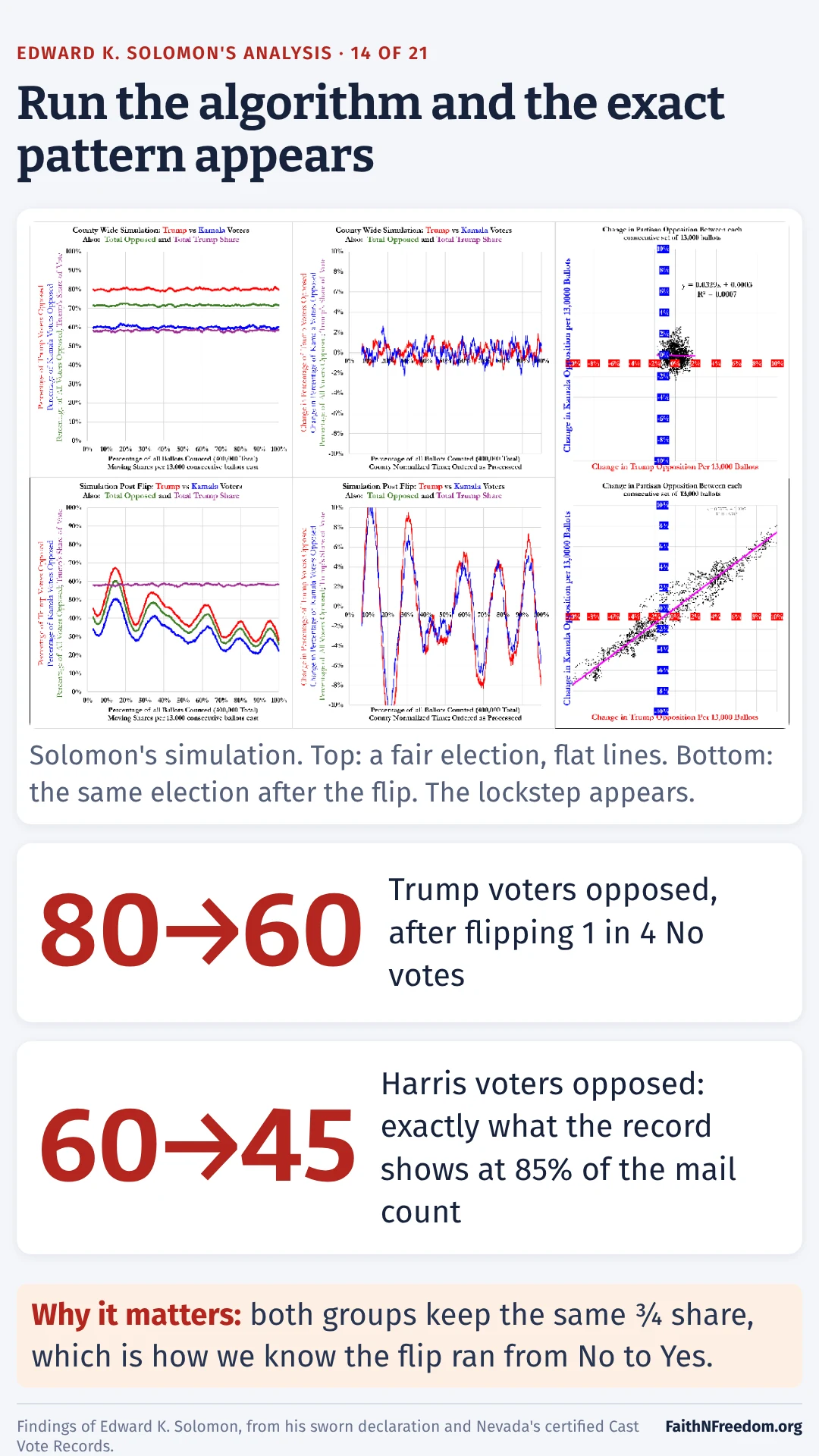
Solomon’s simulation. Top: a fair election, flat lines. Bottom: the same election after the flip. The lockstep appears.
80→60Trump voters opposed, after flipping 1 in 4 No votes
60→45Harris voters opposed: exactly what the record shows at 85% of the mail count
Why it matters: both groups keep the same ¾ share, which is how we know the flip ran from No to Yes.
of slide 15
15. Abortion, 2024: same numbers in two counties
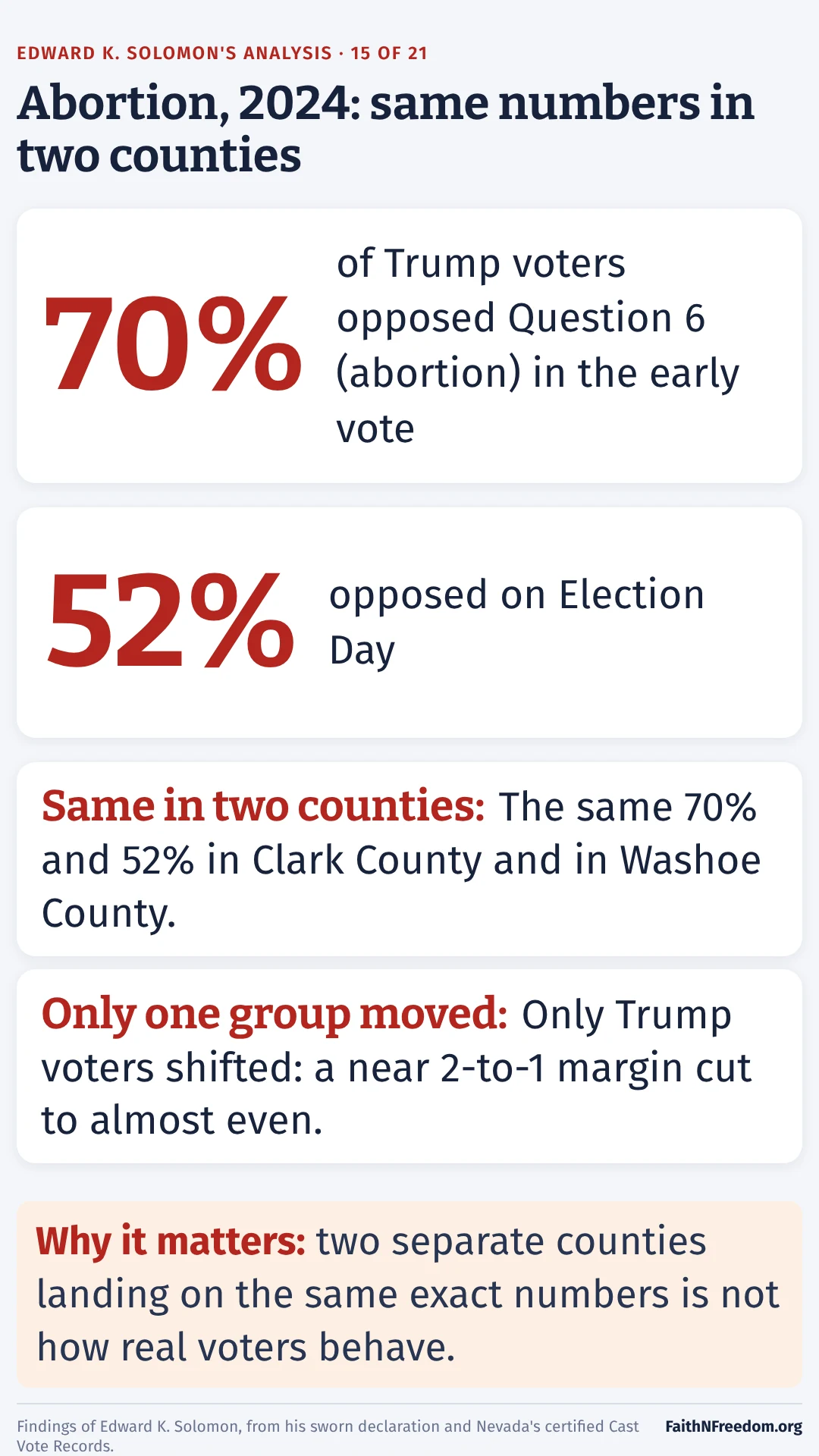
70%of Trump voters opposed Question 6 (abortion) in the early vote
52%opposed on Election Day
- Same in two counties: The same 70% and 52% in Clark County and in Washoe County.
- Only one group moved: Only Trump voters shifted: a near 2-to-1 margin cut to almost even.
Why it matters: two separate counties landing on the same exact numbers is not how real voters behave.
of slide 16
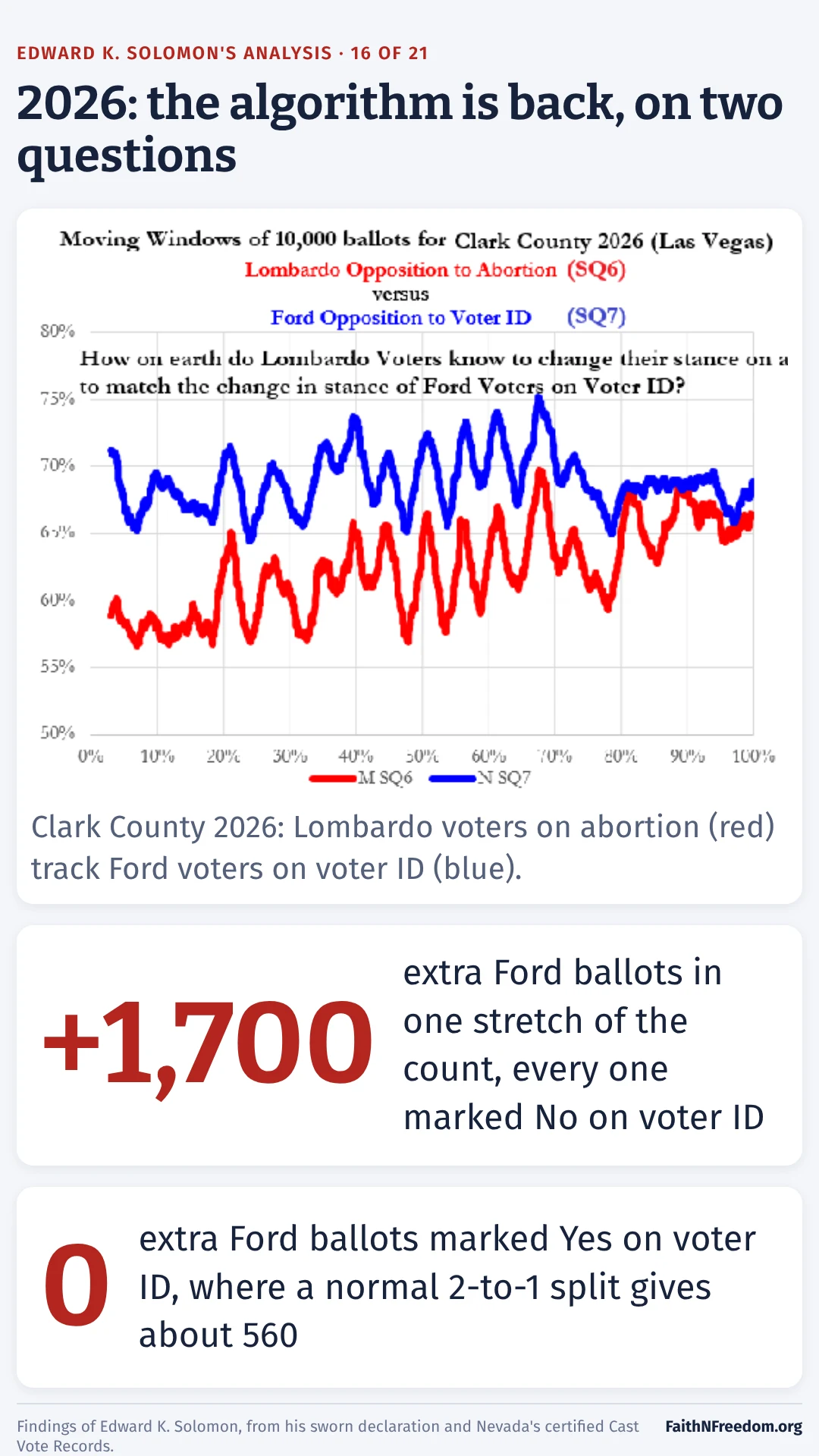
16. 2026: the algorithm is back, on two questions
Clark County 2026: Lombardo voters on abortion (red) track Ford voters on voter ID (blue).
+1,700extra Ford ballots in one stretch of the count, every one marked No on voter ID
0extra Ford ballots marked Yes on voter ID, where a normal 2-to-1 split gives about 560
of slide 17
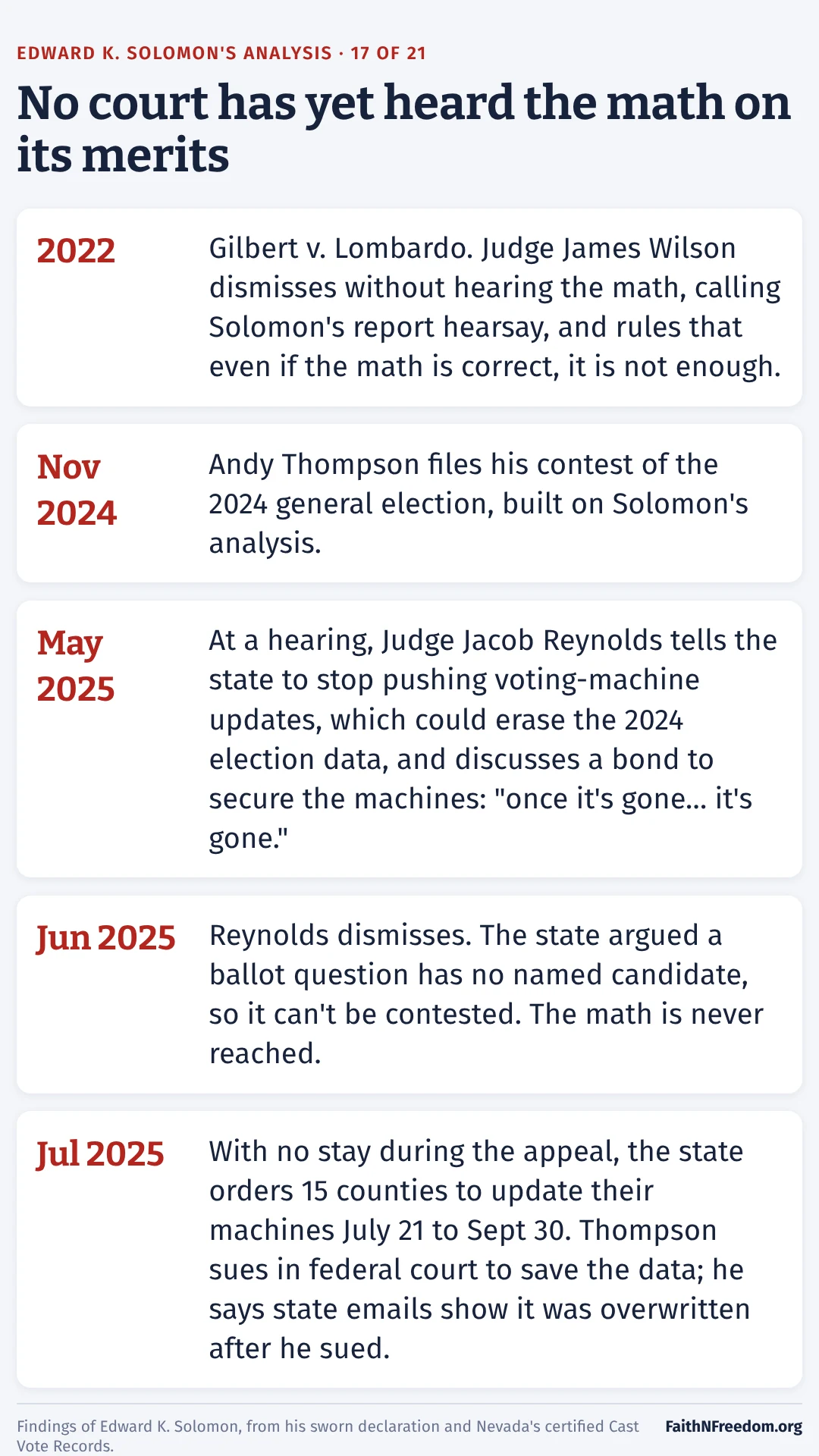
17. No court has yet heard the math on its merits
2022
Gilbert v. Lombardo. Judge James Wilson dismisses without hearing the math, calling Solomon’s report hearsay, and rules that even if the math is correct, it is not enough.
Nov 2024
Andy Thompson files his contest of the 2024 general election, built on Solomon’s analysis.
May 2025
At a hearing, Judge Jacob Reynolds tells the state to stop pushing voting-machine updates, which could erase the 2024 election data, and discusses a bond to secure the machines: “once it’s gone… it’s gone.”
Jun 2025
Reynolds dismisses. The state argued a ballot question has no named candidate, so it can’t be contested. The math is never reached.
Jul 2025
With no stay during the appeal, the state orders 15 counties to update their machines July 21 to Sept 30. Thompson sues in federal court to save the data; he says state emails show it was overwritten after he sued.
of slide 18
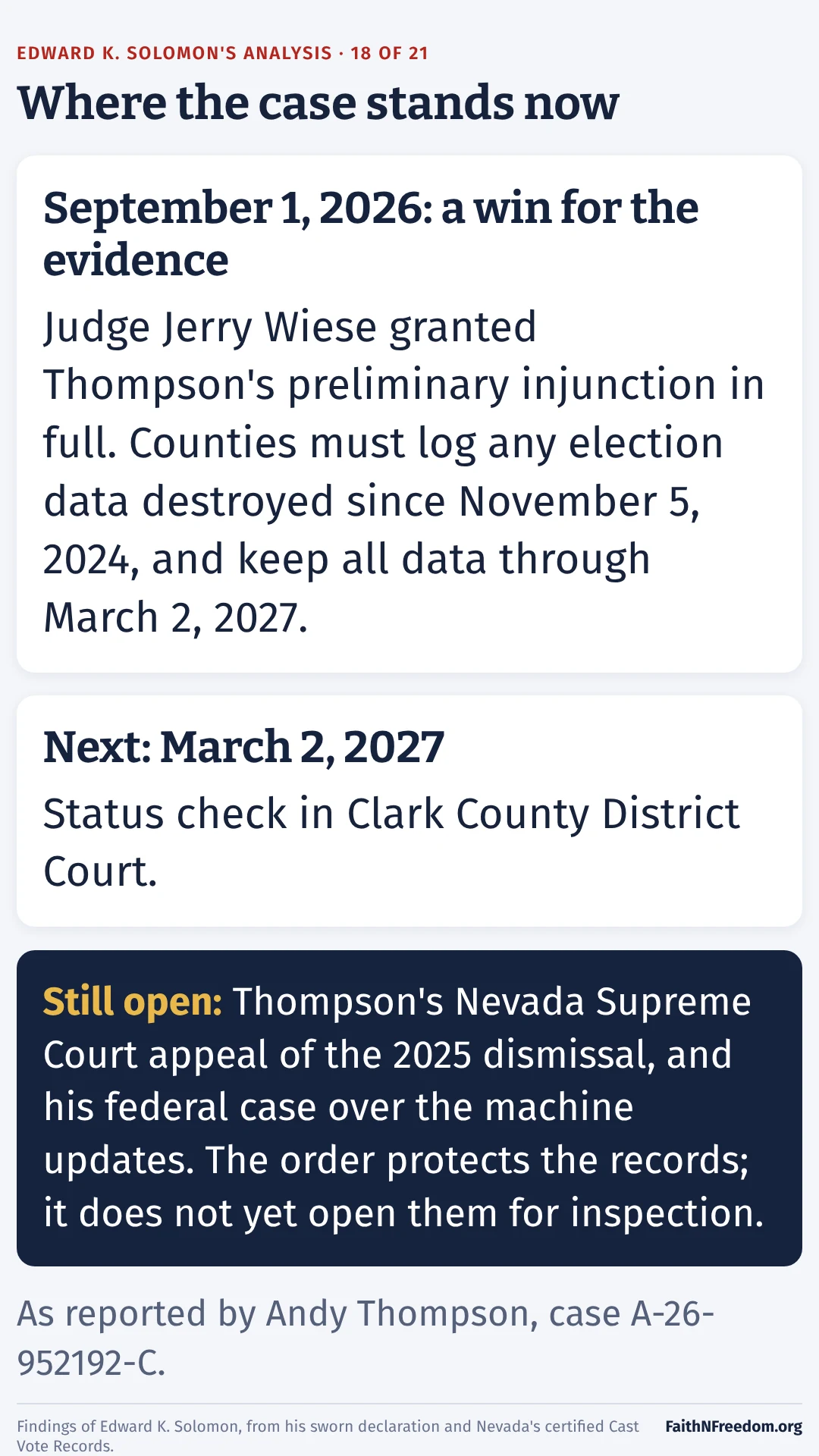
18. Where the case stands now
September 1, 2026: a win for the evidence
Judge Jerry Wiese granted Thompson’s preliminary injunction in full. Counties must log any election data destroyed since November 5, 2024, and keep all data through March 2, 2027.
Next: March 2, 2027
Status check in Clark County District Court.
Still open: Thompson’s Nevada Supreme Court appeal of the 2025 dismissal, and his federal case over the machine updates. The order protects the records; it does not yet open them for inspection.
As reported by Andy Thompson, case A-26-952192-C.
of slide 19
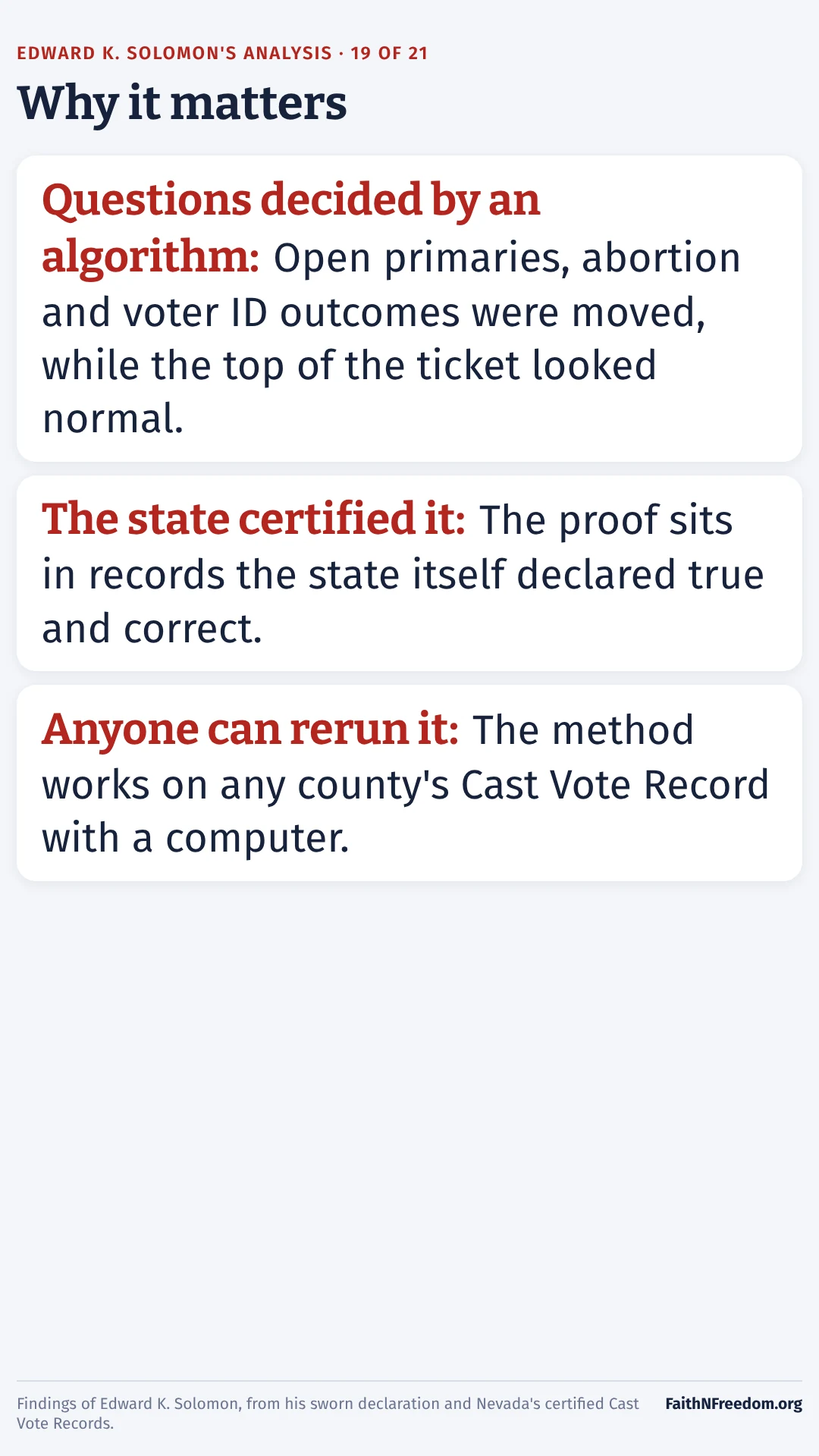
19. Why it matters
- Questions decided by an algorithm: Open primaries, abortion and voter ID outcomes were moved, while the top of the ticket looked normal.
- The state certified it: The proof sits in records the state itself declared true and correct.
- Anyone can rerun it: The method works on any county’s Cast Vote Record with a computer.
of slide 20
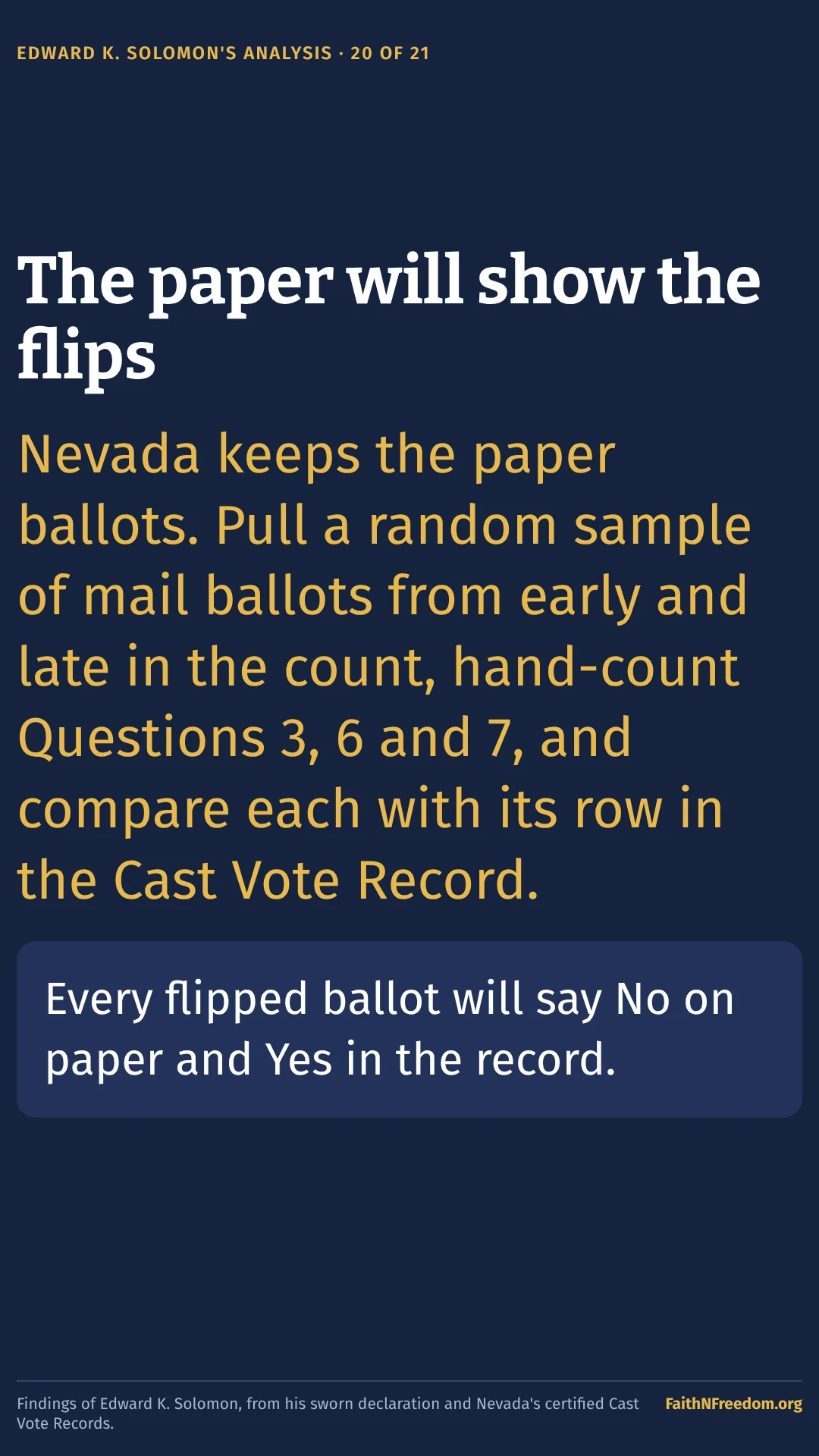
20. The paper will show the flips
Nevada keeps the paper ballots. Pull a random sample of mail ballots from early and late in the count, hand-count Questions 3, 6 and 7, and compare each with its row in the Cast Vote Record.
Every flipped ballot will say No on paper and Yes in the record.
of slide 21
21. Read the full evidence
- The 5-page write-up, with every graph: open the Google Doc
- The 100-page court filing, filed by Andy Thompson: open the PDF
Questions about the analysis
What is a Cast Vote Record?
A Cast Vote Record is the official electronic record of an election, kept by the county and certified by the state. It has one row for every ballot, showing how that ballot was marked in every race and on every question, in the order the ballots were counted. It carries no voter names. Edward Solomon’s analysis uses Nevada’s certified records exactly as issued, graphed with no smoothing and nothing added.
What is lockstep parallel motion?
Lockstep parallel motion is the name Edward Solomon gives to two separate groups of voters changing their opinions at the same moments and in fixed proportion as the count goes on. Real groups drift on their own. In Clark County’s 2024 mail vote on Question 3, Solomon found Harris voters changing at exactly six tenths the rate of Trump voters for 377,000 ballots in a row, about 85 percent of the mail count.
What is the precinct-preserved shuffle test?
The shuffle test keeps every ballot in its own precinct and every vote exactly as cast, and changes only the order the ballots were counted, like shuffling a deck of cards. If voters themselves caused a pattern, it survives the shuffle. On Nevada’s Question 3, the lockstep disappears once the ballots are shuffled. Repeating the test, Solomon puts the odds of the pattern arising by chance at one in ten to the thirty-third power.
What is the vote-flipping algorithm Solomon describes?
The vote-flipping algorithm, which Solomon calls the flip function, is the mechanism he identifies behind the lockstep: Yes ballots are left alone, while every No ballot gets a hidden, weighted coin toss whose odds rise as the count goes on, from about 16 percent early to about 65 percent late. Because every voter is hit the same way, every group moves together. He says it bears the signature of software adjusting the rate during the count.
What did Solomon find in Nevada’s 2026 election?
In Clark County’s 2026 record, Solomon finds Lombardo voters on the abortion question moving in lockstep with Ford voters on the voter ID question, across every pair of congressional districts he checked. In one stretch of the count, about 1,700 extra Ford ballots appear and every one is marked No on voter ID, where a normal two-to-one split would give about 560 marked Yes. He found zero.
Has a court ruled on Solomon’s analysis?
No court has yet ruled on whether the mathematics is right. In 2022 Judge James Wilson dismissed Joey Gilbert’s contest, calling Solomon’s report hearsay and saying the math, even if correct, was not enough under the statute. In 2025 Judge Jacob Reynolds dismissed Andy Thompson’s contest because a ballot question has no named candidate. On September 1, 2026, Judge Jerry Wiese ordered Nevada’s counties to preserve all election data through March 2, 2027.
How can I check these findings myself?
Start with Nevada’s certified Cast Vote Records, which the counties issue after each election. Solomon’s five-page write-up, linked on this page, shows every graph with its method, and the 100-page filing in Andy Thompson’s case gives the full analysis. The decisive check is the paper: hand-count a random sample of mail ballots from early and late in the count and compare each one with its row in the record.
Findings of Edward K. Solomon, from his sworn declaration and Nevada’s certified Cast Vote Records. Join the discussion at FaithNFreedom.Social.