
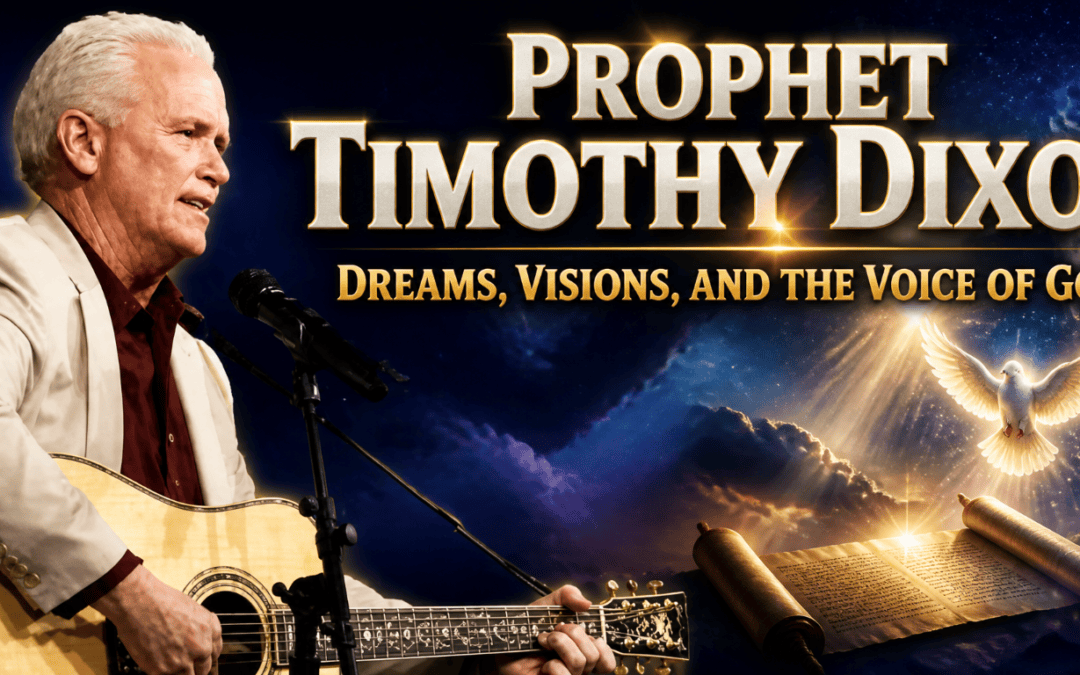
Prophetic Dreams Meaning — Timothy Dixon Day 6

Prophetic dreams meaning is at the heart of Day 6 of FaithNFreedom’s Hearing from God series, where Prophet Timothy Dixon — a truck driver from Alabama who began having specific, verifiable dreams before the age of ten — shares what decades of learning to recognize God’s voice through dreams, visions, and bold prophetic words have taught him about how ordinary believers can access the same Spirit-given gifts. This post covers all three segments of the Day 6 teaching in full: how Timothy first recognized God was speaking through dreams, the courts of heaven dream that preceded Roe v. Wade’s overturning, and why Timothy believes no believer’s calling is too small to matter.

This is Day 6 of the Hearing from God series — a multi-day teaching series featuring prophetic voices on how God speaks, how to recognize His voice, and how to act on what you hear. You can find the full series navigation at the bottom of this post.

Memory Verse

“And it shall come to pass afterward, that I will pour out my Spirit on all flesh; your sons and your daughters shall prophesy, your old men shall dream dreams, and your young men shall see visions.” — Joel 2:28 ESV

Segment 1 — The Gift That Started Before He Had Words For It

Learning That God Is a Spirit

Timothy says his dreams began at a very young age, but for years he didn’t know what to call what was happening to him. “I just didn’t know that it was God speaking to me,” he says. “It’s something that you had to learn. You had to learn that God is a spirit. He don’t talk like me and you.” Nobody sat him down and explained it. He had to figure it out the hard way, dream by dream, over years — and along the way, he says he was “persecuted a very long time” over what he was seeing, because dreams that specific only leave two options: “either God’s given them to you, or you’re lying about it.”

That’s almost the exact spot a boy named Samuel found himself in, centuries earlier. God called Samuel’s name in the night three separate times before the boy understood who was speaking. He kept running to Eli, thinking the old priest had called him, because Samuel didn’t yet know the Lord. It took a third time before Eli realized what was happening and told Samuel what to say the next time the voice came.

“And the Lord called Samuel again the third time. And he arose and went to Eli and said, ‘Here I am, for you called me.’ Then Eli perceived that the Lord was calling the young man. Therefore Eli said to Samuel, ‘Go, lie down, and if he calls you, you shall say, “Speak, Lord, for your servant hears.”‘… And the Lord came and stood, calling as at other times, ‘Samuel! Samuel!’ And Samuel said, ‘Speak, for your servant hears.'” — 1 Samuel 3:8-10 ESV

Samuel wasn’t lacking the calling. He was lacking the recognition. That’s exactly the gap Timothy describes closing, dream by dream, as a child — not becoming someone new, but slowly learning to recognize a voice that had been speaking to him the whole time.

A Promise Older Than the Dreams Themselves

What makes this recognizable at all, for Timothy or for Samuel or for anyone else, is that God said He would do this. Long before Timothy was born, the prophet Joel wrote down the promise in Joel 2:28 — that dreams and visions wouldn’t stay locked up in Old Testament history, that a day was coming when God’s Spirit would be poured out, and ordinary people, old and young, would start dreaming and seeing again. A boy dreaming about things he had no way of knowing isn’t a strange exception to how God works. According to Joel, it’s exactly what was promised.

The Boy Who Dreamed About Elvis

Timothy tells one story from that early season that still makes him laugh a little, even now. He dreamed that Elvis Presley was found dead in his bathroom. He was young — young enough that Elvis was still “the man” to him — and he ran into the living room crying, telling his father Elvis had died. His dad, watching TV, told him Elvis was fine, out in Las Vegas. Timothy went back outside and let it go.

It wasn’t long after — Timothy says maybe less than a year — that his father called him back inside out of nowhere and asked him to tell the Elvis dream again. Timothy repeated it: found dead on the bathroom floor. “That’s when my dad started taking note that there’s something here,” Timothy says.

He describes his father teasing him about the dreams the way Joseph’s brothers teased their little brother — “the dreamer” said like an insult. Timothy doesn’t resent that comparison. He leans into it, because he sees the same pattern: ridicule first, confirmation later, on God’s timing, not the family’s.

The Newspaper That Said He’d Missed It

The dream that shook Timothy the hardest as a child wasn’t Elvis. It was one where he stood in his own front yard, and a newspaper landed at his feet — the same way the real paper used to land in the yard growing up. He picked it up. The headline said Jesus had returned the night before. He’d missed it.

He woke up shaking, crying, and ran through a dark house looking for his mother. When he found her still in bed, he calmed down instantly. “Jesus ain’t come yet,” he told himself. “‘Cause mama’s still here.”

That kind of fear — the fear of being left behind, of missing the moment that mattered most — is exactly what Paul writes to comfort believers about, when he describes the day of the Lord not as a threat hanging over God’s own children, but as a day they’re already prepared for because of where they stand with Christ.

“For God has not destined us for wrath, but to obtain salvation through our Lord Jesus Christ, who died for us so that whether we are awake or asleep we might live with him. Therefore encourage one another and build one another up.” — 1 Thessalonians 5:9-11 ESV

Timothy gave his life to Christ at eighteen, on March 1, 1983, at a small church his mother took him to. The fear from that childhood dream didn’t need to chase him forever. It just needed an answer — and he found one.

Write the Dream Before You Try to Explain It

Timothy didn’t start publicly sharing his dreams until his early thirties — his first recording, he says, was made on an eight-track tape. Before that, for years, he simply wrote them down and filed them away. That habit is still the first piece of advice he gives anyone today who wants to hear from God more clearly: write it down before you try to remember it, before you tell anybody, before you try to make it make sense.

“I always just rule of thumb, I just have a dream, tell it as a dream,” he says — meaning: report what you saw, don’t hand someone your interpretation dressed up as the dream itself. He describes writing everything down exactly as it came, out of order, repetitive, messy — and only afterward going back with scissors, literally cutting out the repeated details, to put it in a shape he could understand. “Write the dream. Don’t try to make sense of it. And don’t try to put it in order. Just write it.”

That instinct has ancient roots. When Habakkuk asked God how long injustice would be allowed to stand, the answer he got wasn’t permission to sit and stew on it. It was an instruction to write it down, plainly, and let the writing itself carry the word forward until its moment came.

“And the Lord answered me: ‘Write the vision; make it plain on tablets, so he may run who reads it. For still the vision awaits its appointed time; it hastens to the end — it will not lie. If it seems slow, wait for it; it will surely come; it will not delay.'” — Habakkuk 2:2-3 ESV

Timothy’s filing cabinets full of handwritten dreams, decades before he ever spoke one out loud on camera, are exactly that principle lived out: write it plain, and let it wait.

Quick Answer — Segment 1

How did Timothy Dixon first realize he was hearing from God?
Timothy didn’t have a dramatic first encounter he can point to — he describes it as gradual, starting in early childhood, with dreams so specific they couldn’t be explained away. What changed over time wasn’t the dreams; it was his understanding that God is a Spirit who speaks differently than a person does, and that recognizing His voice is something you have to learn, the same way young Samuel had to learn to recognize the Lord calling his name before he could ever answer it.

Write It Before You Explain It

If you’ve ever had a dream, an impression, or a sudden thought that felt like it came from somewhere outside you — and then talked yourself out of it before you ever wrote it down — you’re not alone, and you haven’t missed your chance. Timothy’s own method is almost embarrassingly simple: get a pen, write down exactly what you saw or heard, in whatever order it comes, and resist the urge to interpret it while you’re still writing.

This week, if something like that happens — however small — write it down before you tell anyone, including yourself, what you think it means. Let it sit written and plain, the way Habakkuk was told to. You can go back later and make sense of it. You can’t go back and recover what you never wrote down.

A voice you’re still learning to recognize is still a voice worth writing down.

Segment 2 — Boldness, Confirmation, and Words That Came to Pass

A Sign Nobody Wanted Him to Give

Standing on a platform at the Choctaw Indian Reservation, Timothy heard the Lord tell him something he knew would cost him: to say it was going to rain fish, as a sign that God wasn’t through with Donald Trump. He remembers thinking he was about to get run out of the building for it. He said it anyway.

A short time later, on a stage in Nashville with another minister, Timothy repeated the word — and before he could finish, a man in the audience jumped up and said it had already happened. It had rained fish the day before, in Texarkana, Texas. A friend who witnessed it called Timothy afterward, describing picking the fish up in buckets.

Delivering a word that sounds foolish, in public, before there’s a shred of evidence to back it, is exactly the kind of boldness the early church prayed for the moment their own preaching put them in danger. They didn’t ask God to make the threats go away. They asked for the nerve to keep speaking anyway.

“And now, Lord, look upon their threats and grant to your servants to continue to speak your word with all boldness.” — Acts 4:29 ESV

Timothy said the word that sounded like it would get him “run out of the building.” It rained fish anyway, one state over, the same week. Timothy is careful to say something else too, and it matters: the sudden, specific things God shows a prophet are never given without a reason behind them, even when the reason isn’t obvious yet.

“Surely the Lord God does nothing, unless he reveals his secret to his servants the prophets.” — Amos 3:7 ESV

The Courts of Heaven and Two Scrolls

The story Timothy tells with the most weight behind it is a dream that came true down to a detail he’d told no one but his wife. In the dream, Timothy and fellow minister Robin Bullock walked through what Timothy describes as the courts of heaven — not a courtroom exactly, but a place where the prayers and petitions of God’s people are presented before the Lord. An arm reached out of a bright opening and asked, “What is your petition?” Robin, carrying two scrolls under his arm, laid them out, walked between them, and wept over them — signing them, Timothy says, not with ink but with tears. When the question came again, Robin answered: “I want my country back.” The response came immediately: “Granted.”

About a year later — before Timothy had told the dream to more than a couple of people — the Justice Foundation called and invited him and Robin to the Supreme Court steps for the unrolling of the scrolls tied to the overturning of Roe v. Wade. When they arrived, there was only one large scroll. An official explained they’d need to cut it in half to unroll it properly. In front of Timothy, with no idea he was watching his own dream reassemble itself in real time, they cut one scroll into two.

“Say It Right”

Rain threatened to ruin the event. Standing under a hotel balcony with Robin the night before, Timothy said they needed the Lord to hold it off. Robin looked at him and said only, “Say it right.” The next day, after the scrolls were unrolled and Timothy and Robin walked between them just as in the dream — weeping over what those scrolls represented — a sense of danger hit them both at once. They loaded up and left minutes before a group Timothy calls the Red Cape Witches of DC arrived to protest. As Robin ducked into the car, he looked up and said, “It can rain now.” Timothy says it poured immediately.

Not long after, Roe v. Wade was overturned. Timothy is careful about how he frames his own part in it: “It wasn’t that we really had any kind of overbearing significance that we was the hero,” he says. “We was just an obedient servant.”

That posture — access to something real, used only to represent others, never to claim credit — is the same posture Hebrews describes believers having at the actual throne of God, not because of anything they’ve earned, but because the way in was already opened for them.

“Let us then with confidence draw near to the throne of grace, that we may receive mercy and find grace to help in time of need.” — Hebrews 4:16 ESV

A Country Surrounded

Timothy also describes a recurring theme in his dreams lately: a sense of real spiritual warfare pressing in on the country, and on the church specifically. He connects it to Jesus’ words to the disciples about what would mark the last days — not comfortable predictions, but real conflict, nation against nation, kingdom against kingdom.

He’s also spoken about standing with Amanda Grace at the Potomac River in a dream, watching it rise around the Capitol, sensing something shifting in the atmosphere tied to a coming presidential election — a dream, he says, that “has definitely played out to be right dead on it,” describing the real opposition Trump would face afterward.

“God is our refuge and strength, a very present help in trouble. Therefore we will not fear though the earth gives way, though the mountains be moved into the heart of the sea, though its waters roar and foam, though the mountains tremble at its swelling.” — Psalm 46:1-3 ESV

The water rising doesn’t mean the ground actually gives way. It means it’s time to remember whose refuge you’re standing in.

Quick Q&A — Segment 2

What is the “courts of heaven” concept Timothy Dixon describes?
Timothy describes it as a real place in the spirit where the prayers, petitions, and legal-style appeals of God’s people are presented directly before the Lord — not a courtroom in the human sense, but a place of genuine authority where a specific request can be asked and specifically granted. His dream about Robin Bullock’s scrolls and the words “I want my country back… granted” is the clearest picture he gives of how that access works, and how it played out later in a real, verifiable event.

Don’t Wait for the Feeling to Obey

Ask yourself honestly: is there a word you’ve sensed from God that you’ve been sitting on because it sounds too strange, too bold, or too likely to embarrass you if it doesn’t come true? Timothy delivered the rain-fish word fully expecting to be “run out” of the building for it. He said it anyway.

This week, if you’re carrying something like that — a prompting to say a hard thing, pray a specific prayer, or step toward something uncomfortable — don’t wait until the feeling of confidence shows up first. Obedience came before confirmation every time in Timothy’s stories. Confirmation is what came after.

Say it before you feel brave enough to. That’s usually when it matters most.

Segment 3 — The Year of Miracles, and Why You Were Never Meant to Sit This Out

The Dream He Couldn’t Finish Telling

Among the dreams Timothy holds closest is one about a visitation to heaven — a dream so overwhelming he says he couldn’t even speak for two and a half hours after waking, and cried on the floor with his head in his wife’s lap for another hour after that. In the dream, he walked a narrow gold path into heaven behind two men he later recognized as Guy Penrod and Michael English, one of them singing a song Timothy had never consciously heard before: “I Bowed on My Knees and Cried Holy.” When he woke and unlocked his phone to search for the song, the exact recording was already on his screen.

He describes heaven in that dream as narrow and unadorned — a straight path, not the sweeping golden streets people often picture — echoing Jesus’ own description of what the way in actually looks like.

“Enter by the narrow gate. For the gate is wide and the way is easy that leads to destruction, and those who enter by it are many. For the gate is narrow and the way is hard that leads to life, and those who find it are few.” — Matthew 7:13-14 ESV

The Year God Told Him to Mark Down

Going into a recent gathering, Timothy says the Lord told him plainly that 2024 was going to be a year of miracles — miracles he’d never seen before, and could mark it down. He’d heard God move powerfully before — as a teenager, he watched a woman’s clubbed foot straighten in real time in a service — so he knew what a real bar looked like. This word told him God intended to clear it.

That kind of specific, dated promise about what’s coming next isn’t unusual in Scripture. It’s the same posture James describes when he ties the healing of the sick directly to the prayer offered over them in faith — not a vague hope, but an expected, specific outcome.

“Is anyone among you sick? Let him call for the elders of the church, and let them pray over him, anointing him with oil in the name of the Lord. And the prayer of faith will save the one who is sick, and the Lord will raise him up.” — James 5:14-15 ESV

Sixty Miracles and Counting

Timothy describes over sixty documented healings from that gathering — not, in his words, “their headache went away,” but real, verifiable cases. A young woman on her deathbed with kidney cancer received a handkerchief the ministry team had prayed over; she got out of bed, and her cancer was later confirmed gone, with no physical trace she’d ever undergone chemotherapy at all. A woman bedridden for a year got up the morning after her husband prayed over a handkerchief and was found in the kitchen cleaning broccoli. Timothy’s own decades-old bone spur and a fist-sized hernia he’d carried since he was seventeen were both simply gone. A coworker’s sixteen-year wart vanished overnight.

“And these signs will accompany those who believe: in my name… they will lay their hands on the sick, and they will recover.” — Mark 16:17-18 ESV

Timothy is quick to add that this isn’t about the people praying being special. “Not to say that the Lord don’t need us — he does. He uses people,” he says. “But man, the Lord just showed up and just showed out.”

No Big I, Little U

For all the scale of what Timothy describes, the point he keeps returning to is smaller and, in his words, more important: don’t let the size of someone else’s calling make you think yours doesn’t matter. “I can’t be an Elijah. I cannot be a Moses,” he says. “But I can be a Timothy… in the realm that God has chose me to be in. There’s no big I and little u with the Lord.”

Paul makes the same case to the church at Corinth using the exact language of gifting — not one gift handed to everyone in the same shape, but a variety of real gifts, distributed by the same Spirit, for the same body.

“Now there are varieties of gifts, but the same Spirit; and there are varieties of service, but the same Lord; and there are varieties of activities, but it is the same God who empowers them all in everyone.” — 1 Corinthians 12:4-6 ESV

Peter says it even more plainly when he ties humility directly to how close you can actually get to God’s power moving through you.

“Clothe yourselves, all of you, with humility toward one another, for ‘God opposes the proud but gives grace to the humble.’ Humble yourselves, therefore, under the mighty hand of God, so that at the proper time he may exalt you.” — 1 Peter 5:5-6 ESV

Timothy’s own instruction for staying in a place where God can use you like that is disarmingly simple: “Be the clay twenty-four hours a day.” Not shaped once and set on a shelf. Workable, every day, whenever the Potter wants to move.

Quick Answer — Segment 3

Does Timothy Dixon believe every believer can walk in this kind of gifting, or only a select few?
Yes — and it’s the point he returns to hardest. Timothy explicitly rejects the idea that some believers’ callings are more important than others’. His own framing is that not everyone is called to be an Elijah or a Moses, but everyone is called to be exactly who God made them to be, fully engaged, with no calling ranked as small in God’s eyes.

Build, Don’t Break

Every believer in this teaching series started in the exact same place: a person willing to listen, willing to write it down, and willing to obey before the confirmation ever showed up. The gift was never about being impressive. It was about staying close enough to hear, and humble enough to act on what you heard.

So if you’ve been telling yourself your calling is too small to matter next to someone else’s — hear Timothy’s answer directly: there’s no big I and little u with the Lord. Be the clay. Stay workable. Watch what He does with the smallest step of obedience you’re willing to take this week.

You were never called to be someone else’s miracle. You were called to be exactly the vessel you already are.

Closing Prayer

Father, thank You for Prophet Timothy Dixon. Thank You for a boy who didn’t understand what he was hearing at seven or eight years old, and who spent a lifetime learning to recognize Your voice instead of walking away from it because it was strange or because people laughed.

Teach us to write down what You show us before we try to explain it away. Give us the boldness to say the hard, strange thing when You ask us to, the way Timothy did at that reservation, trusting You with how it lands. Where we’ve believed our own calling is too small to matter, break that lie over us today. There is no big I and little u with You — only children You’ve called by name, each carrying a measure that was never meant to be someone else’s.

Keep us workable in Your hands, Lord. Make us the clay, every day, not just on the days it’s easy.

In the name of Jesus, Amen.

Coming Up — Day 7

Prophet Emanuel (Manny) Johnson — Hunger Is the Spark
Prophet Emanuel Johnson closes out the series with what he believes is the one ingredient that turns hearing from God into a lived reality: hunger.

Hearing from God Series Navigation

  • ✅ Day 1 — Amanda Grace: My Sheep Hear His Voice
  • ✅ Day 2 — Nathan French: It’s Not Meant to Be a Secret
  • ✅ Day 3 — Stacy Whited: Come to Me for Explicit Directions
  • ✅ Day 4 — Meri Crouley: Test the Word, Walk in Boldness, Build Unity
  • ✅ Day 5 — Donne Clement Patruska: Every Believer Can Prophesy
  • Day 6 — Prophet Timothy Dixon: Dreams, Visions, and the Voice of God ← You are here
  • Day 7 — Coming Soon: Prophet Emanuel Johnson

🔗 Full Series Hub: Hearing from God — Central Navigation Hub

Discuss Day 6 with the Community →

Questions About Prophetic Dreams and the Voice of God

How can an ordinary person learn to hear God’s voice through dreams?

Prophet Timothy Dixon says hearing God’s voice through dreams is a learned skill, not an automatic gift. He began receiving specific dreams as a child but spent years gradually understanding that God communicates differently than people do. His starting-point advice for any believer: resist the urge to interpret what you saw while you’re still writing it down. Write the dream first, exactly as it came, in whatever order, without trying to make it make sense. Interpretation can come later. What you never write down, you’ll never be able to revisit. The discipline of recording what you receive, as Habakkuk 2:2 instructs — write the vision, make it plain — is where recognition begins.

Does God still speak through dreams today? What does the Bible say?

Yes — and according to Timothy Dixon and the biblical record, dreams are one of the most consistent ways God has communicated with people across both testaments. Joel 2:28 promises explicitly that in the last days God would pour out His Spirit on all flesh, and that old and young alike would dream dreams and see visions. That promise, quoted by Peter at Pentecost in Acts 2, was understood by the early church as already in effect. Timothy’s own experience — specific, verifiable dreams beginning in childhood, confirmed over decades — is his testimony that this promise remains active for believers today, not as a rare exception but as an expected outworking of the Spirit.

What is the best way to start a dream journal and why does Timothy Dixon recommend it?

Timothy Dixon’s method is intentionally simple: keep a pen and paper or recording device within reach when you sleep, and the moment you wake from a significant dream, write it down before you do anything else — before you tell anyone, before you try to organize it, before you attach meaning to it. He describes writing his own dreams out of order, repetitively, even messily, then physically cutting out the repeated elements afterward to find the core. The goal at the writing stage is pure reporting — what you saw, not what you think it means. This mirrors the instruction in Habakkuk 2:2: write the vision plainly. The filing cabinets of handwritten dreams Timothy accumulated over decades before ever speaking one publicly are his model for how to honor what God shows you before the time to speak it arrives.

What are the courts of heaven, and how does Timothy Dixon describe praying there?

Timothy Dixon describes the courts of heaven as a real spiritual realm — not a human-style courtroom, but a place of genuine divine authority where the prayers and petitions of God’s people are presented directly before the Lord. In a dream that preceded the overturning of Roe v. Wade, Timothy saw Robin Bullock present two scrolls before an opening of intense light, walk between them weeping, and speak the petition: “I want my country back.” The immediate answer: “Granted.” Timothy connects this access to the posture Hebrews 4:16 describes — drawing near to the throne of grace with confidence, not because of personal merit but because the way in was already opened. Courts of heaven prayer, in his framing, is less about a legal formula and more about bringing a specific, heartfelt petition before God with the humility of an obedient servant.

What spiritual gifts does the Bible say every believer has access to?

According to 1 Corinthians 12:4-6, the same Spirit distributes a variety of gifts — prophecy, healing, discernment, tongues, knowledge, and others — to members of the same body. No single gift is given to everyone in identical form, and no calling is ranked as more important than another. Timothy Dixon’s teaching reinforces this directly: he explicitly rejects the idea that only certain high-profile prophets carry real gifting. His language — “there’s no big I and little u with the Lord” — reflects Paul’s point that every gift comes from the same Spirit, serves the same Lord, and is empowered by the same God. The question is not whether a believer has a gift, but whether they are staying close enough to God — workable, humble, like clay — to let Him use what He’s already placed in them.

What prophetic words has Timothy Dixon given about America?

Timothy Dixon has delivered a number of specific prophetic words about America that he and others say have been verified by subsequent events. Among the most documented: he declared publicly that it would “rain fish” as a sign that God was not finished with Donald Trump — and within days, fish reportedly fell from the sky in Texarkana, Texas. He dreamed of the overturning of Roe v. Wade before it happened, seeing Robin Bullock present scrolls at what Timothy later recognized as the Supreme Court steps, and watched the dream replay in real physical detail when he arrived at that event. He also described a vision of water rising around the U.S. Capitol in connection with a coming presidential election, which he says played out accurately. His posture throughout is that he was “just an obedient servant,” not the hero of any of these events.

What was Timothy Dixon’s “year of miracles” prophecy?

Going into a gathering in 2024, Timothy Dixon says the Lord told him plainly that 2024 would be a year of miracles unlike anything he had seen before — and that he could mark it down. Timothy’s own frame of reference for “real” miracles was high: as a teenager he had watched a woman’s clubbed foot straighten in real time during a church service. The 2024 gathering produced, by Timothy’s account, over sixty documented healings — including a woman with terminal kidney cancer who received a prayed-over handkerchief, got out of her deathbed, and was later confirmed cancer-free with no trace of prior chemotherapy in her body. Timothy frames all of it as God’s own power at work, not human ability, consistent with the James 5:14-15 promise that the prayer of faith offered over the sick will result in the Lord raising them up.

What signs and wonders does Timothy Dixon describe, and are they biblical?

The healings Timothy describes — cancers disappearing, a woman bedridden for a year found cleaning her kitchen the morning after her husband prayed over a handkerchief, a decades-old bone spur and hernia simply gone, a sixteen-year wart vanished overnight — align directly with what Mark 16:17-18 says will accompany those who believe: they will lay their hands on the sick, and the sick will recover. Timothy is careful not to claim these as his own miracles. His consistent framing is that God uses people because He chooses to, not because those people are inherently special. The pattern James 5 describes — elders praying over the sick, anointing with oil, in faith — is the same pattern at work in what Timothy reports, scaled up by what he understands as a specific season of God’s favor and outpouring.

How do you learn to hear God’s voice?
Prophet Timothy Dixon teaches that learning to hear God’s voice is a gradual process that begins with recognizing God communicates differently than people do — as a Spirit, not in audible human speech. He describes spending years as a child simply not knowing what to call what was happening in his dreams. The turning point wasn’t a single revelation but a slow accumulation of confirmed, specific dreams that couldn’t be explained any other way. His practical starting point for any believer: write down what you receive before you try to understand it, exactly as Habakkuk 2:2 instructs — write the vision plain. You can interpret later. You cannot recover what you never recorded. Recognition builds over time, not all at once. Find more on the full Hearing from God series at FaithNFreedom: https://faithnfreedom.org/hearing-from-god-biblical-teaching-prophetic-voices/
Does God still speak through prophetic dreams today?
Yes — according to Prophet Timothy Dixon, Joel 2:28, and the New Testament’s record of the early church, God continues to speak through dreams today. Joel’s promise that God’s Spirit would be poured out on all flesh, with sons and daughters prophesying and old and young dreaming and seeing visions, was quoted by Peter at Pentecost as a present fulfillment, not a future one. Timothy’s own history — specific dreams beginning before age ten, confirmed by events years and decades later — is his personal testimony that this promise remains actively in effect for believers who are willing to listen, record what they receive, and wait for God’s timing to bring it to pass. The question is not whether God speaks through dreams, but whether the believer is positioned to hear.
Does God still speak to people today — and how?
Timothy Dixon’s entire testimony is built on the answer yes. He argues from both personal experience and Scripture that God has never stopped communicating with His people — through dreams, visions, an inner knowing, specific impressions, and the kind of precise detail that defies coincidence. The biblical foundation is Joel 2:28’s promise of the Spirit poured out on all flesh, and the New Testament pattern of God speaking to ordinary people — Paul on the Damascus road, Ananias receiving instructions by name, Peter receiving the vision at Joppa. The mechanism varies. The posture required is consistent: willingness to recognize the voice, record what you receive, and obey before the confirmation arrives.
Who is Timothy Dixon and what are his prophecies?
Prophet Timothy Dixon is an Alabama-born minister who began receiving specific prophetic dreams as a child and has spent decades recording, confirming, and publicly delivering what he understands as words from the Lord. He is known for a range of specific prophetic words about America, including a public declaration that it would rain fish as a sign that God was not finished with Donald Trump — confirmed days later in Texarkana, Texas — a dream that previewed the overturning of Roe v. Wade down to the detail of two scrolls at the Supreme Court steps, and a vision of rising water around the U.S. Capitol tied to a presidential election. He describes himself not as a hero of any of these events but as an obedient servant who delivered what he was given. He is featured in Day 6 of the FaithNFreedom Hearing from God teaching series.
What are the courts of heaven and how do you pray there?
The courts of heaven concept, as Prophet Timothy Dixon describes it, refers to a real spiritual realm — not a human courtroom but a place of divine authority — where the prayers and petitions of God’s people are presented directly before the Lord and can receive specific, authoritative answers. Timothy’s foundational experience of this is a dream in which he and Robin Bullock presented scrolls before a radiant opening, and a specific petition — “I want my country back” — received the immediate answer “Granted.” That dream preceded and matched in specific detail the real-world events at the Supreme Court steps connected to the Roe v. Wade decision. Courts of heaven prayer is not presented as a formula but as access already opened for believers through Christ — the same access Hebrews 4:16 describes as drawing near to the throne of grace with confidence, receiving mercy and finding grace in time of need.
What does the Bible say about spiritual gifts — 1 Corinthians 12?
First Corinthians 12:4-6 establishes that the same Spirit gives a variety of gifts — prophecy, healing, words of knowledge, discernment, tongues, interpretation, and others — distributed to different members of the same body, all empowered by the same God. No single gift is given to everyone in the same form, and no calling is ranked as more important than another. Timothy Dixon’s teaching directly reflects this: he insists that every believer carries a real measure of gifting, that there is no hierarchy of importance in God’s eyes — “no big I and little u with the Lord” — and that the job of every believer is not to replicate someone else’s gift but to remain workable in God’s hands so He can use what He’s placed in them specifically.
What is the throne of grace in Hebrews 4:16 and why does it matter for prayer?
Hebrews 4:16 instructs believers to draw near to the throne of grace with confidence — not timidity — to receive mercy and find grace in time of need. The access point is Jesus as the great High Priest who has passed through the heavens and who sympathizes with human weakness because He was tested in every way as humans are, yet without sin. For Timothy Dixon, this verse grounds the entire courts of heaven framework: the boldness with which Robin Bullock could stand before a divine presence and say “I want my country back” isn’t presumption — it’s the posture Hebrews explicitly invites. The throne is one of grace, not condemnation, and the way in was already opened by Christ’s intercession, not earned by the person presenting the petition.
What does it mean to humble yourself under God’s mighty hand — 1 Peter 5:5-6?
First Peter 5:5-6 tells believers to clothe themselves with humility toward one another because God opposes the proud and gives grace to the humble — and then to humble themselves specifically under God’s mighty hand, so that at the proper time He can exalt them. For Timothy Dixon, this verse describes the posture that makes a prophet usable: not claiming credit for what God does, not building a personal platform on confirmed words, not deciding you’ve graduated from being the clay. His phrase “be the clay twenty-four hours a day” is a direct expression of this — remaining workable, pliable, never set on a shelf. The same posture that allowed him to say a word about raining fish in public, expecting ridicule, is the posture 1 Peter says positions a person under God’s exalting hand rather than under His opposition.
What was the rain fish prophecy about Donald Trump?
Standing on a platform at the Choctaw Indian Reservation, Prophet Timothy Dixon says the Lord told him to declare publicly that it was going to rain fish — as a sign that God was not finished with Donald Trump. Timothy describes fully expecting to be “run out of the building” for saying it. He said it anyway. Days later, at a Nashville event with another minister, before Timothy finished repeating the word, a man in the audience stood up and said it had already happened — fish had fallen from the sky in Texarkana, Texas, the day before. A friend of Timothy’s who witnessed it described picking them up in buckets. Timothy grounds this in Amos 3:7: the Lord does nothing without revealing His secret to His servants the prophets. The specific and seemingly foolish nature of the sign, delivered before any evidence existed, is central to the story’s point about obedience preceding confirmation.
What was Timothy Dixon’s prophetic dream about Roe v. Wade?
Prophet Timothy Dixon received a dream in which he and minister Robin Bullock walked through what he describes as the courts of heaven. An arm extended from a bright opening and asked Robin for his petition. Robin laid out two scrolls he was carrying, walked between them, and wept over them — signing them with tears, not ink. His petition: “I want my country back.” The answer came immediately: “Granted.” Timothy says he told this dream to almost no one. About a year later, the Justice Foundation invited him and Robin to the Supreme Court steps for an event tied to the scrolls associated with the legal challenge to Roe v. Wade. When they arrived, there was one large scroll — and an official explained it needed to be cut in half to be unrolled. In front of Timothy, watching his own dream replaying in physical detail, they cut one scroll into two. Roe v. Wade was overturned not long after. Timothy’s consistent framing of his role: “We was just an obedient servant.”
What is the year of miracles prophecy Timothy Dixon gave?
Prophet Timothy Dixon says the Lord told him specifically, going into a gathering in 2024, that it would be a year of miracles — miracles of a scale he had never witnessed before, and that he could mark it down. Timothy’s own internal benchmark for a real miracle was set high: he had personally watched a woman’s clubbed foot straighten in real time during a church service as a teenager. The 2024 gathering produced, by his account, more than sixty documented healings. He describes a woman on her deathbed with kidney cancer who received a handkerchief prayed over by the ministry team, got out of bed, and was later confirmed cancer-free with no medical trace of having undergone chemotherapy. A woman bedridden for a year was found in her kitchen cleaning broccoli the morning after her husband prayed over a handkerchief. Timothy’s own long-standing bone spur and a hernia he’d carried since seventeen were both simply gone. The year of miracles word, in his framing, was a specific, datable promise from the Lord — consistent with the James 5:14-15 pattern of faith-filled prayer producing real, expected healing outcomes.
What does the narrow gate in Matthew 7:13-14 mean?
Jesus describes two gates and two paths in Matthew 7:13-14: the wide gate and easy way that leads to destruction, which many take, and the narrow gate and hard way that leads to life, which few find. Timothy Dixon’s heaven-visitation dream directly engaged this imagery — in the dream, the path into heaven was narrow and unadorned, not the sweeping golden expanse people often imagine, but a straight and simple road. He did not present this as an original theological insight but as a visual confirmation of what Jesus had plainly said. The narrow gate is not a bureaucratic checkpoint but a description of the way itself — it requires something specific: entering through Christ, on His terms, along a path that is described as hard precisely because it runs counter to the wide and easy choices available.
Why does Timothy Dixon recommend writing down dreams immediately?
Timothy Dixon spent years writing his dreams into filing cabinets before ever speaking one publicly. His practical reason is simple and firm: you cannot recover what you never wrote down, and you cannot reliably remember the specific details of a dream once the waking mind takes over and begins interpreting. He describes writing his own dreams exactly as they came — out of order, repetitive, sometimes incoherent — and only afterward using scissors to literally cut out the repeated elements and arrange what remained into a coherent shape. The instruction to write first and interpret later reflects Habakkuk 2:2-3: write the vision, make it plain, let it wait for its appointed time. What feels unimportant or confusing when written may be the precise detail that confirms the word years later. The filing cabinets mattered because he was faithful with what he received before he knew what it meant.
What signs and wonders and healings did Timothy Dixon witness?
Among the healings Timothy Dixon documents: a young woman with terminal kidney cancer received a handkerchief prayed over by the ministry team, left her deathbed, and was later confirmed cancer-free with no trace of chemotherapy in her body. A woman who had been bedridden for a full year was found by her husband in the kitchen the morning after he prayed over a handkerchief. Timothy’s own decades-old bone spur and a fist-sized hernia he had carried since age seventeen were both gone with no explanation. A coworker’s wart of sixteen years disappeared overnight. In total, Timothy describes more than sixty documented healings from a single gathering. He grounds the expectation for these outcomes in Mark 16:17-18 — signs will accompany those who believe, including the laying on of hands and the recovery of the sick — and attributes all of it to God’s own action, not human ability.
What does the prayer of faith mean in James 5:14-15?
James 5:14-15 instructs any believer who is sick to call for the elders of the church, who are to pray over that person and anoint them with oil in the name of the Lord. The promise attached is specific: the prayer of faith will save the one who is sick, and the Lord will raise them up. Timothy Dixon’s ministry experience — particularly the over sixty documented healings he describes from a single 2024 gathering — is his testimony that this is an active, present-tense promise, not an apostolic-era relic. He does not present the prayer of faith as a technique requiring a special gifting in the person praying; he presents it as a posture of genuine belief that God will act, consistent with what James says the prayer produces. The frame is expectation, not performance.
What is the throne of grace in Hebrews 4:16 and why is it important?
Hebrews 4:16 is the verse Timothy Dixon and the teaching series connect to the broader courts of heaven framework: “Let us then with confidence draw near to the throne of grace, that we may receive mercy and find grace to help in time of need.” The reason believers can approach with confidence — not shame, not timidity, not a long credential of spiritual achievement — is that Jesus, as the Great High Priest, has already opened the way by passing through the heavens. He sympathizes with human weakness because He was tested in every way humans are, yet without sin. The throne is one of grace — defined by mercy and help, not by performance review. For Timothy Dixon, this is the foundation under every bold act of prophetic obedience: you don’t earn access to God’s presence by being impressive; you receive it because Christ made a way.
What does humble yourself under God’s mighty hand mean in practice?
First Peter 5:5-6 ties humility directly to the movement of God’s power through a person’s life: God opposes the proud and gives grace to the humble, and those who humble themselves under His mighty hand are the ones He exalts at the proper time. For Timothy Dixon, this isn’t abstract — it’s the posture that kept him saying “we was just an obedient servant” even after publicly confirmed prophetic words about national events. He never took credit for the rain-fish sign, for the courts of heaven dream, or for the sixty-plus healings at the 2024 gathering. His instruction — “be the clay twenty-four hours a day” — is a practical translation of 1 Peter 5:5-6: remaining soft, workable, and under God’s hand rather than stiffening into pride over what He has done through you so far.
What does “decree a thing and it shall be established” mean in biblical context?
The phrase “decree a thing and it shall be established” comes from Job 22:28 in the King James Version — “Thou shalt also decree a thing, and it shall be established unto thee: and the light shall shine upon thy ways.” This verse describes one of the conditions of a life restored to right relationship with God: declarations made in that alignment carry weight. Timothy Dixon’s prophetic practice connects to this principle — when he declared publicly that it would rain fish as a sign, or stood with Robin Bullock at what he describes as the courts of heaven and heard the petition “granted,” those declarations were made from a posture of humble obedience and covenant alignment, not personal presumption. The biblical pattern throughout the prophets is that specific declarations made in obedience to what God has already spoken carry authority not because of the speaker but because of the One who sent the word.
What is the Hearing from God series on FaithNFreedom?
The Hearing from God series is a multi-day biblical teaching series hosted by Rick Rene on FaithNFreedom, featuring a different prophetic voice each day on the subject of how God speaks, how to recognize His voice, and how to act on what you hear. Contributors include Amanda Grace (Day 1), Nathan French (Day 2), Stacy Whited (Day 3), Meri Crouley (Day 4), Donne Clement Patruska (Day 5), Prophet Timothy Dixon (Day 6), and Prophet Emanuel Johnson (Day 7). Each day covers practical teaching, relevant Scripture, and the teacher’s own testimony of learning to hear from God. The full series hub and navigation are available at FaithNFreedom: https://faithnfreedom.org/hearing-from-god-biblical-teaching-prophetic-voices/